Grow A Garden and Bee Swarm Simulator are both Roblox games built around bees and collection loops, but they play very differently. Grow A Garden is a gardening tycoon where pets (including bees) boost your crop output and mutation chances, and progression is driven by hatching rare eggs and mutating plants for multiplied value. Bee Swarm Simulator is a pure incremental hive-builder where you field a team of bees to collect pollen, convert it to honey, and unlock gear and new bees. If you're a mid-to-hardcore Grow A Garden player, you're in the right place: this guide uses BSS mechanics as a reference frame to sharpen your GAG strategy, maps the key creature matchups from both games, and gives you clear recommendations on creatures, items, and progression priorities.
Grow A Garden vs Bee Swarm Simulator: Matchups & Tips

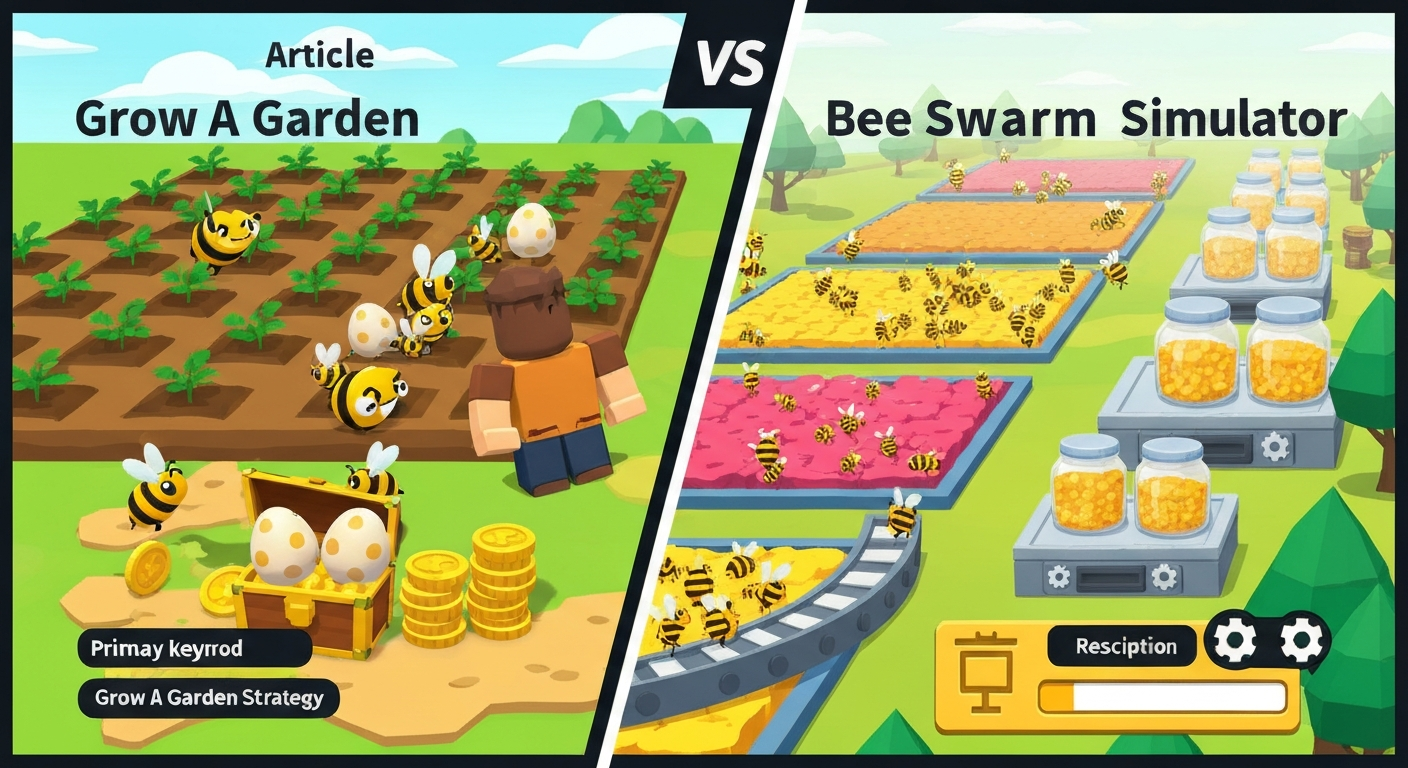
TL;DR, Which Game (or Approach) Fits Your Goals
| Your Goal | Best Fit | Quick Recommendation |
|---|---|---|
| Max crop value and pet synergies | Grow A Garden | Chase Divine-tier pets (Queen Bee, Cockatrice, Phoenix); prioritize mutation chaining |
| Idle/AFK incremental farming | Bee Swarm Simulator | Build a gifted-bee hive, focus pollen-to-honey conversion efficiency |
| Bee-specific mechanics and lore | Both (different systems) | GAG for pet-bee interactions; BSS for deep hive composition strategy |
| Trading and asset value growth | Grow A Garden | Hold Divine pets and Amber-family mutations; Queen Bee and Old Amber are high-value targets |
| Quick sessions with clear dailies | Bee Swarm Simulator | Daily quest loops and ticket rewards are structured and short |
| Deep breeding and egg strategy | Grow A Garden | Bee Egg hatch planning (1% Queen Bee from Bee Egg) drives long-term ROI |
| Event-driven limited content | Grow A Garden | Bizzy Bee Event (May 2026), Prehistoric Event — limited pets and Amber mutations are time-gated |
| New to Roblox simulators | Bee Swarm Simulator | Cleaner onboarding; GAG complexity scales steeply with pet/mutation systems |
Head-to-Head: Core Goals, Progression, and Endgame
Grow A Garden's loop goes: buy seeds, plant and harvest crops, sell for Sheckles, reinvest into better seeds and Pet Eggs. The official Roblox page 'Grow a Garden | Play on Roblox' describes Grow a Garden as a gardening/tycoon simulator where players buy seeds, plant and harvest crops, and sell for in‑game currency (Place ID 126884695634066). Pets are the real endgame multiplier. Each pet has an ability that activates on a cooldown and directly modifies your crop yields, mutation chances, or currency gain. The progression ceiling is defined by your pet roster and how well your mutation chains compound. There are 89 total pets in the community database (64 available, 25 limited), sorted into rarity tiers from Common up through Divine.
Bee Swarm Simulator runs a parallel but fundamentally different loop: bees collect pollen from fields, you bring that pollen back to your hive to convert to honey, and honey plus tickets unlocks new bees, gear, and field upgrades. Hive composition matters a lot, you're balancing pollen producers, converters, combat bees, and gifted-bonus providers. The endgame in BSS is optimizing that composition and grinding through increasingly hard quest chains to unlock mythic-tier bees.
The key philosophical difference is active versus incremental. GAG rewards active optimization: you're checking egg timers, managing pet cooldowns, and reacting to mutation windows. BSS rewards patient hive-building: once your composition is solid, pollen converts to honey semi-automatically and you're mainly managing upgrades. Endgame GAG is trading and mutation stacking; endgame BSS is mythic bee collection and max-level gear.
Mechanics Side-by-Side
| Mechanic | Grow A Garden | Bee Swarm Simulator |
|---|---|---|
| Core resource | Sheckles (sell crops), Robux (optional) | Honey, Pollen, Tickets |
| Creature/pet system | 89 pets; rarities from Common to Divine; equipped from egg pool | 500+ bees; Normal, Rare, Epic, Legendary, Mythic tiers; hatched from eggs or Royal Jelly upgrades |
| Egg mechanics | Pet Eggs (Bee Egg, Bug Egg, etc.); fixed hatch times (Bee Egg = 4h 10m); rarity-gated hatch tables | Basic/Premium eggs; Royal Jelly to boost Gifted/Mythic chance; no fixed timer — instant hatch |
| Breeding/upgrade system | No direct breeding; mutation system modifies crop value (Amber → Old Amber → Ancient Amber chain) | Royal Jelly gifts/upgrades existing bees; no traditional breeding |
| Tier ranking | Common / Uncommon / Rare / Epic / Legendary / Divine (+ Limited events) | Normal / Rare / Epic / Legendary / Mythic (+ Gifted variants) |
| Monetization | Robux for eggs (e.g., Bee Egg 129 Robux) or grind 30M Sheckles for shop purchase | Robux for hive slots, boosts, cosmetics; core progression free-to-play |
| Event content | Limited pets and mutations (Bizzy Bee 2026, Prehistoric Event, Fairy Event) | Seasonal events with Gumdrops, event currencies, limited bees |
| Cooldown/ability system | Each pet has an ability with a cooldown (Queen Bee refreshes longest cooldown ~every 25 min) | Gifted bee bonuses are passive; no player-managed cooldown loop |
| Trading | Active player-to-player pet trading; Divine pets are high-value assets | Limited trading; mostly self-progression focused |
Grow A Garden Creature Systems Deep-Dive
Pets in Grow A Garden are not cosmetic, they are your primary output multipliers. Every pet has a weight (which affects passive yield contributions) and an active ability with a cooldown. Managing that cooldown cycle is where mid-to-hardcore play separates from casual. The tier system is the clearest shorthand for pet value: Common pets are entry-level, Uncommon and Rare are workhorses for new accounts, Epic and Legendary add meaningful abilities, and Divine pets are the endgame targets that shape entire farm strategies.
How Egg Pools Work
Each Egg type has its own hatch table with fixed probabilities. The Bee Egg is one of the most important: it costs 30,000,000 Sheckles in the Pet Egg Shop (the shop has only a 6% chance to list a Bee Egg on each restock, so availability is part of the grind) or 129 Robux when offered directly. Hatch time is 4 hours 10 minutes. The hatch table breaks down as follows:
| Pet | Hatch Chance | Tier |
|---|---|---|
| Bee | 65% | Common/Uncommon |
| Honey Bee | 25% | Rare |
| Bear Bee | 5% | Epic |
| Petal Bee | 4% | Legendary |
| Queen Bee | 1% | Divine |
That 1% Queen Bee rate means you're looking at an expected 100 Bee Eggs to pull one Queen Bee, or roughly 3 billion Sheckles worth of eggs at shop price if you're going pure grind. Most hardcore players use a mix of Sheckle grinding, Robux purchases, and trading to hit that target efficiently. The community value calculators are essential here for working out expected value per egg spend versus just trading for a Queen Bee directly.
Pet Roles and Progression Paths
Think of your pet roster in three layers. First, your core yield pets: these are Epic and Legendary tier pets whose abilities directly boost crop output or harvest rates. Second, your utility pets: pets like Queen Bee whose abilities interact with other pets' cooldowns, letting you cycle abilities faster. Third, event/limited pets: time-gated Divines from events like the Bizzy Bee Event (May 2026) or Fairy Event that often carry unique passive effects not available anywhere else. Building a roster that combines all three layers is the hallmark of an optimized GAG farm.
Creature-by-Creature Matchups and Equivalent-Role Mapping
Several sibling topics on this site map directly to specific creature comparisons worth breaking down in detail. Here's how each key matchup plays out in Grow A Garden, with context on how analogous roles exist in Bee Swarm Simulator.
Bee vs. Honey Bee (Grow A Garden)
From the Bee Egg pool, Bee (65% chance) and Honey Bee (25% chance) are your two most likely pulls. Bee is a Common-to-Uncommon tier pet, functional early on but outscaled quickly. Honey Bee is Rare tier and offers meaningfully better ability values and weight. If you're sitting on a base Bee with no mutation and have a Honey Bee available, the upgrade is always worth making. Honey Bee holds its relevance into mid-game, whereas plain Bee gets benched as soon as better options arrive. For a detailed stat comparison between these two, the bee vs honey bee guide on this site goes deeper into ability breakdowns.
Bee vs. Wasp (Grow A Garden)
The Wasp was introduced in the Bizzy Bee Event's Wasp Dungeon expansion (May 2026) and operates in a different role than Bee. Wasp is more combat/offensive in its ability interaction, while Bee is a straightforward yield-support pet. In terms of raw tier, Wasp sits above base Bee and brings unique event-tied utility that Bee doesn't have. For players who farmed the Wasp Dungeon, Wasp is the better hold for ability variety. If you didn't get the Wasp during the event window, trading for one is worth considering if you're building a diverse roster. The which is better bee or wasp guide on this site has a full breakdown of their ability mechanics.
Tarantula Hawk vs. Queen Bee (Grow A Garden)
This is a matchup between two high-tier pets with very different roles. Queen Bee is a utility/cooldown specialist: her ability refreshes the single longest pet cooldown on your roster approximately every 25 minutes (current iteration post-Bizzy Bee Event). Community trackers and patch guides (Queen Bee Pet, Grow a Garden Bizzy Bee Event Guide (GAGData)) describe Queen Bee's signature effect as refreshing the single longest pet cooldown approximately every ~25 minutes in current event iterations blank" rel="noopener noreferrer">Community trackers and patch guides (Queen Bee Pet — Grow a Garden Bizzy Bee Event Guide (GAGData)) describe Queen Bee's signature effect as refreshing the single longest pet cooldown approximately every ~25 minutes in current event iterations.. That makes her disproportionately valuable on farms running expensive high-cooldown Divines, because she effectively increases how often your best ability fires. Tarantula Hawk is a high-offense creature with direct damage/disruptive ability interactions, positioned more toward combat-adjacent farm defense scenarios. For pure crop value optimization, Queen Bee generally wins because cooldown refresh compounds across your whole roster. Tarantula Hawk is the better pick in combat-heavy or dungeon-adjacent playstyles. The tarantula hawk vs queen bee guide on this site has the full ability number comparison.
Cockatrice vs. Phoenix (Grow A Garden)
Both are Divine-tier pets, which immediately puts them at the top of the value ladder. Cockatrice was introduced in the Fairy Event and brings mutation/utility strengths, community sources flag it as a strong pick for players who prioritize mutation chains. Phoenix is obtainable from Enchanted Chests and is a widely sought Divine for its passive bonuses. In terms of farm role: Cockatrice favors mutation-focused builds where you're stacking value multipliers on crops; Phoenix favors broader passive output builds. If you're running an Amber mutation chain (see item section below), Cockatrice's mutation synergy makes it the stronger pairing. The cockatrice vs phoenix guide on this site compares their full ability sets and farm-fit scenarios.
BSS Equivalent-Role Mapping
For BSS players mapping over to GAG, the role concepts translate roughly as follows: BSS pollen-producer bees map to GAG yield-boost pets (your Rare and Epic workhorses). BSS converter bees map to GAG utility pets that speed up your Sheckle output cycle. BSS gifted-bonus providers have no direct analog in GAG, but Queen Bee's cooldown refresh fills a similar 'amplifier' role for your best assets. BSS mythic bees map roughly to GAG Divine pets, rare, high-impact, farm-defining.
Matchup Analysis and Counters for Mid-to-Hardcore Play
| Matchup | Winner (GAG Context) | Counter / Situational Note |
|---|---|---|
| Bee vs. Honey Bee | Honey Bee | Bee is fine early; replace as soon as Honey Bee is available from Bee Egg pulls |
| Bee vs. Wasp | Wasp (if obtained) | Wasp has event-gated utility; Bee is the fallback if Wasp is unavailable or too expensive to trade for |
| Tarantula Hawk vs. Queen Bee | Queen Bee (yield/cooldown farms) | Tarantula Hawk wins in combat/dungeon builds; Queen Bee is better for crop value optimization |
| Cockatrice vs. Phoenix | Cockatrice (mutation builds) / Phoenix (passive builds) | Pair Cockatrice with Amber mutations; Phoenix shines in broader-output farms without heavy mutation chains |
| Queen Bee vs. Empress Bee | Empress Bee (all cooldowns) | Queen Bee refreshes ONE cooldown (longest); Empress Bee refreshes ALL — if you can get Empress, it replaces Queen Bee in most builds |
| Honey Bee vs. Bear Bee (Bee Egg pulls) | Bear Bee (higher tier) | Bear Bee (5%) beats Honey Bee (25%) on ability value; but Honey Bee is far more accessible and a better short-term hold |
A key principle for mid-to-hardcore players: tier alone doesn't decide every matchup. Queen Bee is Divine but her value is conditional on your roster having high-cooldown Divines to refresh. If you only have Common and Rare pets, Queen Bee's ability is mostly wasted. Build your roster depth first, then layer in utility Divines like Queen Bee once you have abilities worth refreshing.
Item Showdown: Amber vs. Old Amber
The Amber mutation family was introduced in the Prehistoric/Amber-related update and is one of the most important mutation chains in the game for late-game crop value. It works as a timed aging system: a crop starts with the Amber mutation, and if you allow it to age (by leaving it in the ground or through specific conditions), it progresses to Old Amber, and then to Ancient Amber. Each stage carries a progressively larger value multiplier.
| Mutation Stage | Value Multiplier (approx.) | Use Case | Priority |
|---|---|---|---|
| Amber | ~x10 | Good baseline; sell if you need immediate Sheckles | Medium — fine to cash in early game |
| Old Amber | Higher than Amber (community-tracked, stage 2) | Hold for significant value gain over Amber; key mid-game upgrade | High — most players target this as their primary sell point |
| Ancient Amber | Highest of the chain (stage 3) | Maximum value realization; hold only if you can afford the time investment | Situational — only viable if your farm can sustain the aging window without cash flow pressure |
The practical recommendation: Old Amber is the sweet spot for most mid-game players. Amber to Ancient Amber requires a longer time investment that not every farm setup can afford, if you're cash-flow constrained, sell at Old Amber. If you're running a Cockatrice or similar mutation-synergy pet, the multiplier gap between Old Amber and Ancient Amber is more likely to justify the wait. Always check the current community value calculators before deciding, because multiplier values can shift with updates. The amber vs old amber guide on this site has the current tracked multipliers and timing windows.
Queen Bee: Visual ID, Feeding, Breeding, and Upkeep
How to Identify and Draw Queen Bee
Queen Bee in Grow A Garden has a visually distinct Divine-tier appearance that sets her apart from Bee and Honey Bee in your pet roster. Here's a simple visual ID and drawing guide you can use to confirm you've hatched the right pet or sketch her out:
- Start with a larger oval body than standard Bee — Queen Bee has a noticeably bigger, rounder abdomen
- Add a crown or regal headpiece detail on top of the head (this is the key Divine-tier visual marker)
- Use alternating yellow and black bands on the abdomen, but the yellow bands are wider and more prominent than on Bee or Honey Bee
- Add two sets of wings — they are slightly more ornate or larger-proportioned than base Bee
- Draw larger, more expressive eyes compared to Bee — Queen Bee has a more detailed facial design
- Add a subtle golden glow or halo effect around the body to represent the Divine-tier aura in-game
In the pet roster UI, Queen Bee will show the Divine rarity badge and her ability description reads as a cooldown refresh effect. If you see a crown icon on the pet card, you've got Queen Bee and not Honey Bee or Petal Bee. The how to draw queen bee guide on this site has a more detailed step-by-step with proportions.
Queen Bee Feeding and Upkeep
In the current game build, Queen Bee does not require feeding in the traditional sense, she is a pet, not a farm animal with a hunger mechanic. However, 'feeding' in the community context often refers to what crops or items you prioritize growing to maximally trigger and benefit from her ability. Because Queen Bee refreshes the longest cooldown on your roster every approximately 25 minutes, the feeding strategy is really a roster management strategy: you want to make sure your highest-cooldown Divine pet is always the one being refreshed. If you re-equip pets and change your roster composition, reassess which cooldown is now the longest so Queen Bee's refresh lands on the most valuable ability.
For day-to-day upkeep: log in at intervals that align with Queen Bee's approximately 25-minute refresh cycle to manually collect any triggered bonuses. Set your pet slots so Queen Bee is paired with your most cooldown-heavy Divines. If you later acquire Empress Bee, note that Empress refreshes ALL pet cooldowns, at that point, Queen Bee can be traded or held as a high-value asset rather than used as your primary cooldown utility. The what to feed queen bee guide on this site covers crop pairings and timing routines in detail.
Queen Bee Ability Diagram
Here is a simplified diagram of how Queen Bee's cooldown refresh loop works in a typical roster:
- Your roster fires abilities in rotation based on individual cooldowns
- Pet A (high-cooldown Divine, e.g., 60-min cooldown) fires ability — cooldown timer starts
- Pet B, Pet C (shorter cooldowns) fire normally in the meantime
- Queen Bee's refresh ability triggers at approximately the 25-minute mark
- Queen Bee scans roster and identifies Pet A as the longest active cooldown remaining
- Queen Bee resets Pet A's cooldown — Pet A fires again ahead of schedule
- Net effect: Pet A effectively fires roughly twice as often as it would without Queen Bee
This compounding effect is why Queen Bee is valued at the Divine tier even at only 1% from the Bee Egg. On a roster with multiple 40-60 minute cooldown Divines, the Sheckle and mutation value unlocked by firing those abilities more frequently adds up fast. It's also why her value is conditional: pair her with short-cooldown pets and her ability barely matters. The how long do bee swarms last guide on this site covers swarm duration mechanics that interact with Queen Bee's upkeep routine during active swarm events.
Breeding and Efficiency Recommendations
Grow A Garden doesn't have breeding in the traditional sense (no two pets combine to make a third), but the egg-to-pet pipeline is your effective 'breeding' system. Here's the efficient approach for mid-to-hardcore players targeting the Bee Egg pool:
- Track shop restocks: the Bee Egg has only a 6% chance to appear on each restock. Use community trackers to monitor availability and buy immediately when it lists
- Calculate Robux vs. Sheckle break-even: at 129 Robux per Bee Egg and 30M Sheckles per Bee Egg, decide based on your Sheckle-per-hour farm rate whether grinding or buying Robux is faster
- Run multiple Bee Eggs simultaneously if your account allows parallel incubation — reduces effective time-per-pull significantly
- At 1% Queen Bee chance, budget for variance: statistically expect 100 eggs for one Queen Bee, but 50-egg and 200-egg outcomes are both realistic — don't over-invest Robux on a streak assumption
- Consider trading for Queen Bee if community value calculators show her trading price is below your expected egg-spend cost — active trading forums often have Queen Bee offers at competitive rates
- Once you have Queen Bee, build the rest of your roster around high-cooldown Divines to maximize her refresh value before chasing Empress Bee
For BSS players crossing over: the Royal Jelly mechanic in BSS (spending jelly to boost mythic/gifted chances) is conceptually similar to repeated Bee Egg purchases in GAG, both are probability investments in top-tier creatures. The key difference is BSS Royal Jelly upgrades an existing bee you already own, while GAG egg pulls are always from scratch. That makes GAG egg strategy more like a lottery and BSS Royal Jelly more like a guaranteed slow upgrade, factor that into your patience and budget planning when deciding where to invest time.
Final Verdict: Which Game Deserves Your Time
If your goal is deep pet optimization, mutation stacking, and a trading economy with real asset value, Grow A Garden is the stronger long-term investment. The creature system has more moving parts, the mutation chains (especially the Amber family) create compounding value, and the Divine-tier pets like Queen Bee, Cockatrice, and Phoenix give you clear milestones to work toward. The Bizzy Bee Event content from May 2026 added significant depth with Wasp Dungeon, Royal Jelly systems, and new bee-type pets that reward players who've already built a solid foundation.
If you want a cleaner incremental loop with less active management, Bee Swarm Simulator is a comfortable place to farm while thinking about your next GAG move. Many players run both in parallel, BSS for passive sessions, GAG for active optimization windows. Either way, the creature mechanics knowledge transfers: understanding bee roles in BSS makes you a better GAG roster builder, and the Amber mutation logic in GAG will feel familiar if you've managed Royal Jelly upgrade timing in BSS.
FAQ
What is the high-level head‑to‑head comparison of core goals and progression in Grow A Garden vs Bee Swarm Simulator (BSS)?
Grow A Garden (GAG): a Roblox gardening/tycoon loop — buy seeds, plant, grow crops, harvest for Sheckles, obtain pets (bees/creatures) via eggs/chests, breed/mutate pets, and expand farm/automation. Progression is driven by in‑game currency, pet collection, pet abilities (cooldowns, buffs), and event-limited content. Bee Swarm Simulator (BSS): a long-running incremental where you hatch bees to collect pollen, convert pollen into honey, use honey/tickets/royal jelly to upgrade hive, unlock areas and bees, and optimize bee roles. Progression emphasizes pollen→honey throughput, bee synergy (roles/gifted), and incremental gear. Primary difference: GAG is tycoon + pet collection with hunting/breeding/value economy; BSS is resource-production optimization with clearer role specialization and repeatable throughput metrics. (Sources: GAG Roblox page; BSS wiki). Links: Grow A Garden Strategy / creature stats, eggs, breeding guides — https://growagarden.wiki/ (use the Pets, Bee Egg, and Breeding pages); Bee Swarm Simulator reference — https://beeswarmsimulator.wiki/.
How do core mechanics compare (creatures, eggs, breeding, tiers, currency, monetization)?
Creatures & Tiers: GAG uses pet families (Bees, Cockatrice, Phoenix, etc.) with rarity tiers up to Divine and mutation aging (Amber → Old Amber → Ancient). BSS uses bees categorized by role/rarity (common → mythic/gifted) and classifies them by production/combat utility. Eggs & Breeding: GAG uses eggs (Bee Egg, event eggs) with fixed hatch pools and timed hatches (e.g., Bee Egg hatches ~4h10m with published hatch probabilities). Breeding/mutation in GAG changes pet stats/value over time. BSS hatching is immediate from eggs/packs and uses Royal Jelly/tickets to influence mythic/gifted odds rather than time‑based breeding. Currency & Progression: GAG currency = Sheckles (in‑game) and Robux as a Robux‑purchase option for some eggs; progression via selling crops, purchasing eggs, breeding. BSS primary currencies = pollen (field), honey (converted), and tickets/Royal Jelly for upgrades. Monetization: Both offer Robux/paid‑for shortcuts (BSS codes/events and packs; GAG offers Robux egg purchases and limited shop restocks). Practical implication: GAG rewards long-term collection and breeding planning; BSS rewards optimized steady production and slot/role management.
What are the published Bee Egg hatch chances and costs in Grow A Garden?
Current community‑documented Bee Egg data: cost in the Pet Egg Shop ~30,000,000 Sheckles when listed (shop restocks with ~6% chance to include Bee Egg) and an alternate purchase offer for ~129 Robux when offered. Bee Egg hatch time ≈ 4 hours 10 minutes. Hatch probabilities (community/PC Gamer snapshot): Bee ~65%, Honey Bee ~25%, Bear Bee ~5%, Petal Bee ~4%, Queen Bee ~1%. These are the working community numbers used by mid‑to‑hardcore players for EV calculations. Sources: PC Gamer summary and Bee Egg pages (Grow A Garden wiki). Link: https://growagarden.wiki/Bee_Egg and PC Gamer guide.
Creature‑by‑creature mapping between GAG and BSS roles (examples) and mini‑matchups: bee vs honey bee; bee vs wasp; tarantula hawk vs queen bee; cockatrice vs phoenix.
Mapping logic: map GAG pets to BSS roles by primary function (production/utility/refresh/attack). Mini‑matchups below interpret 'versus' as which creature is more useful for common mid/hardcore objectives (production, cooldown utility, combat/event clearing). - Bee vs Honey Bee (GAG): Regular Bee = common production/utility pet; Honey Bee = rarer, usually provides better honey/currency-related buffs. For pure EV and steady output, Honey Bee > Bee due to higher rare benefits per community hatch rates and synergy with honey multipliers. - Bee vs Wasp (GAG): Wasp-type pets (introduced with Wasp Dungeon) trend toward combat/aggro utility in events; standard Bee is better for general collection/currency. Choose Wasp for dungeon/aggro tasks, Bee for farming. - Tarantula Hawk vs Queen Bee (GAG): Tarantula Hawk (combat/attack-inclined) is strong for fighting mobs/dungeon mechanics; Queen Bee is a high-value Divine utility pet whose signature is cooldown refresh/long-term automation support. For event fighing, Tarantula Hawk wins; for long-run cooldown/efficiency and tradable value, Queen Bee wins. - Cockatrice vs Phoenix (GAG): Cockatrice is listed as high-tier/event pet with strong mutation/value; Phoenix is another sought Divine with resurrection/utility-themed lore. For combat survivability, Phoenix-style effects (revive/regen) may edge out; for niche utility/trade value and event boosts, Cockatrice often rates higher. Note: these matchup conclusions are community-aligned heuristics — check specific ability stats on Grow A Garden strategy pages before making trading or breeding decisions. Link to pet stats & guides: https://growagarden.wiki/pets.
How do amber vs old amber (item/mutation) compare and age over time in GAG?
Amber mutation family ages over time with increased multipliers/value. Community references show progression: Amber → Old Amber → Ancient Amber, with each stage applying larger stat/value multipliers. Approximate community multipliers: Amber ≈ ×10 value, Old Amber and Ancient Amber higher (community wikis list relative multipliers used for EV/trade calculations). Amber mutations are time‑dependent (pet ages into Old Amber after a set window). For precise aging timers and exact multiplier values use the Grow A Garden Prehistoric / Amber event pages and value calculators. Links: Prehistoric Event (Amber notes) — https://growagarden.fandom.com/wiki/Prehistoric_Event and community calculators (Grow A Garden Value Calculator). Use calculators to convert mutation tiers into expected trade/value.
What is the Queen Bee’s signature mechanic, lifetime/feeding requirements, and how does it compare to BSS queen/overlord concepts?
Queen Bee (GAG) signature: community trackers describe Queen Bee as a Divine pet that periodically refreshes the single longest pet cooldown (approx. every ~25 minutes in current event iterations). It does not have a conventional 'feeding' lifetime requirement like consumable pets; instead, Queen Bee is persistent once hatched/owned. In contrast, BSS does not have a direct analogue that refreshes cooldowns globally — BSS queen/leader concepts are hive‑wide buffs or powerful mythic bees that passively boost stats. Practical note: Queen Bee is valuable for long‑term automation and cooldown management in GAG; community trading shows it as high‑value. Sources: GAGData Queen Bee page; community patch trackers. Link: https://growagarden.wiki/Bee_Egg and GAGData Queen Bee summary.
What to Feed Queen Bee Grow A Garden: Best Foods & Plan
What to feed Queen Bee in Grow A Garden: exact foods, quantities, schedules, breeding tips & efficient setups.