There is no traditional 'feeding' mechanic for the Queen Bee pet in Grow A Garden. You do not drop food items into a pen or fill a hunger bar the way you might expect from other pet-raising games. Instead, the Queen Bee pet is supported entirely by the pollinated-crop economy: you grow and harvest Pollinated fruits, run them through the Honey Compressor to earn Honey Coins, and spend those coins at the Queen Bee NPC's Honey Shop to buy the eggs, seeds, and gear that actually drive your progression. The Grow a Garden bee guide, PCGamesN documents the Pollinated crops → Compressor → Honey Coin flow and confirms there is no separate player action for feeding the Queen Bee with discrete food items Grow a Garden bee guide — PCGamesN (Pollinated crops → Honey flow explanation). If you came here wondering what food item to hand your Queen Bee, this guide will redirect you to the actual mechanics that matter and show you exactly how to maximize her value in your farm.
What to Feed Queen Bee Grow A Garden: Best Foods & Plan

What this guide covers and who it's for
This is a practical reference for mid-to-hardcore Grow A Garden players who want to squeeze every bit of value out of the Queen Bee pet and the Bizzy Bee event economy surrounding her. Whether you just hatched a Queen Bee from a Bee Egg (congratulations on that 1% pull) or you're farming Honey Coins to eventually get there, this guide walks through the real mechanics: how the pollinated-crop pipeline works, how Swarm Events and the Honey Compressor fit together, what the Queen Bee pet's passives actually do, how feeding schedules translate into Compressor cycles and HC earnings, and where items like Amber and Old Amber factor into your ROI. You'll also find quick comparisons with related creatures, notes on Royal Jelly and special eggs, and a step-by-step workflow from first-time player to optimized Honey Garden setup. For art-focused readers, see the related how to draw queen bee in Grow A Garden guide for step-by-step drawing instructions.
The two Queen Bees you need to know about
Before anything else, you need to separate two distinct entities in the game that share the same name. There are two distinct Queen Bee entities in Grow A Garden: Queen Bee the NPC (merchant/honey shop during Bizzy Bee events) and Queen Bee the Divine pet (with passive pollination and cooldown‑refresh effects) Queen Bee NPC). The first is the Queen Bee NPC, a merchant who appears during Bizzy Bee events and runs the Honey Shop. She accepts Honey Coins in exchange for seeds, eggs, and event gear. The second is the Queen Bee pet, a Divine-tier creature you hatch from a Bee Egg at a 1% chance. These two interact with each other (you spend HC earned through the pet economy at the NPC's shop) but they are mechanically separate. Most confusion around 'feeding Queen Bee' comes from mixing these two up.
What actually counts as Queen Bee 'food': the definitive list
Because there is no direct pet-feeding action for the Queen Bee, the question of 'what to feed her' really means: what inputs does the Queen Bee economy run on? Here are the exact resources that fuel everything connected to Queen Bee progression, listed by role.
- Pollinated crops: fruits that have received the Pollinated mutation (×3 sell value multiplier). These are the primary consumable input for the Honey Compressor and the foundation of the entire HC economy.
- Honey Coins (HC): the Bizzy Bee event currency earned by compressing Pollinated crops. Spent at the Queen Bee NPC Honey Shop and at Princess Anjelly's stall for seeds, eggs, and gear.
- HoneyGlazed crops: fruits with the HoneyGlazed mutation (×5 sell value multiplier, applied by Bear Bee pet or Honey Sprinkler gear). These yield higher HC per Compressor cycle than standard Pollinated crops and stack multiplicatively with other multipliers.
- Hive Fruit: a top-tier event crop that earns approximately 40 HC per unit in the Honey Shop inventory at launch. One of the best crops to run through the Compressor for raw HC output.
- Royal Jelly: a secondary event currency introduced in the 2026 Bizzy Bee update. Earned and spent at the Royal Jelly Incubator and Princess Anjelly's shop for special eggs like King Bee and Carpenter Bee.
- Bee Egg: the egg pool from which the Queen Bee pet is hatched. Obtaining and hatching Bee Eggs is the direct path to acquiring the Queen Bee pet itself (1% hatch chance).
There are no discrete 'food items' with names like berries or pellets that you feed directly to the Queen Bee pet. The hunger value of 65,000 shown in the pet UI is a display stat reflecting the pet's progression tier, not a resource you fill by hand-feeding items. Think of the entire pollinated-crop-to-HC pipeline as the Queen Bee's 'feeding system.'
How the feeding mechanics actually work
The core loop looks like this: you grow crops in a Honey Garden, Swarm Events (or your bee pets) apply the Pollinated mutation to those crops, you harvest them, and then you run the harvest through the Honey Compressor to convert weight into Honey Coins. Those coins are your 'feed' for the Queen Bee NPC's shop, which is where you buy everything that matters for long-term progression.
Honey Garden setup
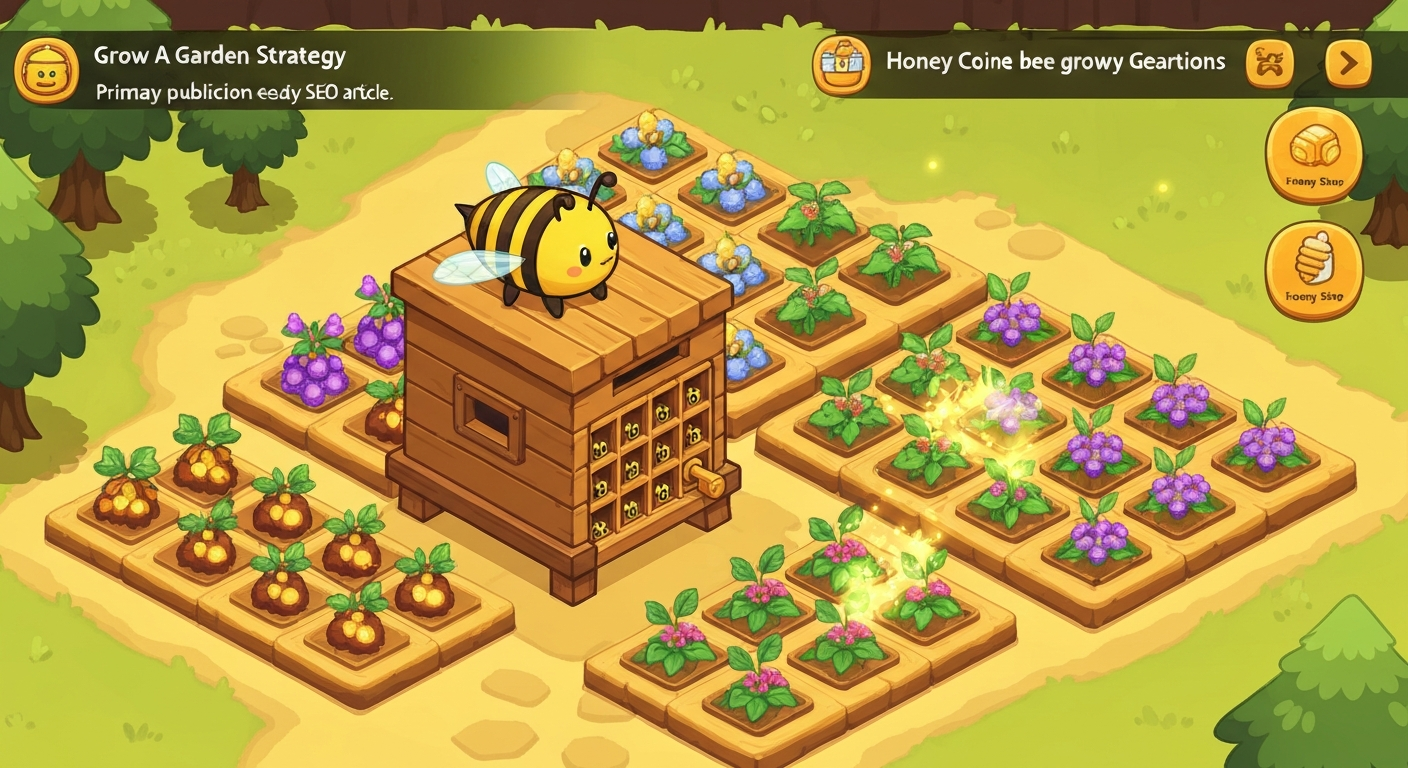
To activate Honey Garden mode, go to your Mailbox and toggle the Honey Garden option. This converts your plot into a Honey Garden and spawns a beehive at the back of the garden with 21 available bee slots. Each bee slot accepts a bee-family pet, and each equipped bee contributes independent pollination attempts to your crops. Filling all 21 slots with bee pets is the endgame Honey Garden setup, and having even one Queen Bee in that lineup meaningfully changes your output because of her passive abilities.
Swarm Events and pollination ticks
Swarm Events occur every hour and last 10 minutes. During those 10 minutes, the game dispatches pollination attempts to plants in your garden approximately every 30 seconds, which means roughly 20 pollination tick opportunities per event window. Your Queen Bee pet's Queen Pollinator passive fires independently of this on its own approximately 25-minute cooldown, applying the Pollinated mutation to a nearby fruit regardless of whether a Swarm Event is active. This means the Queen Bee is the only bee-family pet that guarantees pollination outside of event windows, which is a significant passive income advantage.
Honey Compressor mechanics
The Honey Compressor accepts Pollinated crops and requires a minimum 30 kg submission threshold per compression cycle. Each cycle takes roughly 50 to 90 seconds depending on your Compressor Speed upgrades. Payout is based on total weight, crop rarity, and pollination quality, which runs from Poor through Fair, Good, and Godly tiers. Better pollination quality means higher Honey Coin yield per cycle. The base reference yield is approximately 17 HC per cycle, but with high-rarity crops and Godly pollination quality that number climbs substantially. Hive Fruit at 40 HC per unit makes it one of the best crops to prioritize in your garden during the event.
Optimal quantities and feeding frequency by playstyle
Because 'feeding' translates to Compressor cycles and HC accumulation, your target throughput depends on how much active time you invest. Here is a practical breakdown by playstyle.
| Playstyle | Active Sessions | Target Compressor Cycles/Day | Bee Slots Filled | HC Earned (Est.) | Priority Goal |
|---|---|---|---|---|---|
| Casual | 1-2 per day, 20-30 min each | 5-10 cycles | 6-10 slots | 85-300 HC | Stock up on event seeds, save for Bee Eggs |
| Mid | 3-4 per day, 30-45 min each | 15-25 cycles | 12-16 slots | 350-750 HC | Buy Bee Eggs repeatedly, chase Queen Bee hatch |
| Hardcore | Hourly Swarm Event attendance | 30-50+ cycles | 21 slots (full) | 800-2,000+ HC | Maximize Royal Jelly, target King Bee / special eggs, multiple Queen Bees |
For mid players, the most efficient cadence is logging in for each Swarm Event window (hourly, 10-minute commitment) and running a Compressor batch immediately after. You are capturing the peak pollination tick rate during the event window, then converting that output before the next cycle. Hardcore players extend this by pre-loading their Honey Garden with high-weight crops before each event so the 30-second pollination ticks during the event hit the heaviest, rarest fruits available.
How this affects growth, stats, and egg outcomes
The Queen Bee pet has a reported hunger value of 65,000 in the UI, reflecting her Divine tier standing. Her two key passives are Queen Pollinator (applies Pollinated mutation to a nearby fruit on an approximately 25-minute interval) and a cooldown-refresh passive that refreshes the ability of whichever pet in your lineup currently has the longest remaining cooldown. Both of these directly amplify your farm's passive HC generation rate.
On the egg outcome side, the Bee Egg pool gives you roughly a 1% chance at a Queen Bee hatch, with Bee sitting around 65%, Honey Bee around 20-25%, Bear Bee around 5%, and Petal Bee around 4%. More HC means more Bee Eggs purchased, which means more hatch attempts. If you are running 20+ Compressor cycles per day at roughly 17-40 HC per cycle, you can accumulate enough HC for multiple Bee Egg purchases per session, meaningfully improving your odds of eventually hatching a second or third Queen Bee.
One important mechanic to plan around: multiple Queen Bees in your lineup can refresh each other's cooldowns through the 'For the Queen' cooldown-refresh passive, creating a cyclic refresh loop. Community testing shows this can become an unintended infinite refresh chain if you are not deliberate about your equip order. It is worth planning your slot arrangement so you control which pet gets refreshed rather than letting the loop run unpredictably.
Nectar, pollen, honey, and how they interact with Queen Bee feeding
Grow A Garden does not currently implement nectar or pollen as distinct player-held resource items in the same way that Bee Swarm Simulator does, so comparisons between the two games on that point require some caution. In Grow A Garden, the functional equivalents to 'nectar and pollen' are the Pollinated and HoneyGlazed mutations on crops. Pollinated (×3) is your baseline and is applied by Swarm Events, the Queen Bee pet's Queen Pollinator passive, and other bee-family pets. HoneyGlazed (×5) is a premium layer applied only by the Bear Bee pet or the Honey Sprinkler gear item.
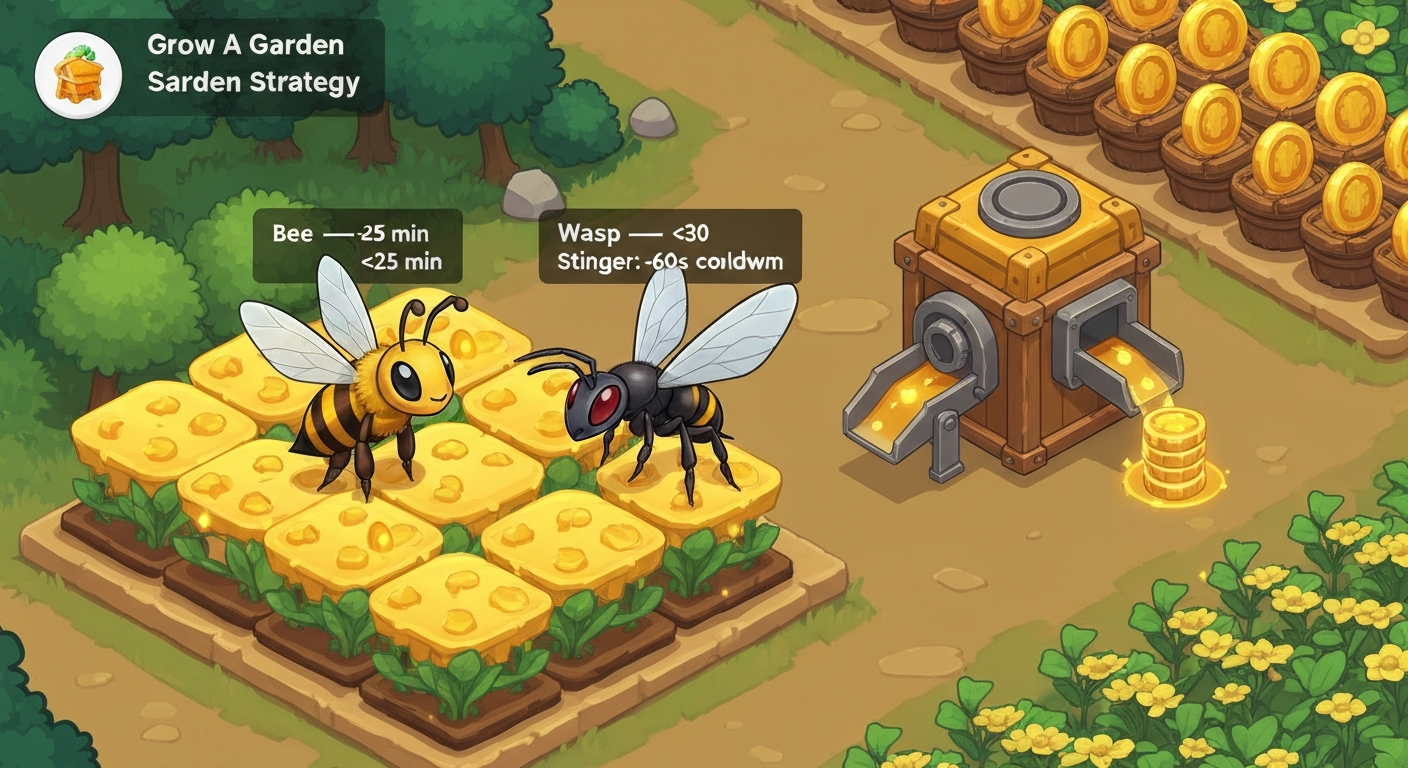
HoneyGlazed and Pollinated stack multiplicatively with each other and with other crop multipliers, so a crop carrying both mutations hits a significantly higher sell value and a higher Honey Coin yield in the Compressor. This is why having a Bear Bee alongside your Queen Bee in the beehive lineup is such a high-value combo: the Queen Bee drives guaranteed baseline pollinations, and the Bear Bee upgrades a portion of those to HoneyGlazed, compounding your output. If you are comparing Bee vs. For a direct side-by-side comparison, see the guide on which is better, Bee or Wasp in Grow A Garden (internal link to the related article) which is better — Bee or Wasp in Grow A Garden. See our Bee vs. Honey Bee comparison in Grow A Garden for a focused breakdown of how those two pets differ in passive income and pollination roles. Honey Bee in your lineup, the Queen Bee outperforms both for passive income because of the cooldown-refresh interaction on top of the pollination passive, making it the anchor pet for any serious Honey Garden setup.
Amber, Old Amber, and special items in the Queen Bee economy
Amber mechanics are separate from the Queen Bee feeding pipeline but intersect with it in ROI terms. Amber is a time-evolving crop mutation: a crop starts as Amber, evolves to Old Amber after roughly 24 hours, and reaches Ancient Amber at around 48 hours. Each stage carries a higher sell value multiplier, so a crop sitting on your plot accumulating Amber age is building passive value without any player action.
Where this connects to Queen Bee strategy: if you have a crop that is already aging through Amber stages, you want to delay harvesting it and instead let the Queen Bee pet's Queen Pollinator passive apply a Pollinated mutation on top of the Amber mutation before you compress it. A fruit carrying both Amber (or Old/Ancient Amber) and Pollinated mutations will compress into a significantly higher HC yield than either mutation alone. The stacking of time-gated mutations with event mutations is one of the highest-ROI plays available during Bizzy Bee events, and the Queen Bee pet is uniquely positioned to apply that final Pollinated layer on a 25-minute cycle without requiring active play.
Royal Jelly is the other special currency worth knowing. It was introduced in the 2026 Bizzy Bee event and is spent at the Royal Jelly Incubator on Honey Island for special eggs including King Bee and Carpenter Bee. This is not a direct 'feeding' resource for the Queen Bee but is part of the same event economy, and earning enough Royal Jelly to access those special eggs requires the same pollinated-crop throughput you are already optimizing.
Step-by-step feeding workflow: beginner to hardcore
Beginner schedule (getting started)
- Toggle Honey Garden mode via your Mailbox. This is required for the beehive to appear and for bees to contribute pollinations.
- Equip any bee-family pets you have to the beehive slots (even basic Bees work). Fill as many of the 21 slots as you can with what you own.
- Plant high-weight crops like Hive Fruit if available, or your highest-rarity crops otherwise. Weight determines Compressor yield, so heavier crops matter.
- Log in during Swarm Events (hourly, 10-minute windows). Watch your crop tiles for the Pollinated mutation animation.
- Harvest Pollinated crops immediately after the Swarm Event ends. Submit a batch of at least 30 kg to the Honey Compressor.
- Take your earned HC to the Queen Bee NPC Honey Shop. Buy Bee Eggs first to work toward hatching a Queen Bee pet.
- Repeat each Swarm Event window. Early on, aim for 5 to 10 Compressor cycles per day.
Mid schedule (consistent farm optimization)
- Upgrade your Compressor Speed as soon as HC allows. Shorter cycles (targeting the 50-second end of the 50-90 second range) mean more batches per session.
- Add a Bear Bee to your lineup if you have one. Place it alongside your best bee pets to maximize HoneyGlazed conversion on top of Pollinated.
- If you have a Queen Bee pet, equip it to the beehive. Note the ~25-minute passive interval and plan harvest timing to catch pollinations she applies between Swarm Events.
- Let Amber-mutated crops age before harvesting. If a crop hits Amber, wait for the Queen Bee passive to add Pollinated on top before compressing for maximum yield.
- Attend every Swarm Event window. Budget 15 minutes per hour: 10 minutes in-event plus a quick harvest-and-compress routine immediately after.
- Track HC totals and restock at Princess Anjelly on her 30-minute restock timer for seeds and gear that further boost crop output.
Hardcore schedule (full optimization)
- Fill all 21 beehive slots. Priority order: Queen Bee (cooldown-refresh anchor), Bear Bee (HoneyGlazed source), Honey Bee units (consistent Pollinated volume), then filler Bees.
- If running multiple Queen Bees, carefully set your equip order to control the For the Queen cooldown-refresh loop. Decide intentionally which pets get refreshed to avoid uncontrolled loop behavior.
- Pre-load your garden with the heaviest, rarest available crops before each hourly Swarm Event. You want maximum-weight Pollinated crops ready for the Compressor the moment the 10-minute window closes.
- Run the Honey Compressor continuously during active sessions. At 50-second cycle times with a full 30 kg+ submission, you can chain 6-7 cycles in a 5-minute window.
- Stack Amber-aged crops with Pollinated mutations from the Queen Bee passive before compressing. This is your highest single-batch ROI action.
- Spend HC at the Honey Shop on a rolling basis: Bee Eggs for more Queen Bee hatch attempts, Royal Jelly-gated eggs at the Incubator on Honey Island, and Honey Sprinkler gear to provide HoneyGlazed without needing a Bear Bee in every slot.
- Monitor patch notes. HC values, shop stock, and Compressor yields are event-specific and shift across updates. What earns 40 HC per Hive Fruit at event launch may change in mid-event patches.
Quick comparison: Queen Bee vs. related bee pets
Understanding where Queen Bee sits relative to other bee-family pets helps you decide how to allocate your limited beehive slots and your HC spending. Here is a direct comparison of the core bee pets and their roles in a Honey Garden setup. See the Cockatrice vs Phoenix comparison in Grow A Garden for a similar head-to-head analysis of pet roles and tradeoffs.
| Pet | Tier | Hatch Chance (Bee Egg) | Key Passive | Unique Value |
|---|---|---|---|---|
| Queen Bee | Divine | ~1% | Pollinated mutation + cooldown refresh (~25 min interval) | Only pet that refreshes other pets' cooldowns; guarantees off-event pollination |
| Honey Bee | Rare/Common | ~20-25% | Applies Pollinated mutation to nearby crops | High-volume pollination worker; good filler for beehive slots |
| Bee | Common | ~65% | Applies Pollinated mutation | Lowest output but easy to obtain; fill empty slots early |
| Bear Bee | Uncommon | ~5% | Applies HoneyGlazed mutation (×5) | Essential for premium multiplier; pairs best with Queen Bee |
| Petal Bee | Uncommon | ~4% | Applies Pollinated mutation with floral interaction | Situational; less broadly useful than Bear Bee combo |
The short answer on whether Queen Bee is worth chasing: yes, definitively. No other pet in the bee family provides the cooldown-refresh passive that she does, and the guaranteed off-event pollination cycle means she generates passive HC income even when you are not actively playing during a Swarm Event. If you are deciding between spending HC on more Bee Eggs (chasing Queen Bee) versus buying other shop items, more Bee Eggs is almost always the right call for long-term farm value.
Queen Bee vs. Tarantula Hawk and threat management
The Tarantula Hawk is a notable counter-consideration for Queen Bee players. While the full breakdown of that matchup is covered in a dedicated comparison guide, the practical impact on your feeding and farm setup is this: the Tarantula Hawk's mechanics can disrupt passive pet cycles, which means if your farm setup relies on the Queen Bee's approximately 25-minute passive pollination interval firing cleanly, disruptions from Tarantula Hawk interactions become a real throughput loss. Plan your Honey Garden layout with this in mind, and consult the Tarantula Hawk vs. Queen Bee guide if you are seeing unexpected passive interruptions in your setup. See the Tarantula Hawk vs. Queen Bee guide for a detailed matchup breakdown and counterplay tips to protect your passive pollination cycles.
A quick note on Grow A Garden vs. Bee Swarm Simulator
If you arrived at this guide having played Bee Swarm Simulator and expecting a similar 'feed your bee with pollen and nectar' system, the core difference is this: Bee Swarm Simulator uses nectar and pollen as explicit inventory resources that you collect on a field and deposit to level up bees. Grow A Garden abstracts all of that into crop mutations and a compressor economy. There is no per-bee feeding action, no pollen bag to fill, and no nectar bar to track. The 'feeding' equivalent in Grow A Garden is your entire Honey Garden operation, and the Queen Bee is less a creature you raise and more a farm multiplier you deploy. The two games share bee theming but are mechanically quite different in how they reward player attention. For a focused comparison, see our grow a garden vs bee swarm simulator guide which lays out the core mechanical differences and player implications.
How Swarm Event timing should shape your daily schedule
Because Swarm Events run hourly and last exactly 10 minutes, your optimal play schedule for any playstyle is structured around the top of each hour. Log in about 2 minutes before the event to ensure your crops are planted and your beehive slots are filled. Stay through the 10-minute window, then spend the next 5 minutes harvesting and running the Compressor. That is a 15-minute hourly commitment for maximum event throughput. If you can only play twice a day, prioritize the sessions around your two highest-weight crop harvests rather than arbitrary login times. The Queen Bee pet's off-event pollination passive means your farm is still generating some Pollinated crops between your sessions, so you will often return to at least one harvestable Pollinated fruit even if you missed a Swarm Event window.
Resource ROI summary
To bring the numbers together in one place: a base Compressor cycle yields approximately 17 HC with standard Pollinated crops. Hive Fruit pushes that toward 40 HC per unit. Adding HoneyGlazed on top of Pollinated via a Bear Bee multiplies the base further. Layering Amber or Old Amber mutations on top of that stacks additional sell value before compression. The highest-ROI single action available is compressing an Ancient Amber + Pollinated (or HoneyGlazed + Pollinated) crop at maximum weight. Getting to that outcome requires time (Amber aging), a Queen Bee pet (guaranteed Pollinated), and either a Bear Bee or Honey Sprinkler (HoneyGlazed). That three-piece setup is what a hardcore Honey Garden is optimizing toward, and every HC you earn along the way is progress toward assembling it.
FAQ
What exactly counts as 'food' for the Queen Bee pet in Grow A Garden?
Strictly speaking, Grow A Garden has no mechanic where you directly 'feed' the Queen Bee pet with consumable food items. The term 'feeding' in community guides refers to producing Pollinated crops and converting them through the Honey Compressor into Honey Coins / event currencies that power bee‑event systems (shops, incubators, eggs). Sources: Grow a Garden Wiki (Queen Bee), PCGamesN bee guide.
If Queen Bee has no direct food, how do I 'grow' or level it?
Queen Bee is a Divine‑tier pet obtained from Bee Eggs (~1% hatch chance). Pet growth/leveling follows the game’s standard pet experience and hunger UI (Queen Bee pet has a reported hunger value of 65,000). You increase pet experience by equipping the pet and gaining in‑game XP (standard pet‑XP systems) — not by feeding specific items. For event value, you maximize its passive effects by running Honey Garden mechanics (21‑bee hive slots) and producing Pollinated crops. Sources: Grow a Garden Wiki, GAGdata event guides.
What are the Queen Bee pet passives and how often do they trigger?
Queen Bee passives (community‑documented): 1) Periodically applies the Pollinated mutation to a nearby fruit, and 2) periodically refreshes the cooldown of the player’s highest‑cooldown pet ability (often described as a cooldown refresh). Interval: roughly every ~25 minutes for the pet passives. During Swarm Events, swarm ticks apply pollination about every ~30 seconds for the duration of the event. Sources: Grow a Garden Wiki; GAGdata patch notes; PCGamesN guide.
Which in‑game items directly increase Queen Bee outcomes (growth, breeding, gene outcomes)?
Direct pet growth uses normal pet XP mechanics (equip and play). For event and breeding outcomes you should focus on: 1) Producing Pollinated crops (Pollinated mutation multiplies crop sell value ×3) which feed the Honey Compressor → Honey Coins; 2) Using Bee Eggs, Incubator/Royal Jelly mechanics, and shop purchases to obtain eggs/pets. Amber items are crop mutations (Amber → Old Amber → Ancient Amber) that increase crop multipliers and thus yield more Honey Coins when compressed. There is no item that you feed directly into the Queen Bee to change breeding odds. Sources: GAGdata Honey Garden guide; grow‑a‑garden.wiki.
What exact foods/items count as 'Pollinated' or give the best compressor value for Queen Bee ROI?
Best ROI items are high‑value event crops and aged Amber crops: 1) Event top crops like Hive Fruit (community‑listed high HC value), 2) Crops with Amber/Old Amber/Ancient Amber mutations (aging Amber increases multipliers), 3) Crops with additional multipliers (HoneyGlazed, Pollinated). Produce highest‑weight, high‑rarity pollinated crops for compressor throughput. Exact HC yields vary by season — check GAGdata Honey Shop and patch notes for current values. Sources: GAGdata Honey Garden & patch notes.
How many Pollinated crops / Honey Coins do I need for Queen Bee related purchases or eggs?
Costs change by event and shop restock. Community references: base compressor cycles and HC payouts give a rough baseline (GAGdata lists a base cycle ~17 HC yield reference — use for order‑of‑magnitude ROI). Bee Egg purchase/hatch sources and incubator eggs usually cost dozens to hundreds of HC or Royal Jelly depending on rarity. Always verify current shop prices (Queen Bee NPC / Princess Anjelly) in‑game or on GAGdata. Sources: GAGdata shop guides.
Which Is Better: Bee or Wasp in Grow A Garden, Verdict Tips
Bee vs Wasp in Grow a Garden: clear verdict, best roles, breeding pairs, egg sources, and tier recommendations.