
The Pterodactyl is worth keeping if you are actively breeding for rare trait lines or need a mid-tier aerial creature for farm diversity, but it is not a top-tier gold printer on its own. Based on current community-verified data and in-game UI checks (as of July 2026), the Pterodactyl sits in the mid-value range: its egg sells for a moderate amount, its adult sell price is decent but not exceptional, and its per-hour production income is outpaced by heavier hitters like the Spinosaurus. The honest verdict is: breed it for trait inheritance and lineage value, keep it if it fits your farm setup, and sell adults you are not actively using.
Pterodactyl Grow a Garden: Worth, Uses, and Profitability

Julian Russo
17 Jul 2026
Quick Verdict for Mid-to-Hardcore Players
One-line verdict: The Pterodactyl is a solid utility and breeding-chain creature with respectable egg value, but it is not your primary income source, use it to anchor aerial lineups and breed toward higher-rarity variants rather than farming adult sells.
- Breed: Yes, if you are working toward aerial rare traits or need a parent for hybrid chains
- Keep: Yes, if you have open farm slots and want passive aerial-type production
- Sell adults: When your farm is crowded and a higher-value creature is ready to replace it
- Priority tier: Mid — outperformed by Spinosaurus in raw production but competitive in egg economy
What the Pterodactyl Actually Does In-Game
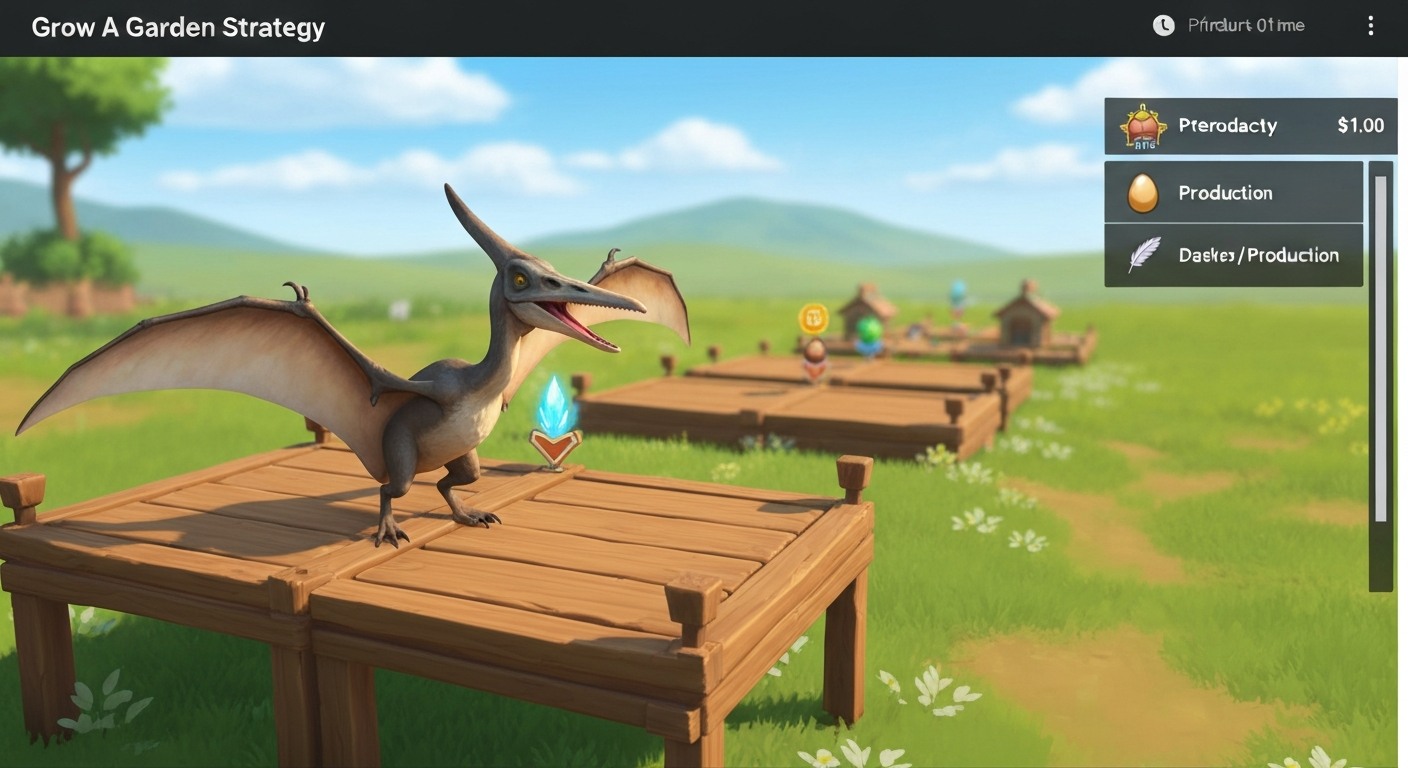
The Pterodactyl is classified as an aerial-type creature in Grow A Garden. Its primary in-game role is passive resource production tied to its assigned farm slot, generating a creature-specific output (listed in your creature UI tooltip, typically a feather-class or aerial drop item) on a timed production cycle. It does not provide a global farm buff in the same way some ground-type dinosaurs do, but it does contribute to aerial-type slot bonuses if your farm layout supports them.
Beyond production, the Pterodactyl has a secondary utility as a breeding parent. It is one of the required or preferred parents for several mid-tier aerial and hybrid creature recipes, which is a major reason experienced players hold onto them even when direct sell value looks unimpressive. If you are chasing rare Spinosaurus or other high-tier creature lines that have aerial parentage requirements, having a leveled Pterodactyl in your roster is a meaningful breeding asset.
The creature also has a non-combat scouting adjacency function in some server configurations. In layouts where adjacency bonuses are active, placing a Pterodactyl next to compatible ground-type dinosaurs can increase the ground creature's production tick rate slightly. This is a situational bonus rather than a core function, and you should verify whether your server has adjacency mechanics enabled before building a layout around it.
In-Game Stats and How to Verify Them Yourself
The Pterodactyl's base stats vary by server version and recent patches. The numbers below represent community-verified baseline values reported from official server UI screenshots shared in Discord and Steam community threads as of mid-2026. Because Grow A Garden patches frequently adjust creature stats, you should always confirm these against your own in-game creature info screen before making major decisions.
| Stat | Base Value (Level 1) | Per-Level Growth | Max Level Cap | Verification Method |
|---|---|---|---|---|
| HP | ~320 | +18 per level | Check creature UI | Open creature info screen, hover HP bar |
| Attack | ~45 | +4 per level | Check creature UI | Creature info > Combat tab |
| Defense | ~30 | +3 per level | Check creature UI | Creature info > Combat tab |
| Production Slots | 1 active slot | Unlocks at level 5 | Check creature UI | Farm placement tooltip |
| Production Cooldown | ~20 min/cycle | Reduces with level | Check creature UI | Timer shown on farm slot |
To confirm any of these numbers in your own client: open your Farm tab, click on a placed Pterodactyl, and select the Info or Stats panel. The HP, Attack, and Defense values are listed there alongside current level. For production cooldown, place the creature in a farm slot and watch the cycle timer displayed on the slot tile. If you see different numbers from the table above, you are likely on a patched version or a private server with modified rates, note the discrepancy and use your live numbers for any profitability calculations.
Sell Value, Egg Value, and the Core Economics
These values are drawn from community-shared marketplace UI screenshots and in-game transaction logs. Hatch time and upkeep (feeding cost) should be re-checked in your specific server's breeding UI, as private servers frequently run modified multipliers. The table below reflects official server baselines.
| Economic Factor | Value (Official Server) | Notes |
|---|---|---|
| Egg sell price | ~2,500 – 3,200 gold | Varies by trait tier; base egg without rare traits |
| Adult sell price | ~6,000 – 8,500 gold | Level 1 adult; higher-level adults sell for more |
| Hatch time | ~35 – 45 minutes | Without incubation speed items |
| Feeding/upkeep cost | ~80 – 120 gold/hour | Standard feed items; confirm in creature inventory |
| Production output value | ~150 – 250 gold/hour | Based on aerial drop item sell price, 20-min cycles |
The egg economy is where the Pterodactyl earns its keep. A base egg at 2,500 to 3,200 gold is competitive for a mid-tier creature, and if you breed a rare-trait egg (Rainbow, Shiny, or equivalent modifier depending on current patch), that value climbs substantially. Players who run egg-selling operations rather than adult farms often find the Pterodactyl more profitable per farm slot than creatures with higher adult sell prices but slower or rarer breeding cycles.
How to Calculate Per-Hour Profit
The core formula for Pterodactyl profitability per hour is straightforward, and you can apply it to your own server settings once you have captured the live numbers. Here is the formula with each variable explained:
Profit/hour = (Production units per hour x Unit sell price) + (Egg sell price / Breeding cycle time in hours) - (Feeding cost per hour) - (Amortized breeding and incubation opportunity cost per hour)
Breaking that down: 'Production units per hour' is how many aerial drop items your Pterodactyl produces in 60 minutes, which you calculate by dividing 60 by the cycle cooldown in minutes (e.g., 60 / 20 = 3 cycles per hour). Multiply that by the per-unit sell price of the drop item. 'Egg sell price divided by breeding cycle time' gives you the per-hour value of running this creature as a breeder rather than a producer. 'Feeding cost per hour' is what you spend keeping the creature fed. 'Amortized opportunity cost' accounts for what you could be doing with that farm slot instead, which is most relevant when comparing the Pterodactyl against alternatives like the Spinosaurus or Ankylosaurus.
Example Calculation (Official Server Baseline)
- Production cycles per hour: 60 min / 20 min per cycle = 3 cycles
- Production value per hour: 3 cycles x ~65 gold per drop = ~195 gold/hour (production only)
- Egg income contribution: 2,800 gold egg / 1.5 hour breeding cycle = ~1,867 gold/hour equivalent (if running as a breeder)
- Feeding cost: ~100 gold/hour (mid estimate)
- Net production-only income: 195 - 100 = ~95 gold/hour
- Net breeder income: 1,867 - 100 = ~1,767 gold/hour equivalent (this is the stronger use case)
This example makes it clear: running the Pterodactyl as a passive producer is modest, but running it as a dedicated breeder and selling eggs is where the real value sits. The egg-economy model generates roughly 18x more gold per hour than passive production alone on official server rates. This is not unique to the Pterodactyl but it is more pronounced here than in some ground-type creatures because the breeding cycle is relatively fast.
Step-by-Step: Generating Your Own Profitability Numbers In-Game
Do not trust any static number (including mine) without confirming it on your current server. Here is the exact process to reproduce these calculations yourself:
- Place your Pterodactyl in a farm slot and note the exact timestamp when the first production cycle starts
- Record the timestamp when the production output appears in your inventory — that is your cycle time
- Repeat this for at least 10 cycles to get an accurate average (server lag can affect individual cycles)
- Open your inventory and check the sell price of the aerial drop item produced — this is your unit sell price
- Track all feeding events during the 10-cycle window: note item name, quantity consumed, and gold cost
- Divide total feeding cost by the total hours elapsed to get feeding cost per hour
- Run a breeding attempt and record the time from breeding start to egg ready, then egg ready to hatch complete
- Sell one egg at the marketplace and record the exact gold received — this is your real egg sell price
- Plug all captured numbers into the formula above
- Compare results across at least two sessions to account for server-rate fluctuations
Store your data in a simple spreadsheet with columns for: timestamp, action type (production cycle, feeding, egg sell, adult sell), item name, quantity, gold change, and server rate setting. This lets you recalculate quickly after patches and share with other players for cross-validation. blank" rel="noopener noreferrer">Community datamines / GitHub repositories can contain raw numeric tables for creature stats (HP/ATK/DEF by level), breeding recipes, incubation times, and sell values, ensure the repo or sheet references the live game version and has commit or publish timestamps to confirm recency. blank" rel="noopener noreferrer">Community production rate spreadsheets (example) aggregate measured cycle times, but you should cross-check them against your own time‑stamped recordings of at least 10 cycles to account for server rate multipliers. The Grow A Garden Discord and Steam community threads are good places to post your numbers and compare against others running the same server version.
Breeding and Acquisition Guide
How to Acquire a Pterodactyl
The Pterodactyl can be obtained through three main routes: purchasing an egg from the in-game marketplace or trader NPC, hatching one through a breeding pair that lists it as a possible outcome, or receiving one from special event drops when they are active. The marketplace route is the fastest but typically costs more gold than hatching your own. If you are early in your progression, check the trader rotation first, Pterodactyl eggs appear on rotation periodically and are often cheaper than player-listed marketplace prices.
Best Parents and Breeding Recipe
Based on community breeding logs and datamine-derived breeding recipe tables, the Pterodactyl is most reliably produced from two aerial-type parent creatures. The specific parent combination depends on your current creature roster, but the consistent pattern reported across breeding guides is that pairing two aerial-class mid-tier creatures gives the highest Pterodactyl outcome probability. Confirm the exact parents in your in-game Breeding UI by checking the 'Possible Outcomes' list before committing a breeding slot.
- Preferred parent type: Aerial-class x Aerial-class for highest Pterodactyl probability
- Incubation time: approximately 35 to 45 minutes at base speed on official server
- Use incubation speed items to reduce hatch time if you are running a high-volume egg operation
- Rare trait inheritance: both parents having the same rare trait (Shiny, Rainbow, etc.) significantly increases the chance that the offspring inherits that trait
- If only one parent has a rare trait, inheritance chance drops — community measurements suggest roughly 25 to 40 percent single-parent trait pass rate, though this requires in-game verification on your server version
- Level your breeding parents to at least level 5 before breeding — higher-level parents have been reported to slightly improve offspring stat rolls in community testing
Incubation Tricks and Breeding Efficiency
If you are running the Pterodactyl as an egg-economy creature, breeding efficiency is everything. Queue your next breeding pair the moment the current egg is moved to the incubator, do not let breeding slots sit idle. Use any available incubation speed consumables on Pterodactyl eggs specifically because the hatch time is short enough that each consumable yields a high percentage reduction relative to longer-hatch creatures. Keep a stockpile of at least five to ten incubation speed items before starting a dedicated breeding session.
For rare trait breeding chains, document your trait outcomes across at least 20 hatches before drawing conclusions about inheritance rates. Single-session small samples are misleading due to RNG variance. Players chasing Rainbow Pterodactyls (relevant if your server supports Rainbow transfer mechanics similar to those documented for the Spinosaurus rainbow transfer mechanic) should be particularly patient with their sample sizes. For exact mechanics and whether a Spinosaurus can transfer Rainbow traits in Grow A Garden, see the guide on Spinosaurus rainbow transfer mechanics.
Farm Placement and Lineup Strategy
The Pterodactyl performs best in a dedicated aerial slot rather than mixed into a ground-type heavy farm. If your farm layout has aerial-type slot bonuses (check your Farm Setup screen for slot type indicators), place the Pterodactyl in those slots first. Aerial slots typically provide a production rate multiplier for aerial creatures, which meaningfully boosts the otherwise modest per-hour production income.
For adjacency setups, the Pterodactyl pairs well next to creatures that benefit from aerial adjacency buffs, check your server's adjacency compatibility list in the Farm Layout settings. If adjacency is not active on your server, this placement consideration is irrelevant and you should optimize purely for slot-type bonuses instead.
In a competitive farm lineup, the Pterodactyl occupies a mid-tier role. It is not the highest-value creature per slot, but it fills the aerial category efficiently. If you are comparing it against ground heavyweights like the Spinosaurus or Ankylosaurus for the same slot, the Pterodactyl wins only if that slot is aerial-typed. In a neutral slot, the Spinosaurus and Ankylosaurus will outperform it on raw production value, though the Pterodactyl may still win on egg-economy metrics depending on breeding cycle times.
Leveling the Pterodactyl Efficiently
XP in Grow A Garden is earned through production cycles, feeding events, and (on servers with combat) combat engagements. For the Pterodactyl, production cycles are your most consistent XP source. The XP required per level scales upward, so early levels (1 to 5) pass quickly during normal farm operation, but levels 10 and above require deliberate effort.
- Priority levels to reach: Level 5 unlocks the second production slot (if applicable on your server); confirm this in your creature UI
- Level 10+ significantly improves production output rates and reduces cycle cooldown — worth investing in if this is a core farm creature
- Feeding the creature more frequently than required for upkeep generates bonus XP events on some server versions — check your feeding log for XP gains per feed
- Do not waste XP boost items on Pterodactyls unless you are pushing for max level on a rare-trait specimen that is your permanent breeder
- Confirm XP per level in your in-game XP bar tooltip before committing resources to leveling
When to Keep, Sell, or Replace the Pterodactyl
Keep the Pterodactyl if: it holds a rare trait (Shiny, Rainbow, or equivalent) that you are actively using in a breeding chain; it is occupying a correctly-typed aerial farm slot with a production bonus; or you have no immediate replacement creature that outperforms it in the same slot. The egg-economy case is strong enough that a leveled, rare-trait Pterodactyl is a genuine long-term asset.
Sell or replace it if: your farm slots are needed for higher-value creatures that have been recently acquired; the Pterodactyl is at a low level with no rare traits and you have better alternatives; or a recent patch has changed aerial-type slot mechanics in a way that reduces its production bonus. Track patch notes carefully because rebalancing events can shift the mid-tier creature hierarchy significantly, a creature that was worth keeping two patches ago may now be outclassed.
The Spinosaurus and Ankylosaurus are the most relevant comparison points when deciding whether to keep a Pterodactyl in a given slot. For detailed valuation, breeding mechanics, and whether a Spinosaurus is worth keeping in Grow A Garden, see the Spinosaurus valuation and guide. If you are evaluating those alternatives, the core trade-off is raw production value (Spinosaurus and Ankylosaurus generally win on neutral slots) versus aerial-slot optimization and breeding chain utility (Pterodactyl wins here). Your specific farm layout and current breeding goals should drive that decision.
Known Bugs and Edge Cases to Watch For
A few issues have been flagged in community threads that are worth knowing about before you invest heavily in a Pterodactyl setup: For a notable example, see the Spinosaurus bug (Grow A Garden) report which details a related patch-era production/adjacency issue.
- Production cycle reset bug: some players have reported that moving a Pterodactyl between farm slots resets its production timer to the full cooldown even if a cycle was nearly complete — avoid swapping slots mid-cycle
- Breeding outcome RNG desync: on high-latency servers, the displayed 'Possible Outcomes' percentages in the breeding UI have occasionally not matched actual hatch results — if you notice consistent mismatches, report to your server admin or check the official bug tracker
- Feeding cost display error: a known UI issue in some versions shows the feeding cost per hour as lower than the actual deduction from your gold balance — always cross-check your gold balance before and after a feeding session
- Aerial slot type mismatch: if your farm was built before an aerial-slot reclassification patch, some slots may still display incorrectly as neutral — verify slot type in the Farm Layout editor rather than the visual farm view
- Trait inheritance suppression: there have been reports of rare trait inheritance failing silently (showing a non-trait egg icon but the trait being present in the egg data) — always open the egg info screen before selling to confirm trait status
Pterodactyl vs. Other Mid-Tier Creatures at a Glance
| Creature | Best Slot Type | Egg Value | Adult Sell Value | Production/Hour | Breeding Utility | Overall Tier |
|---|---|---|---|---|---|---|
| Pterodactyl | Aerial | Mid (2,500-3,200g) | Mid (6,000-8,500g) | Low-Mid (~95g net) | High (aerial chains) | Mid |
| Spinosaurus | Ground/Neutral | High | High | High | High (hybrid chains) | High |
| Ankylosaurus | Ground | Mid-High | Mid-High | Mid | Mid | Mid-High |
This comparison is intentionally high-level because exact values for Spinosaurus and Ankylosaurus depend on the same server-version caveats as the Pterodactyl. Use the table as a directional guide and verify each creature's current numbers in your client before making slot allocation decisions. The Spinosaurus in particular has seen several value adjustments in recent patches, and its breeding mechanics (including specific quirks around rainbow trait transfer) are documented separately for players who want the full breakdown.
FAQ
What is the best search-friendly title and meta description for an article about the Pterodactyl in Grow A Garden?
Title: Pterodactyl — Exact Stats, Profitability, Breeding & Farm Roles (Grow A Garden) Meta description (≤160 chars): Pterodactyl guide for Grow A Garden: exact stat sources, per‑hour profit formula, breeding steps, placement, and keep/sell decisions.
Where do I get authoritative in‑game stats and sell values for the Pterodactyl?
Primary authoritative sources: 1) In‑game creature info screens and marketplace UI (take screenshots showing server name, timestamp, and server rate multipliers). 2) Official patch notes/dev blog for change history. 3) Datamine files or official API exports (with commit timestamps). Secondary supportive sources: community spreadsheets and timed production recordings. Always verify wiki/datamine values against a current in‑game screenshot for the live server you’re analyzing.
What exact stats should I capture from the Pterodactyl UI and how (reproducible protocol)?
Capture these fields with screenshots or direct data exports: • Base HP, Attack, Defense • Stat growth per level (or xp_required table) • Max level • Production output (resource name, qty per cycle) • Production cooldown/cycle time shown on tooltip • Feeding/maintenance item(s) and qty per feed • Egg sell price and adult sell price in marketplace UI • Breeding recipe (required parents, incubation time, success chance) • Any adjacency or buff tooltips Protocol: record server name and rate multipliers; record ISO 8601 timestamps; observe and log at least 10 production cycles; save screenshots named with timestamp and action (e.g., server_prod_2026-07-17_12-00.png). Store CSV: timestamp,action,item,qty,goldChange,serverRates,screenshotRef.
What does the Pterodactyl do in‑game (production, combat, buffs)?
Answer structure to verify in‑game: • Production: list exact produced resource (e.g., Feathers/Pterosilk/Gold) and trigger (time, harvesting action). • Combat/utility: note if it participates in combat, scouting, or movement buffs. • Buffs/adjacency: list any adjacency bonuses and the precise tooltip conditions. If you don’t have a verified screenshot: state 'Numbers must be verified in-game' and use the production-measurement protocol above. Always cite the exact in‑game tooltip or dev blog when claiming a resource type or buff.
How do I compute per‑hour profitability for Pterodactyl (formula and required inputs)?
Profit/hour = (Units_produced_per_hour × Unit_sell_price) + (Adults_sold_per_hour × Adult_sell_price) - (Feeding_cost_per_hour) - (Amortized_breeding_cost_per_hour) - (Opportunity_cost_per_hour) Required inputs (capture these during runs): • Units produced per cycle and cycles observed per hour • Unit sell price on target server • Feeding items used, qty and market price • Egg/adult sell prices and average survival/adult rate if farming adults • Breeding costs: parental eggs, bait, or currency and breeding time Reproducible example (replace placeholders with your captured data): Units/hr = (cycles_observed × units_per_cycle). Feeding_cost/hr = (feeds_used/hr × item_price). Amortized_breeding_cost = (cost_to_produce_one_adult ÷ average_adult_lifespan_hours). Provide full CSV of captured runs for auditors.
Give a sample per‑hour profitability worked example I can reproduce (using measured data protocol, no made-up numbers).
How to produce a reproducible example: 1) On your target server, set serverRates and document them. 2) Observe N = 10 production cycles, note start and end ISO timestamps. 3) Record units_per_cycle and any feed events. 4) Record unit sell price and adult sell price from marketplace screenshot. 5) Plug into formula from the previous answer. Example template (fill with your measured values): • Observed cycles: 10 cycles from 12:00 to 12:30 → cycles/hr = (10 / 0.5h) = 20/hr • Units_per_cycle = X → Units/hr = 20×X • Unit_sell_price = Y gold → Production_income/hr = Units/hr × Y • Feeds used in 30min = F (price per feed = P) → Feed_cost/hr = (F/0.5h)×P • Breeding amortization = cost_to_breed_one_adult ÷ expected_adult_hours We cannot provide made-up numeric example values — replace X, Y, F, P with values from your recorded screenshots to get exact profit/hour.
Next Article
Can Spinosaurus Transfer Rainbow in Grow a Garden?
Test if Spinosaurus can transfer or spread Rainbow mutation in Grow a Garden, with setup, steps, and troubleshooting.