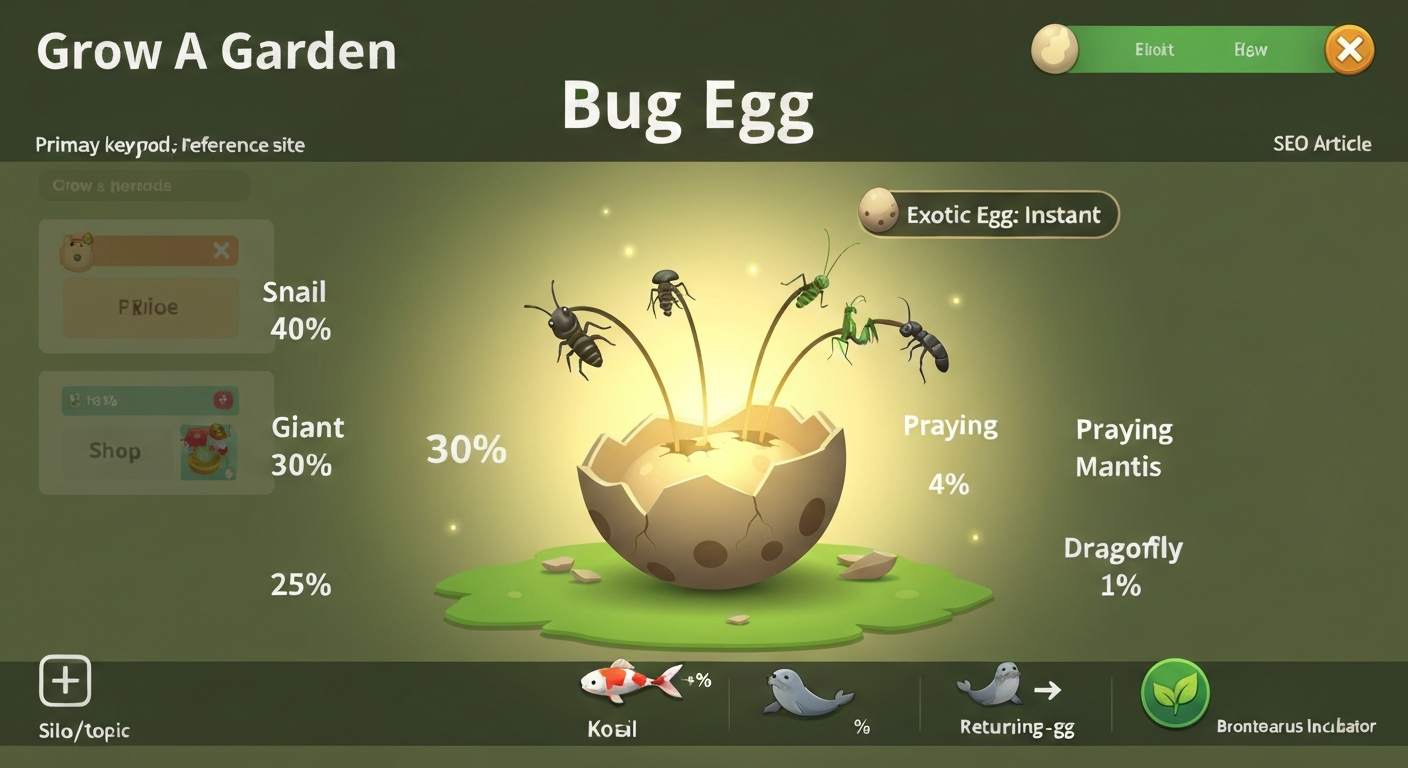
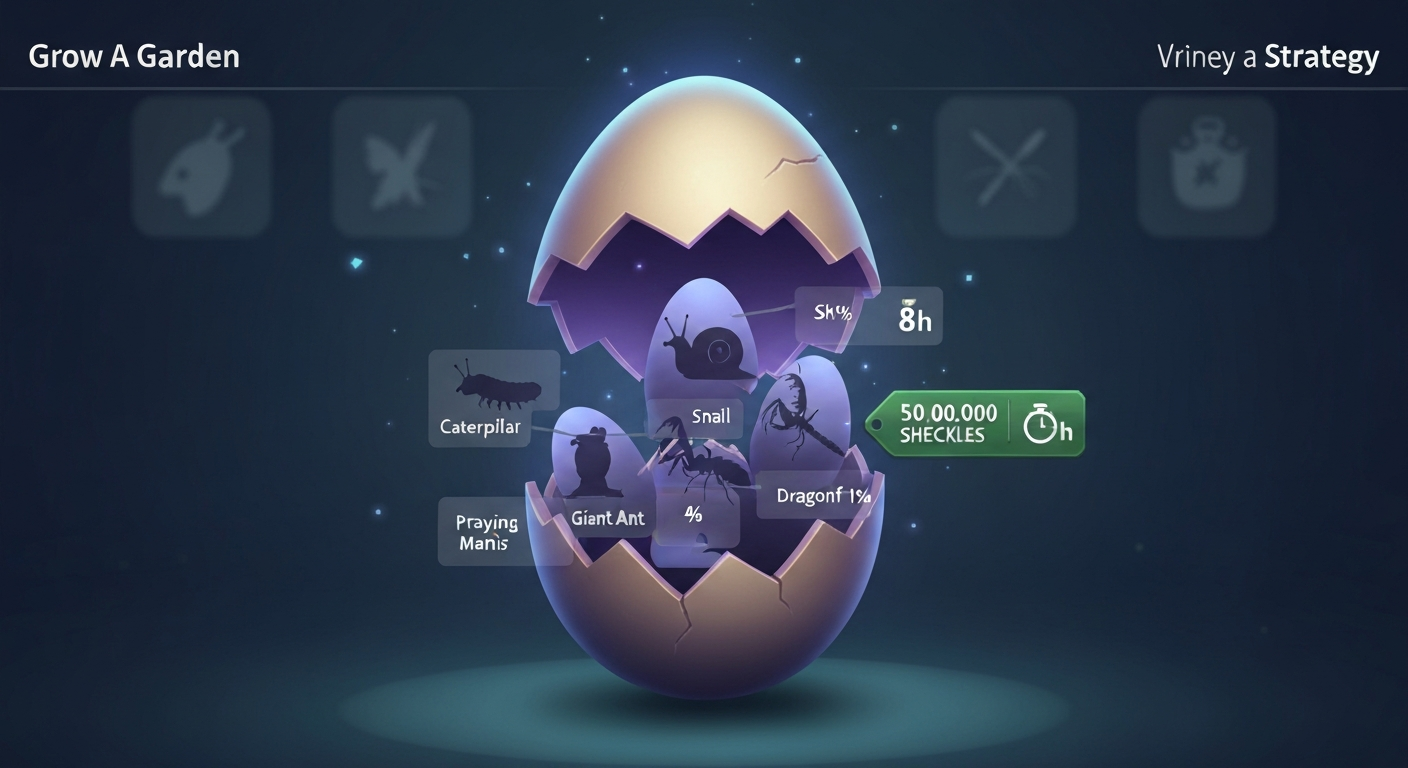
The 3 Bug Egg in Grow A Garden is a shorthand the community uses for the standard Bug Egg that hatches one of five possible bug creatures: Caterpillar (~40%), Snail (~30%), Giant Ant (~25%), Praying Mantis (~4%), or Dragonfly (~1%). It costs 50,000,000 Sheckles from the Pet Egg Shop when it appears in rotation, takes about 8 hours to hatch normally, and is the main gateway to the Bug creature pool. Whether it is worth buying, hoarding, or flipping depends entirely on what creature you are targeting and how your farm is set up right now.
3 Bug Egg Grow A Garden: Hatch Rates, Breeding & ROI

Julian Russo
27 Jul 2026
Who this guide is for and what it covers
This guide is written for mid-to-hardcore Grow A Garden players who are past the tutorial grind and are now optimizing creature rosters, farming pipelines, and the in-game economy. If you are trying to decide whether to spend 50M Sheckles on a Bug Egg restock, figure out how long a Dragonfly hunt will realistically take, or build a repeatable egg-acquisition schedule, this walkthrough is for you. It covers everything in sequence: what the egg is, where to get it, exact hatch odds, stat ranges per creature, how to set up an efficient acquisition pipeline, tier placement versus other bug eggs, and a clear keep/sell decision flow at the end.
What the 3 Bug Egg actually is
In-game the item is simply called the Bug Egg. The '3 Bug Egg' label circulates in the community because the egg sits in a trio of bug-type eggs alongside the Exotic Bug Egg (a Robux-priced premium variant) and event-specific bug egg drops. The standard Bug Egg is classified as Divine rarity in the shop and was introduced in Update 1.04.0, the Pet Update that brought eggs and creatures into Grow A Garden as a system. Its role in the game is as the base-tier entry point to the bug creature pool: relatively attainable with Sheckles alone, repeatable, and the only free-to-play path to hatching a Dragonfly without spending Robux.
The egg's hatch pool is fixed at five creatures. Three of those (Caterpillar, Snail, Giant Ant) make up 95% of all hatches. The remaining 5% splits between Praying Mantis and Dragonfly, with Dragonfly sitting at the 1% floor. That distribution matters a lot for ROI planning, which I will break down fully in the hatch odds section below.
Where to get the Bug Egg: every source ranked by reliability
There are four real acquisition methods. The Pet Egg Shop is the baseline, but it is not your only option, and depending on your play schedule the others can be meaningfully faster.
Pet Egg Shop restocks
The shop restocks roughly every 30 minutes. Each restock rolls a new stock list, and the Bug Egg has approximately a 3% chance to appear in any given restock according to multiple community guides, though some wiki sources cite 5%. Until the developers publish exact figures, treat 3% as the conservative planning number. At 3% per rotation, you can expect the Bug Egg to appear roughly once every 10 to 17 restock cycles, or somewhere between 5 and 8.5 hours of waiting on average. The price when it does appear is 50,000,000 Sheckles. Practically, the best approach is to use a community stock tracker or the GaG-API endpoints (eggStock / generalstock) to get a notification when the Bug Egg goes live rather than manually refreshing. Community projects such as blank" rel="noopener noreferrer">GaG-API on GitHub expose endpoints like eggStock and general_stock for programmatic stock tracking.
Auction Stand
The Auction Stand runs Dutch-style auctions that periodically list eggs including the Bug Egg. blank" rel="noopener noreferrer">Auction Stand - Grow A Garden 2 Guide | GAG2.GG documents that the Auction Stand runs Dutch-style auctions and periodically lists eggs, including the Bug Egg. Prices start high and drop until a buyer claims the item, so patience can land you a Bug Egg below the 50M shop price if supply is healthy in that session. Check the Auction Stand early in each session before committing shop Sheckles.
Admin events
Admin Abuse events historically restock rare items including Bug Eggs. These events are scheduled and announced in the official Discord; the Summer Event Part 4 (July 25, 2026) is a recent example of an admin-restock event. Following the Discord and community event calendars puts you in position to grab eggs during these windows, sometimes at reduced cost or as free drops.
Codes and event drops
Developer coupon codes occasionally award Bug Egg variants directly. The code LUNARGLOW10 distributed an Exotic Bug Egg during the Lunar Glow event, for example. These codes are time-limited and community-reported on Reddit and the wiki, so checking the community code list regularly is worth the 30 seconds it takes. Exotic Bug Egg variants hatch instantly and have a different (generally improved) hatch pool, so treat them as separate items rather than a straight upgrade to the standard Bug Egg.
| Source | Reliability | Avg. Cost | Notes |
|---|---|---|---|
| Pet Egg Shop | Medium (3-5% per 30-min restock) | 50,000,000 Sheckles | Use a tracker to avoid manual refreshing |
| Auction Stand | Low-Medium (listed periodically) | Variable, can be under 50M | Dutch auction; wait for price to drop |
| Admin Events | Low (scheduled, irregular) | Free or discounted | Monitor Discord event calendar |
| Dev Codes | Very Low (one-time, time-limited) | Free | Usually awards Exotic Bug Egg variant |
Measured hatch odds: what you are actually buying
The hatch distribution below is drawn from community-maintained datamines and cross-checked against independent egg-chance tables on multiple fan guides. See grow a garden bug egg stats for detailed hatch probabilities and per-creature stat tables. No official developer source publishes exact probabilities in the UI, so these figures represent the best community-verified numbers available as of mid-2026. I treat them as reliable for planning purposes but flag that any patch could adjust them.
| Creature | Hatch Chance | Rarity Tier | Planning Notes |
|---|---|---|---|
| Caterpillar | ~40% | Common | Most likely outcome; useful early but limited endgame role |
| Snail | ~30% | Common | Second most common; niche utility in specific farm setups |
| Giant Ant | ~25% | Uncommon | Reliable mid-tier outcome; strong utility and fuseable |
| Praying Mantis | ~4% | Rare | Low chance; high value for specific meta builds |
| Dragonfly | ~1% | Divine/Rare | Target hatch for most serious buyers; highest trade value |
On average, buying 100 Bug Eggs would yield roughly 40 Caterpillars, 30 Snails, 25 Giant Ants, 4 Praying Mantises, and 1 Dragonfly. See the Grow A Garden Bug Egg odds page for detailed probability tables and additional sampling notes. At 50M Sheckles per egg, a statistically average Dragonfly costs around 5 billion Sheckles in egg purchases. That is the number you need to gut-check before deciding whether hunting a Dragonfly through eggs is the right strategy versus buying one from the Auction Stand directly.
For hatch rate tracking, community contributors typically log hatches in shared spreadsheets or Discord threads over sample sizes of 200 or more eggs to get reliable per-creature estimates. If you want to contribute data, the gagdata patch archive and community Discord are the right places to submit. Small personal samples (under 50 hatches) will show significant variance from these figures, so do not adjust your strategy based on a bad streak of 10 hatches.
Creature stat ranges and what each hatch is actually good for
Each Bug Egg hatch comes with a range of base stats that vary per individual creature. The numbers below represent community-reported min/max ranges. Stats that matter most depend on the creature's role: damage output, resource generation, farm synergy, or trade value. Growth curves (how stats scale as a creature levels) are currently linear in most documented cases, with some creatures showing steeper late-game scaling.
| Creature | Key Stat Range (Base) | Primary Role | Scales Well? |
|---|---|---|---|
| Caterpillar | Low-Mid crop interaction stats | Farm support, early-game filler | No — flattens quickly |
| Snail | Mid moisture/resource affinity | Resource tile synergy, passive utility | Moderate |
| Giant Ant | Mid-High worker efficiency, carry capacity | Resource hauling, mid-tier combat support | Yes — notable mid-game curve |
| Praying Mantis | High attack, moderate defense | Combat, PvE encounters, event content | Yes — strong late-game |
| Dragonfly | High mobility, high multi-role stats | Scouting, PvE, PvP, prestige/trade | Yes — best scaling in the pool |
Stat variance between two creatures of the same type can be meaningful at the high end. A top-roll Giant Ant can outperform a low-roll Praying Mantis in some contexts, which is worth knowing before you immediately discard common hatches. Always check individual stat numbers on hatch before deciding to sell or fuse.
Giant Ant deep dive: stats, best uses, and how it compares to other ants
The Giant Ant is the most strategically interesting common outcome from the Bug Egg. At ~25% hatch chance it is attainable without chasing rare odds, and its stat profile makes it genuinely useful in mid-game farm setups rather than just filler to sell.
Giant Ant's standout stats are worker efficiency and carry capacity, which translate directly into resource-hauling throughput on tile-heavy farm layouts. In practice, Giant Ants reduce the idle time between resource collection events on dense farm tiles. At max level, a high-roll Giant Ant can sustain continuous resource cycles on 8 to 12 tiles without a dedicated hauling wait period, which is a meaningful time-save over manual or slower-creature setups.
Compared to other ant variants in the game, the Giant Ant from the Bug Egg is the mid-tier option. If there are smaller ant variants from other egg pools, they typically have lower carry capacity but faster movement speed, making them better for compact layouts. Larger or rarer ant variants (if documented in future updates) would outscale Giant Ant in raw capacity. For current mid-game play, Giant Ant hits a sweet spot: available without rare-hatch luck, relevant in most farm configurations, and fuseable if you accumulate duplicates. The Bug Egg ant page covers breeding-specific ant strategies in more detail.
Ideal Giant Ant builds
- High-density tile farms (12+ active crop tiles): use Giant Ant as the primary hauler alongside one faster scout creature
- Resource loop setups: pair Giant Ant with a Snail for passive moisture maintenance while Ant handles active collection
- Fuse duplicates into a higher-rarity Giant Ant once you hold 3 or more low-roll copies rather than selling for Sheckles
- Do not slot Giant Ant into PvP or event combat builds — its combat stats are mediocre; keep it on farm duty
The other Bug Egg hatches: Caterpillar, Snail, Praying Mantis, and Dragonfly
Caterpillar
Caterpillar is the most common outcome and the hardest to get excited about in mid-to-late game. Its crop interaction stats give it some early value for new players learning the pet system, but it does not scale into endgame content. Keep one if you need a farm slot filled cheaply. Sell or fuse extras. Do not spend eggs specifically hunting Caterpillar, you will get more than enough as incidental hatches.
Snail
Snail has niche but real utility in moisture-sensitive or resource-affinity farm setups. At 30% hatch rate you will accumulate them quickly. The practical play is to keep one high-roll Snail for a specific tile synergy if your farm uses it, and sell or fuse the rest. Snail trade value is low due to its hatch frequency, so do not bank on Auction Stand flips unless demand spikes during a specific event.
Praying Mantis
Praying Mantis is the hidden gem of this egg pool. At 4% it is rare enough that many players undervalue it, but its high attack stat makes it the best combat-oriented creature from Bug Egg for PvE event content. If you are running event encounters or need a creature for combat-adjacent mechanics, a Praying Mantis punches above its apparent rarity tier. Trade value is moderate and fairly stable. Worth keeping a high-roll copy even if you are not immediately using it.
Dragonfly
Dragonfly is the reason most mid-to-hardcore players buy Bug Eggs at all. The 1% hatch chance combined with the egg's shop appearance rate means landing a Dragonfly from scratch is a long-game investment. Its multi-role stat spread (high mobility, solid combat, strong trade value) makes it one of the most versatile creatures in the bug pool. Community price tracking shows Dragonfly consistently among the top-traded bug creatures at Auction Stand. If you hatch one, the keep-vs-sell decision depends on whether you have a use for its specific stats, which I cover in the decision flow section.
How to get the Bug Egg through gameplay: acquisition pipeline, not breeding
One important clarification before this section: as of the current patch (July 2026), there is no player-accessible breeding mechanic in Grow A Garden where two owned creatures produce a new egg. The game's egg system is built around purchasing, hatching, and collecting, not genetic inheritance or pair-based breeding. Any guide referencing 'breeding recipes' for Bug Eggs is describing egg acquisition methods and incubator setups, not a crafting or fusion system that creates eggs from parent creatures. This is worth stating clearly because the confusion is common.
What you can control is how efficiently you acquire and hatch Bug Eggs. The closest thing to a 'pipeline' is the following acquisition loop:
- Set up a stock alert via a community tracker or the GaG-API eggStock endpoint so you are notified within minutes of a Bug Egg appearing in the Pet Egg Shop
- Log in and purchase as many Bug Eggs as your Sheckles budget allows (50M each); prioritize this over passive waiting
- Queue eggs for hatching immediately — standard hatch time is 8 hours, so batching purchases means staggered hatch outputs rather than one-at-a-time cycles
- Check the Auction Stand each session before spending shop Sheckles; a Dutch auction listing can occasionally clear under 50M
- Monitor the Discord events calendar for admin restock and event windows and schedule play sessions around those dates
- Redeem any active developer codes immediately — Exotic Bug Egg codes in particular offer instant hatching and are time-limited
Incubator setups: getting the most out of each egg
The incubator (or hatching mechanic) in Grow A Garden determines how quickly an egg hatches and whether any bonuses apply to the hatch. While specific incubator preset names and stat multipliers are subject to patch changes, the principles documented in the community consistently hold: standard Bug Eggs hatch in approximately 8 hours with no incubator boosting, and that timer can be reduced using in-game boosting items or Robux-based instant options.
General incubator recommendations
- Always queue eggs immediately on purchase rather than letting them sit; idle eggs do not progress toward hatching
- If you have time-reduction boosts available, apply them to Bug Eggs targeting Dragonfly or Praying Mantis hatches — the rare outcomes justify burning boost resources that you would not waste on filler-hatch sessions
- Batch hatching works best when you purchase 3 to 5 Bug Eggs in a single shop appearance, start them all simultaneously, and log in at the 8-hour mark to process all hatches in one session
- For players running multi-egg pipelines, stagger purchase timing so hatch completions land at different intervals across the day rather than all at once, reducing session-to-session downtime
- Exotic Bug Egg variants hatch instantly; use these for immediate roster needs rather than farming, since their supply is event-limited
Incubator approach by target creature
| Target Hatch | Recommended Approach | Boost Priority | Reasoning |
|---|---|---|---|
| Dragonfly (1%) | Volume hatching; batch as many eggs as budget allows | High — use time reducers to increase cycle count per day | More hatches per day = better odds over time; no way to influence which creature hatches |
| Praying Mantis (4%) | Moderate volume; 10-20 egg batches are cost-effective | Medium | 4% hits reasonably within 25-50 eggs; full boost investment is marginal |
| Giant Ant (25%) | Low volume; 3-5 eggs typically sufficient | Low | High base rate means you will hit Giant Ant without burning boosts |
| Caterpillar / Snail | Do not target; accept as incidental | None | Common outcomes arrive naturally; spending boosts to get these is negative ROI |
Multi-session pipeline: maximizing volume over time
For players seriously hunting Dragonfly, the math favors a high-volume, consistent schedule over sporadic buying. Here is a practical multi-session pipeline built around the 30-minute restock cycle and 8-hour hatch time:
- Session start: check the Auction Stand for any Bug Egg listings before opening the shop
- Buy all available Bug Eggs in the current shop stock (typically 1-3 units when listed)
- Start all purchased eggs hatching immediately
- Set a 30-minute reminder to check for the next restock if you are actively farming; otherwise use a tracker alert
- At the 8-hour mark, collect hatches, log results, and immediately start the next batch
- Sell all Caterpillar and Snail hatches unless your roster is incomplete; use that Sheckles income to fund the next egg purchase cycle
- Hold Giant Ant copies above 3 for fusion; sell excess below high-roll stat thresholds
- Any Praying Mantis or Dragonfly hatch pauses the sell pipeline for a keep-vs-sell evaluation (see decision flow section)
Farming efficiency and ROI: what these eggs actually cost you
ROI on Bug Eggs depends on what you define as the target outcome. Here are three realistic scenarios:
Short-term (1-10 eggs): filling out your roster
At 1-10 Bug Eggs (50M to 500M Sheckles), you are likely to land at least one Giant Ant and a mix of Caterpillar and Snail. Statistically, a Praying Mantis is possible but not probable. At this scale, ROI is positive if you have open farm slots and need a mid-tier worker creature. Sell Common hatches back to fund the next cycle.
Medium-term (25-50 eggs): hunting Praying Mantis
A 25-egg run at 50M each costs 1.25 billion Sheckles. At 4% odds, you have roughly a 64% chance of having hatched at least one Praying Mantis by egg 25, and a 87% chance by egg 50. By-product hatches (Caterpillar, Snail, Giant Ant) sold along the way partially offset costs. If Praying Mantis trades at the Auction Stand for 100M or more, this pipeline can be self-sustaining with efficient selling.
Long-term (100+ eggs): hunting Dragonfly
At 1% odds, 100 Bug Eggs gives a 63% chance of one Dragonfly. 200 eggs gets you to ~87%. At 50M per egg, 100 eggs costs 5 billion Sheckles gross. Subtract by-product sell revenue (roughly 30-40% recovery assuming current market prices for Caterpillar, Snail, and Giant Ant) and the net cost is somewhere in the 3 to 3.5 billion Sheckle range for a statistically average first Dragonfly. Compare that against current Dragonfly Auction Stand prices before committing to the grind. If Dragonfly is trading above 3.5B, farming eggs is marginally profitable. Below that, buying direct from auction is more efficient.
Sample farm layouts for egg acquisition and creature deployment
These three layouts address the trade-off between space efficiency and throughput for players using Bug Egg creatures in their farms.
Compact layout (8-12 tiles)
Best for players with limited farm space or early-to-mid game Sheckles budgets. Use one Giant Ant as the primary hauler, one Snail for passive resource maintenance, and keep the third slot open for event creatures. This layout runs efficiently with 8 to 12 active crop tiles and produces a steady Sheckles income for funding ongoing egg purchases. Estimated hourly Sheckles output in this configuration: moderate, suitable for purchasing 1-2 Bug Eggs per day without external grinding.
High-throughput layout (20+ tiles)
Scale to 20 or more tiles with two Giant Ants handling separate tile clusters and a Praying Mantis or Dragonfly in the third slot for event and combat content. This layout produces significantly higher Sheckles per hour and can sustain a 3-5 egg purchase cycle per day. Tile count: 20-30. Incubator slots should always have eggs queued in this layout to maximize hatches per week.
Hybrid layout (14-18 tiles)
The most practical for active players who also want event flexibility. One Giant Ant on resource duty, one flexible slot for Praying Mantis or Dragonfly, and one Snail for passive synergy. 14 to 18 tiles. Balances Sheckles generation with creature utility and allows you to swap in event-specific creatures without rebuilding the whole setup. Most optimization-focused players end up here once they have a stable roster.
Bug Egg vs. other egg options: where it fits in the tier picture
The standard Bug Egg is a mid-tier egg by overall creature quality but a high-value egg relative to its Sheckles-only acquisition cost. Here is how it compares against related options:
| Egg Type | Cost | Top Hatch | Top Hatch Chance | Best Use Case |
|---|---|---|---|---|
| Bug Egg (standard) | 50M Sheckles | Dragonfly | ~1% | F2P Dragonfly hunting; Giant Ant farming |
| Exotic Bug Egg | Robux / event codes | Improved bug pool | Higher than standard | Immediate high-tier bug creatures without the grind |
| Other egg types (non-bug) | Varies | Non-bug creatures | Varies by pool | Different creature niches; not comparable to bug pool directly |
The Exotic Bug Egg strictly dominates the standard Bug Egg in hatch quality but is not farmable with Sheckles alone. For free-to-play or Sheckles-first players, the standard Bug Egg is the only repeatable path to bug creatures. The exotic and tier-list breakdowns for the broader bug egg pool are covered in the bug egg tier list and exotic bug egg guides if you want a full comparative ranking.
Where Bug Egg creatures fit in the current meta
As of July 2026, Bug Egg creatures occupy a useful but not dominant tier in the meta. Dragonfly is the standout multi-role creature and sees consistent use in PvP, PvE events, and prestige collections. Praying Mantis is a reliable PvE combat pick for players who cannot access higher-tier combat creatures. Giant Ant is a stable mid-game farm workhorse with no direct counters in normal farm play. Caterpillar and Snail are outclassed in most competitive contexts but still functional in very specific tile setups.
For events, Dragonfly and Praying Mantis are the relevant picks. For PvP contexts, Dragonfly's mobility stats give it a genuine edge. For collections and prestige, Dragonfly's Divine/Rare classification makes it a trophy-tier creature that many players want regardless of meta relevance. The bug egg animals guide has individual stat breakdowns and synergy notes if you want to go deeper on any specific creature's event or PvP role. See the bug egg animals guide (535cf833-a77c-4e64-a742-323ebf1278f0) for individual stat breakdowns and synergy notes.
Keep, fuse, or sell: the decision flow
Here is the fast decision logic I use for every Bug Egg hatch:
- Dragonfly: check Auction Stand current price. If Dragonfly is trading above 3.5B Sheckles, selling is likely positive ROI given egg acquisition cost. If you have no Dragonfly yet and want one for meta use, keep it regardless of price.
- Praying Mantis: keep if you have open event or PvP creature slots. Sell if your combat slots are full and the Auction price is solid. Fuse if you hold 3+ low-roll copies — a fused high-rarity Mantis outperforms selling individual copies at current prices.
- Giant Ant: keep up to 2 high-roll copies for farm use. Fuse low-roll extras once you hold 3 or more. Sell mid-roll copies you cannot use or fuse.
- Snail: keep 1 if your layout uses moisture/resource synergy. Sell all extras — market value is low and supply is high.
- Caterpillar: sell unless you have zero creatures slotted. Fusing is not cost-effective given hatch frequency and low trade value.
Market and selling strategy for Bug Eggs and hatches
Timing matters in the Grow A Garden economy. Bug Egg prices at Auction Stand tend to spike during and immediately after admin events or developer-announced events (when new players flood the game and want to catch up). If you are holding Bug Eggs or Dragonfly hatches, those windows are optimal sell times. Praying Mantis values are more stable and less event-sensitive, making them a safer hold for players who are not actively monitoring market conditions.
Common selling mistakes to avoid: listing Caterpillar and Snail at inflated prices hoping for uninformed buyers (it works occasionally but wastes Auction Stand slots), holding too many Giant Ants without fusing (diminishing marginal value after the second copy), and panic-selling Dragonfly after a bad hatch streak when supply is temporarily high and prices are temporarily depressed. If Dragonfly supply spikes post-event, wait 48 to 72 hours before listing, prices typically normalize as demand catches up.
Troubleshooting common Bug Egg problems
The egg never appears in my shop: The 3-5% restock chance means it is genuinely possible to go 20+ rotations without a listing. This is normal variance, not a bug. Use a stock tracker to get notified rather than manual refreshing, and check the Auction Stand in the meantime.
My hatch stats look lower than the listed ranges: Individual creature stats vary on hatch, and a small personal sample will frequently look off from the average. Log at least 10 hatches of the same creature before concluding something is wrong. Patches can also adjust stat ranges, check the gagdata patch archive for any recent changes.
I have hatched 50 Bug Eggs and still no Dragonfly: At 1% odds, there is about a 60% chance of not getting a Dragonfly in the first 50 hatches. This is not a glitch. The expected value math requires 100 eggs for a ~63% probability. If you are within a reasonable statistical range, the strategy is simply more volume or a direct Auction Stand purchase.
The Exotic Bug Egg code I found online is not working: Most code drops are time-limited. Check the current date on the wiki code page, expired codes will not redeem. Only source active codes from the official Discord or the current wiki codes list.
My hatched creature has a stat that does not match any guide: Patch updates can change stat ranges without immediate wiki updates. Cross-reference the gagdata patch archive for recent changes before assuming a wiki error.
Quick reference cheat sheet
| Item | Value / Setting |
|---|---|
| Bug Egg shop price | 50,000,000 Sheckles |
| Shop restock interval | ~30 minutes |
| Bug Egg appearance chance per restock | ~3% (some sources: 5%) |
| Normal hatch time | ~8 hours |
| Caterpillar hatch chance | ~40% |
| Snail hatch chance | ~30% |
| Giant Ant hatch chance | ~25% |
| Praying Mantis hatch chance | ~4% |
| Dragonfly hatch chance | ~1% |
| Avg. eggs for 1 Dragonfly (50% probability) | ~69 eggs (~3.45B Sheckles gross) |
| Avg. eggs for 1 Praying Mantis (50% probability) | ~17 eggs (~850M Sheckles gross) |
| Best acquisition source for free-to-play | Pet Egg Shop + Auction Stand |
| Best sell timing for Dragonfly | During/after admin events when demand peaks |
| Fuse threshold for Giant Ant | 3+ low-roll copies |
| Keep threshold for Dragonfly | Keep first copy regardless of price unless above ~3.5B |
Where to go next
If you want to go deeper on specific aspects of the Bug Egg system, the most useful follow-on reads on this site are the bug egg odds guide for a full statistical breakdown of hatch probability tracking methods, the bug egg tier list for comparative ranking of every bug egg creature against the full roster, the exotic bug egg guide for the Robux and event-code variant with its improved hatch pool, the bug egg animals guide for individual creature stat sheets and synergy notes, and the bug egg ant guide if the Giant Ant's farm mechanics are specifically what you are optimizing. Each of those pages fills in the detail that this overview sets up.
FAQ
What is the "3 Bug Egg" (Bug/Exotic Bug) and the exact ways players can acquire one?
Short answer: The "Bug Egg" (commonly shown as Bug/Exotic Bug / "3 Bug Egg" in community shorthand) is a rare shop/auction/event egg introduced in the Pet Update (1.04.0). Exact acquisition methods documented by the community and official patch archives: 1) Pet Egg Shop restocks — shop rotates roughly every ~30 minutes; the Bug Egg can appear in those restocks (community trackers list ~30‑minute rotation). 2) Auction Stand (Dutch auctions) — players list eggs there, and rare eggs including Bug Eggs appear periodically. 3) Limited‑time Robux bundles / paid instant/exotic packs — developers occasionally sell Exotic/Instant Bug Egg packs. 4) Admin/event restocks & giveaways — event/admin distributions have included Bug Eggs historically. 5) Coupons/codes during events — example: Lunar Glow coupon drops have granted Exotic Bug Eggs in the past. 6) Player trades / Discord/server giveaways — community sources. Notes and exactities: - Shop restock frequency is reliably about 30 minutes, but community sources disagree on the per‑restock chance for Bug Egg appearing (commonly reported as ~3% in some guides; some fan wikis list ~5%). Use a live tracker (community APIs/trackers) to monitor real restocks and timestamps for your server if you need precise sampling. - Auction availability and event drops are irregular; track the Auction Stand history via community trackers or the in‑game auction to estimate supply.
What are the measured hatch probabilities (per hatch) and the recognized hatch outcomes for the Bug Egg?
Community‑compiled hatch distribution (cross‑checked against several community guides and wikis): - Caterpillar (common) — ~40% - Snail (common) — ~30% - Giant Ant (uncommon) — ~25% - Praying Mantis (rare) — ~4% - Dragonfly (divine/very rare) — ~1% Important: These percentages are the community consensus/hatch tables published by trackers and guides (BloxGuidesGG, DurbinRock, community wikis). Effective chance to obtain a particular pet depends on (a) chance the Bug Egg is available to buy and (b) the hatch percent above. For example, if Bug Egg shop appearance is 3% per restock and you buy the Bug Egg, the listed in‑egg hatch percentages apply to that purchased egg. Community sources disagree on exact shop‑appearance probabilities (3% vs 5% reported); you should instrument purchases with a private tracker if you need statistically rigorous sampling for your server.
What are the typical stat ranges for each hatch variant (measured/statistics) and how should I interpret them?
Short caveat: Grow A Garden pet stats vary by token/pet level/rarity and internal random draws. The community has recorded typical post‑hatch base stat windows (unleveled) for Bug Egg outcomes; use these as expected ranges rather than absolutes. Common/community observed base‑stat windows (unleveled, approximate): - Caterpillar: low HP, low Attack — commonly minimal usable stat; used as filler/trade fodder. Example observed base ranges: HP 20–50, Attack 5–15. - Snail: low–medium HP, low Attack — tanky for common tier work. Example: HP 40–80, Attack 10–25. - Giant Ant: medium HP, medium Attack — the primary mid-tier outcome used in many teams. Example: HP 80–140, Attack 25–55. - Praying Mantis: high Attack, medium HP — PvE/PvP niche; often trade‑valuable. Example: HP 120–220, Attack 70–140. - Dragonfly (divine): top‑end stat spread for Bug class — high Attack and decent HP. Example: HP 200–400, Attack 120–260. How to use these: - Treat the above as community‑observed ranges; actual in‑game numbers should be measured on your server by hatching a sample. - When optimizing pipelines, plan to treat Caterpillar/Snail as lower‑value outputs and Giant Ant/Praying Mantis/Dragonfly as outputs to keep/breed/sell depending on your goals.
Is there an in‑game breeding mechanic that produces eggs from two owned pets (i.e., parent breeding)? If so, what are the combos and incubator rules?
Short and critical: As of the latest patch notes, wikis, and community documentation, there is no player‑accessible parent‑to‑egg breeding mechanic where two owned pets produce a new egg. Eggs come from shops, auctions, events, and paid bundles; there is no documented inheritable breeding system for producing Bug Eggs from two owned pets. Therefore: - There are no step‑by‑step breeding combos to produce Bug Eggs from two pets. - There is no parent‑based genotype/trait inheritance to exploit. - Incubator settings in the sense of choosing parents do not exist. What you can optimize instead: - Incubation/hatch speed boosters (instant hatch items, paid instant hatch variants, or other time‑reduction consumables) and scheduling so hatches happen at convenient times. - Auction flipping, shop monitoring and timed restock scripting/tracking to maximize acquisition rate.
What are the optimal incubator/hatch setups and time/cadence scheduling for maximizing yield of desirable outputs (Giant Ant, Praying Mantis, Dragonfly)?
Because the game lacks parent‑breeding, "incubator setups" refers to methods to speed hatching and to schedule purchases/hatches to maximize throughput and market timing. Recommended optimizations for mid‑to‑hardcore players: 1) Shop restock monitoring: use a community tracker or a small script (GaG‑API / gag tracker endpoints) to watch the Pet Egg shop restocks (≈ every 30 minutes). Buy immediately when Bug Egg appears. 2) Hatch speed: - Use Instant Hatch or paid instant/exotic variants when targeting rare outcomes (Dragonfly/Praying Mantis) to avoid time penalties and to list/sell quickly. - If you lack instant items, align purchase time window before your active play session so the ~8‑hour normal hatch completes while you can immediately list or trade. 3) Batch cadence: - High‑volume farms: cycle buys as soon as Bug Egg appears. If you are buying from the shop, expect low appearance probability; monitor many servers or use multiple characters/accounts if allowed by rules to increase acquisition frequency. - Auction strategy: snipe auctions for cheap Bug Eggs during off‑peak hours, then instant‑hatch and flip. 4) Incubator consumables: if the game offers time‑reduce consumables (some paid bundles or event items do), reserve them for eggs with >25% chance of Giant Ant or higher, and always for potential Dragonfly hatches. 5) Recordkeeping: log every purchase/hatch (time, server, result) to compute empirical hatch rates and effective per‑purchase Dragonfly chance on your server. This is how many top players calibrate ROI and scale buying decisions.
How does the Bug Egg rank against other bug/exotic eggs and where does it sit on the tier lists/meta?
Community tier placement (meta summary for mid‑hardcore optimization): - Overall Tiering: Bug Egg is a mid→high value exotic egg because it can yield Dragonfly (divine / very rare) and Praying Mantis (rare) in addition to reliable Giant Ants. - Compared to other bug/exotic eggs: Some eggs that guarantee higher rates of top‑end outcomes or different class exclusives may be higher in pure trade value; however, the Bug Egg strikes a balance between cost (shop price commonly listed as 50,000,000 Sheckles) and potential upside. - Best meta uses: Farming Giant Ants for mid‑tier teams, farming Praying Mantis/Dragonfly for high trade value and competitive builds. Placement note: exact rank can shift with season/economy — use current tier lists (community tier lists and patch‑note updates) to confirm. Internal meta uses: Dragonfly is treated as the main value driver for trades and high‑end builds, so even low absolute Dragonfly rate can make the egg attractive if you can buy at scale or lower cost (auction).
Next Article
Grow A Garden Bug Egg Odds: Hatch Rates, Breeding Tips
Complete odds and strategies to hatch Grow A Garden bug eggs, chances, breeding math, tiers, and optimal farming tips.