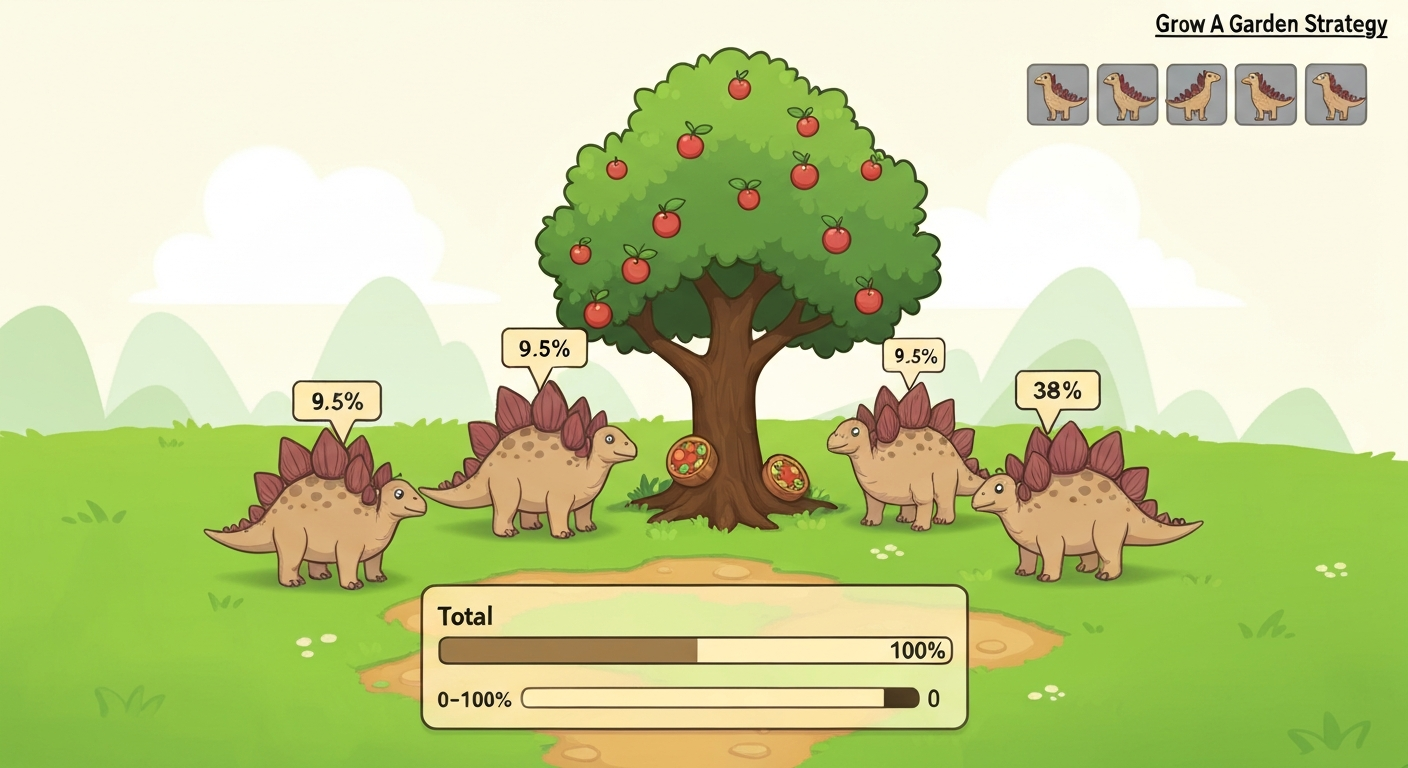
Yes, Stegosaurus does stack in Grow A Garden. For related stacking behavior of other pets, see the internal guide titled 'do Brontosaurus stack in Grow A Garden' for specifics on Brontosaurus stacking. Multiple Stegosauri equipped at the same time each contribute their individual duplication chances, and community calculators model this as a simple additive sum. So if one Stegosaurus gives you roughly a 9.5% chance to duplicate a harvested fruit, equipping two gives you approximately 19%, three gives you around 28.5%, and so on, up to a natural 100% ceiling that no probability can exceed. There is no official developer-published stacking formula, but every independent calculator, datamine, and community consensus treats duplication-chance pets as additively stackable, and that model holds up in large-sample player testing.
Does Stegosaurus Stack in Grow A Garden? Definitive Guide

The definitive answer: does Stegosaurus stack?
To be precise about what 'stacking' means here: each equipped Stegosaurus rolls its duplication passive independently at harvest time. Community datamines show a base duplication chance of approximately 9.5% per Stegosaurus (some fan wikis report ~8%; the in-game tooltip only says 'small chance' without a number). When you have multiple Stegosauri in your pet slots, their chances are summed. This is additive stacking, not multiplicative. That distinction matters a lot for planning: additive stacking gives you linear gains, while multiplicative stacking would give diminishing returns. The community consensus is firmly additive.
There is one important caveat: there is no indexed official developer statement confirming the exact engine-level formula. Everything above comes from community datamines, third-party calculators, and player testing. The numbers are reliable for planning purposes, but if the developers push a balance patch, values can shift without a detailed public changelog. Always verify current base rates against a trusted community calculator before committing significant resources.
How stacking works in Grow A Garden: the core rules
Before diving deeper into Stegosaurus specifically, it helps to understand the general stacking framework the game uses. Grow A Garden distinguishes between a few categories of pet effects, and which category an ability falls into determines how, or whether, duplicates combine.
- Passive proc abilities (like duplication chances): these trigger on a specific game event, such as harvesting a fruit. Multiple pets with the same proc type each roll independently, and their probabilities are summed additively before capping at 100%.
- Same-species stacking: equipping multiple copies of the same pet species (for example, three Stegosauri) is permitted and does combine their passive chances. There is no same-species penalty documented by community sources.
- Same-ability, different species stacking: pets that share a logical ability category — duplication-on-harvest pets like Stegosaurus, Giant Ant, and Cape Buffalo — also stack additively with each other. You are not locked into a single-species approach.
- Global and leader buffs: these apply as separate multipliers on top of the stacked passive chances. A leader with a farm-wide yield bonus does not replace pet passive stacking; it layers on after pet contributions are summed.
- Farm-wide multipliers: crop-type multipliers (for example, buffs that specifically affect Prehistoric-type plants) are applied to the final output, not to the duplication roll itself.
Pet abilities are only active when the pet is equipped in a pet slot, not sitting in your inventory. You start with 3 equip slots and can unlock more through in-game progression. This slot limit is the practical ceiling on how many Stegosauri (or any duplication pets) you can run simultaneously, so slot count is a real constraint when planning a stacking build.
Stegosaurus abilities: exactly what the game gives you
Stegosaurus has two distinct passives, both tied to harvest events. Understanding them separately is important because they apply to different crop pools.
| Ability Name | Trigger | Base Chance (Community Datamine) | Applies To |
|---|---|---|---|
| Prehistoric Doubling | On fruit harvest | ~9.5% (some sources report ~8%) | All harvested fruits |
| Prehistoric Harvester | On fruit harvest | +5 to 6% additional chance on top of Prehistoric Doubling | Prehistoric-type plants only |
The in-game tooltip does not show numbers, it says 'small chance to duplicate harvested fruit' for Prehistoric Doubling and 'increased chance to duplicate harvested prehistoric-type plant' for Prehistoric Harvester. The numeric values above come from community datamines and the widely-used Grow a Garden Calculator's pets. For example, the Grow a Garden Calculator documents its Stegosaurus values on the Stegosaurus | Grow a Garden Wiki (Grow a Garden Calculator), representative community datamine and summary (see also fan wikis and Reddit threads) Stegosaurus | Grow a Garden Wiki (Grow a Garden Calculator) — representative community datamine and summary (see also fan wikis and Reddit threads). js formulas. Because different fan sources report slightly different numbers (8% vs 9.5% base; 5% vs 6% Prehistoric bonus), treat them as approximate. For general planning, use 9.5% base and 6% Prehistoric bonus as the higher-end estimate, and 8% base and 5% bonus as the conservative estimate.
When harvesting a Prehistoric-type plant, both passives combine on the same roll event, effectively giving a single Stegosaurus a combined duplication chance of approximately 14.5% to 15.5% on Prehistoric crops (9.5% + 6% at the high end, or 8% + 5% conservatively). This makes Stegosaurus meaningfully better on Prehistoric farms than on general mixed farms.
Exactly how multiple Stegosauri stack: order, caps, and the formula
Here is the stacking model community calculators use. For each harvest event, the game sums the duplication chance contributions from every equipped pet, then rolls once against that total. The formula looks like this:
- Calculate each equipped Stegosaurus's applicable chance: base duplication chance, plus the Prehistoric Harvester bonus if the harvested crop is Prehistoric-type.
- Sum those individual chances across all active Stegosauri (and any other duplication-class pets you have equipped).
- Apply any relevant global or leader buff multipliers to the output value or yield — these do not alter the duplication roll probability itself.
- Roll against the summed probability. If the roll succeeds, a duplicate of the harvested fruit is created.
- Clamp the summed probability at 100%. A 100% chance guarantees one duplicate per harvest; it does not produce a second additional duplicate.
No official developer documentation confirms whether the game's engine processes these rolls simultaneously or sequentially, but because community calculators assume a single summed roll (not cascading independent rolls), the practical result is additive probability up to 100%. If the engine were running sequential independent rolls, you would occasionally get two duplicates from a single harvest, that behavior has not been consistently reported by the community, which supports the single-summed-roll interpretation.
There is no documented per-species cap that prevents you from equipping, say, five Stegosauri. The only limits are your available pet slots and the natural 100% probability ceiling. Beyond 100%, additional Stegosauri provide zero incremental expected duplicates per harvest.
Edge cases and known bugs worth knowing
A few real issues have been flagged by the community. None have been officially confirmed in indexed patch notes, but they are consistent enough across player reports to take seriously.
The 'zero duplicates with multiple Stegosauri' problem
One of the most common complaints is players equipping four or five Stegosauri and seeing zero duplicates across a short run. One Reddit report described five Stegosauri producing zero duplicates in a single session. This is almost certainly RNG variance, not a bug. At 9.5% per pet, five Stegosauri sum to 47.5%, still less than even odds. In a 20-harvest run, you could statistically go empty-handed roughly 0.5% of the time even at that rate (and much more often if your run is only 10–15 harvests). The lesson: short-run testing is unreliable. You need at least 200+ harvests per configuration to draw meaningful conclusions, and ideally 2,000+.
Pet slot activation delay
Players have reported edge cases where a newly equipped pet does not seem to contribute to the first few harvest rolls after equipping. This appears to be a client-state issue rather than a persistent bug, reloading the session typically resolves it. If you swap pets mid-farm, give it a moment and harvest once before trusting the new configuration is fully active.
Prehistoric Harvester not triggering on reclassified crops
Some players report that the Prehistoric Harvester bonus does not appear to apply to certain crops they expected to be Prehistoric-type. This is likely a crop classification issue, not every visually 'ancient-looking' crop is tagged as Prehistoric in the game's data. Verify your target crop's type in a community wiki before building a Prehistoric-stacking farm around it.
Workaround for suspected activation issues
- Fully close and reopen the game session after equipping new pets, especially if swapping in multiple Stegosauri at once.
- Harvest 3 to 5 fruits as a 'warm-up' before recording data — this avoids any activation-delay window.
- If duplication seems completely absent, unequip and re-equip the pets to force a fresh state registration.
- Check that all Stegosauri are in equipped slots, not inventory — ability passives do not activate from inventory.
Worked examples: 1 to 4 Stegosauri on real farms
Let's run the numbers on a few common setups. I'll use 9.5% base per Stegosaurus and 6% Prehistoric bonus as the working values (high-end community datamine). For non-Prehistoric crops, only the 9.5% base applies per pet.
Setup A: mixed-crop farm, no Prehistoric specialization
| Number of Stegosauri | Summed Duplication Chance | Expected Duplicates per 100 Harvests | Expected Duplicates per 500 Harvests |
|---|---|---|---|
| 1 | 9.5% | ~9.5 | ~47.5 |
| 2 | 19.0% | ~19 | ~95 |
| 3 | 28.5% | ~28.5 | ~142.5 |
| 4 | 38.0% | ~38 | ~190 |
Setup B: Prehistoric-type crop farm
| Number of Stegosauri | Summed Duplication Chance (Base + Prehistoric) | Expected Duplicates per 100 Harvests | Expected Duplicates per 500 Harvests |
|---|---|---|---|
| 1 | 15.5% (9.5% + 6%) | ~15.5 | ~77.5 |
| 2 | 31.0% | ~31 | ~155 |
| 3 | 46.5% | ~46.5 | ~232.5 |
| 4 | 62.0% | ~62 | ~310 |
A quick worked calculation for three Stegosauri on a Prehistoric farm: each pet contributes 9.5% base plus 6% Prehistoric bonus, totaling 15.5%. Three pets: 15.5 x 3 = 46.5%. Over 200 harvests, you expect approximately 93 duplicated fruits. That effectively means nearly half your harvests produce a bonus fruit, which is a significant yield gain on a high-value Prehistoric crop. At conservative estimates (8% + 5% = 13% per pet), three pets still reach 39%, giving about 78 duplicates per 200 harvests.
To hit the 100% cap on a Prehistoric farm, you would need approximately 7 Stegosauri (7 x 15.5% = 108.5%, effectively capped at 100%). On a mixed farm without the Prehistoric bonus, you need 11 Stegosauri to reach 100% (11 x 9.5% = 104.5%). Both scenarios exceed a standard expanded pet slot count, so in practice you are unlikely to hit the cap with Stegosaurus alone. Mixing in other duplication pets like blank" rel="noopener noreferrer">Giant Ants or Cape Buffalo can get you there faster.
How Stegosaurus interacts with global buffs, leader effects, and farm multipliers
Stegosaurus's duplication passive interacts with the rest of your farm's buff stack in a layered way. Understanding the order of operations prevents double-counting or missed optimizations.
- Leader yield multipliers: a leader ability that boosts overall farm yield (for example, a percentage bonus to crop output) applies to the harvested quantity after the duplication roll resolves. If a duplicate is produced and you have a 20% yield leader buff, both the original and the duplicate fruit benefit from that multiplier. This synergy is multiplicative in effect.
- Global event buffs: during timed events that boost specific crop types, the duplication chance itself is not changed — Stegosaurus still rolls at its base rate. But the value of each duplicated fruit increases, which raises the effective ROI of stacking Stegosauri during events.
- Farm-wide crop multipliers (mutations, fertilizers): these affect crop value and quantity but operate independently of the duplication roll. A high-mutation Prehistoric crop duplicated by Stegosaurus will carry its mutation bonuses into the duplicate, making high-mutation setups especially synergistic.
- Other duplication pets: Giant Ants, Cape Buffalo, and similar pets add their own duplication chances on top of Stegosaurus's contribution, all summed additively. Mixing species to build toward the 100% cap is a valid strategy.
The most important takeaway is that global buffs amplify the value of each duplicated crop but do not change the probability of duplication. So maximizing your duplication rate (through more pets) and maximizing the value of what gets duplicated (through mutations, event timing, and leader buffs) are parallel optimization tracks that compound each other.
Stegosaurus vs. other duplication pets: which to stack and when
Stegosaurus is not the only duplication-class pet, and for players optimizing a duplication-focused build, understanding how it compares to alternatives is essential. Giant Ants, Cape Buffalo, and Gorilla Chef all have overlapping or competing value in different setups.
| Pet | Duplication Type | Approx. Base Chance | Best Farm Use | Notable Strength |
|---|---|---|---|---|
| Stegosaurus | All fruits + Prehistoric bonus | ~9.5% base, +6% for Prehistoric | Prehistoric crop farms | Dual-passive advantage on Prehistoric types |
| Giant Ant | All harvested fruits | Community-documented (varies by source) | General mixed farms | No crop-type restriction; broad applicability |
| Cape Buffalo | All harvested fruits | Community-documented (varies by source) | General or event farms | Combines additively with any duplication pets |
| Gorilla Chef | Cooking/processed output (different mechanic) | N/A for raw duplication | Processing-focused farms | Different mechanic; not a direct duplication stacker |
If your farm is Prehistoric-focused, Stegosaurus is the clear top pick because its dual passive gives it roughly 63% more expected duplications per pet on Prehistoric crops compared to its own base rate. For a general mixed farm, Giant Ants compete directly, the effective difference depends on which pet has the higher base rate in the current game version, which can shift with updates. A mixed build (some Stegosauri plus some Giant Ants) is a practical way to reach the 100% cap faster while keeping flexibility. Gorilla Chef operates on a different mechanic entirely and is not a substitute for harvest-time duplication. For details on Gorilla Chef's mechanics and whether it stacks, see does gorilla chef stack in Grow A Garden.
Pack Bees also come up in duplication-adjacent conversations, but their mechanics focus on different harvest interactions rather than direct fruit duplication. If you are building purely toward maximum duplication probability, Pack Bees are not a direct slot competitor with Stegosaurus.
Breeding, egg value, and ROI: how many Stegosauri to actually breed
Knowing that Stegosaurus stacks is one thing; knowing how many to breed and when to stop is where most players lose value. Here is how to think through the ROI question.
How many Stegosauri make sense per slot count
Your pet slot count is the hard ceiling. If you have 3 slots and dedicate all three to Stegosaurus on a Prehistoric farm, you are running at approximately 46.5% duplication chance, that is excellent value and likely worth the full slot commitment if Prehistoric crops are your primary income source. If you have 5 or 6 slots, filling them all with Stegosauri on a Prehistoric farm starts pushing toward or past 90%+ duplication chance, where each additional slot's marginal gain shrinks. At that point, using the last slot for a leader-synergy pet or a mutation-boosting pet may return more total value than the incremental duplication chance.
Time-to-profit and egg value
Stegosaurus eggs are event-tied, which means their value is highest during Prehistoric-themed events when Prehistoric crops are active and more widely farmed. Outside of those events, a Stegosaurus's Prehistoric Harvester bonus is less relevant, and the base 9.5% duplication chance faces direct competition from other duplication pets. Breeding multiple Stegosauri specifically for stacking makes the most sense in the window before or during a Prehistoric event. Breeding them outside of that context to hold long-term is viable only if you regularly run Prehistoric crop setups.
When not to stack Stegosauri
- When your farm does not grow Prehistoric-type crops: the Prehistoric Harvester bonus is wasted, and you are paying the egg cost for a pet that only delivers its 9.5% base rate, where a Giant Ant or Cape Buffalo might be equally or more effective.
- When you are close to the 100% duplication cap from other pets: additional Stegosauri past the cap add nothing to expected duplicates per harvest.
- When pet slot opportunity cost is high: if a leader-effect pet or a mutation-amplifying pet would add more total farm value than an incremental 9.5% to 15.5% duplication chance, the Stegosaurus slot is not the optimal spend.
- During non-Prehistoric events: if the active event buffs a crop type where Stegosaurus has no type-bonus advantage, a farm-specialized duplication pet (if one exists for that event type) will outperform Stegosaurus per slot.
- Very early game with limited slots: with only 3 slots, reserving at least one for a high-value leader pet is often better than going all-in on Stegosaurus stacking.
A practical breeding target
For most Prehistoric-focused players, breeding 2 to 3 Stegosauri is the practical sweet spot. Two pets gives you 31% duplication chance on Prehistoric crops (nearly 1-in-3 harvests duplicated), which is already strong. A third pet bumps that to 46.5%, giving close to half your harvests a duplicate. Beyond three, the marginal gain per additional pet is 15.5%, which is still meaningful but increasingly competes with other high-value pet options for your remaining slots. Breed a fourth only if you have 5+ slots and are running a dedicated Prehistoric farm during an active event.
How to test this yourself: a reproducible methodology
Because no official developer stacking specification is publicly indexed, the only way to fully verify current values is controlled in-game testing. Here is a method that produces statistically meaningful results and avoids the common mistake of drawing conclusions from small samples.
- Prepare a controlled account with a documented pet slot count. Record every active pet and all global/leader/farm buffs before each trial — any change in buffs between trials invalidates the comparison.
- Choose a single high-value Prehistoric crop as your test crop. Grow it in consistent conditions (same soil, same fertilizer) across all trials.
- Run four configurations: (A) no duplication pets, (B) 1 Stegosaurus, (C) 3 Stegosauri, (D) 3 Stegosauri plus 1 Giant Ant or Cape Buffalo.
- For each configuration, harvest at least 200 fruits. Record every harvest: timestamp, crop name, whether a duplicate occurred. Aim for 2,000+ harvests per configuration if you want tight confidence intervals.
- Calculate empirical duplicate rate: (number of duplicated harvests) divided by (total harvests). Compare to the predicted additive model. If your empirical rates track the additive formula within normal RNG variance, the model is confirmed for your current game version.
- If you observe a systematic shortfall (empirical rate consistently below predicted even at 500+ harvests), investigate whether a recent patch changed base values or whether a specific bug is affecting your setup.
The single most important discipline in this testing is sample size. A 20-harvest run tells you almost nothing useful about a 10–15% chance event. A player running five Stegosauri and seeing zero duplicates in 20 harvests is experiencing completely normal variance, not a bug. Run the numbers: at 47.5% chance per harvest, the probability of zero duplicates in 20 harvests is (0.525)^20, which is approximately 0.0046%, extremely rare but not impossible. At smaller sample sizes with lower individual pet counts, zero-duplicate runs are much more probable and entirely expected.
FAQ
TL;DR — does Stegosaurus stack in Grow A Garden and should I stack them for farming/breeding?
Yes — community datamines, calculators, and repeated player tests treat Stegosaurus’ duplicate-on-harvest ability as stackable with other duplicate pets. Practically, community tools model stacking additively (sum the individual duplicate chances) and then interpret the result as the overall per-harvest duplicate probability (clamped at 100%). However, there is no indexed official developer specification published; community numeric values vary (typical community estimates: ~8–9.5% base duplicate chance for Stegosaurus plus an extra ~5–6% when harvesting Prehistoric-type fruits). Recommendation: stack duplicate pets (including Stegosaurus) when you need higher expected duplicate yields for a specific high-value crop, but treat stacking as probabilistic (not guaranteed) and prioritize mixing highest-quality duplicate pets you own rather than mass-breeding a single pet unless your ROI and egg supply justify it.
What exact stacking rule do community sources use for duplicate-on-harvest pets (additive, multiplicative, or highest-only)?
Community datamines, calculators, and most player guides model duplicate-on-harvest pet effects additively: take each equipped pet’s duplicate chance for that harvest (numerical values come from datamines/community calculators), sum them, and treat the sum as the total per-harvest duplication probability (then clamp at 100%). This is the commonly used community interpretation; no official engine-level confirmation was found. Several independent community calculators and guides use this additive model when projecting expected duplicates.
How and when is Stegosaurus’ duplication ability applied (order-of-application and trigger moment)?
Community documentation and pet pages describe the ability as a passive that rolls at the moment of harvest (proc-on-harvest). Order-of-application for stacking is effectively simultaneous for duplicate-chance pets: the combined probability is computed for that harvest. Interactions with other buffs (global/leader/farm) generally do not change whether the duplicate roll happens — they affect yield or crop value separately. Because there is no official engine spec, exact internal order (e.g., whether buffs modify base chance before summing) is not documented; community practice assumes buffs do not alter the numeric duplicate chance of pet abilities (pets’ duplicate chances are properties of the pets themselves).
What numeric values should I use for Stegosaurus’ duplicate chance when doing calculations?
There is no single canonical in-game numeric tooltip. Community datamines and calculators commonly report Stegosaurus base duplicate chances in the ~8%–9.5% range and an additional Prehistoric-type bonus of ~5%–6% for prehistoric fruits. Use a conservative range for planning (base 8–9.5% + prehistoric bonus 5–6% on applicable crops). If you need exact numbers for ROI calculations, pick a single source (e.g., growagardencalculator.com lists ~9.5% + 6%) and state that you are using that datamined value; be explicit that other community pages report slightly different figures.
How do multiple Stegosauri change expected duplicate output — worked numerical examples?
Using community-typical numbers (base 9.5% per Stegosaurus; +6% if the fruit is Prehistoric): Example A — non-Prehistoric fruit with N Stegosauri (each 9.5%): N=1 → duplicate chance = 9.5% N=2 → 19.0% N=3 → 28.5% N=6 → 57.0% N=11 → 104.5%, clamped to 100% (guaranteed duplicate) Example B — Prehistoric fruit: per-Stego = 9.5% + 6% = 15.5% N=1 → 15.5% N=3 → 46.5% N=5 → 77.5% N=7 → 108.5% → clamped to 100% Note: the community-additive model assumes independence by summation; expected duplicate rate = min(100%, sum of individual chances). Expected number of items per harvest = 1 + duplicate_probability (because duplicate creates one extra fruit). Use large sample sizes when testing due to RNG variance.
Are there caps, special edge cases, or known bugs for Stegosaurus stacking?
Caps: probability cannot exceed 100% — community calculators clamp summed probabilities to 100% (no in‑game doc contradicting this). Edge cases/known community-reported issues: (1) RNG noise — players sometimes observe long runs with few duplicates despite stacking because probability is still stochastic. (2) Timing/cooldown or UI-timing reports — some players report apparent misses or timing inconsistencies, but no indexed official patch note documents a stacking bug for Stegosaurus. (3) No authoritative engine-level details found — some subtle interactions (e.g., whether leader/global buffs modify pet chances) are unconfirmed; community convention treats buffs as unrelated to pet duplicate chance. Because of these uncertainties, verify with controlled tests for critical decisions.
Do Pack Bees Stack to Grow a Garden? Quick Guide
Learn if Pack Bees can stack to boost garden growth, setup steps, limits, efficiency, and how to verify results fast.