
SEO Title: Chicken Zombie vs Dragonfly in Grow a Garden: Full Comparison, Breeding Guide & Stats | Meta Description: Compare Chicken Zombie vs Dragonfly in Grow a Garden. Dragonfly | Pets | Grow a Garden (fan database) notes that Ability mechanics fields available in public community pet pages (i.e., what in-game 'stats' exist for pets): common documented fields are hunger, rarity tier, ability description, ability cooldown, egg/hatch sources and hatch chance, 'huge' chance; Grow a Garden fan databases & pet pages are the primary place community reporters extract these values. Get full stats, egg sources, breeding odds, habitat tips, and a head-to-head verdict in one guide.
Chicken Zombie vs Dragonfly, Grow A Garden Complete Guide

Julian Russo
25 Jul 2026
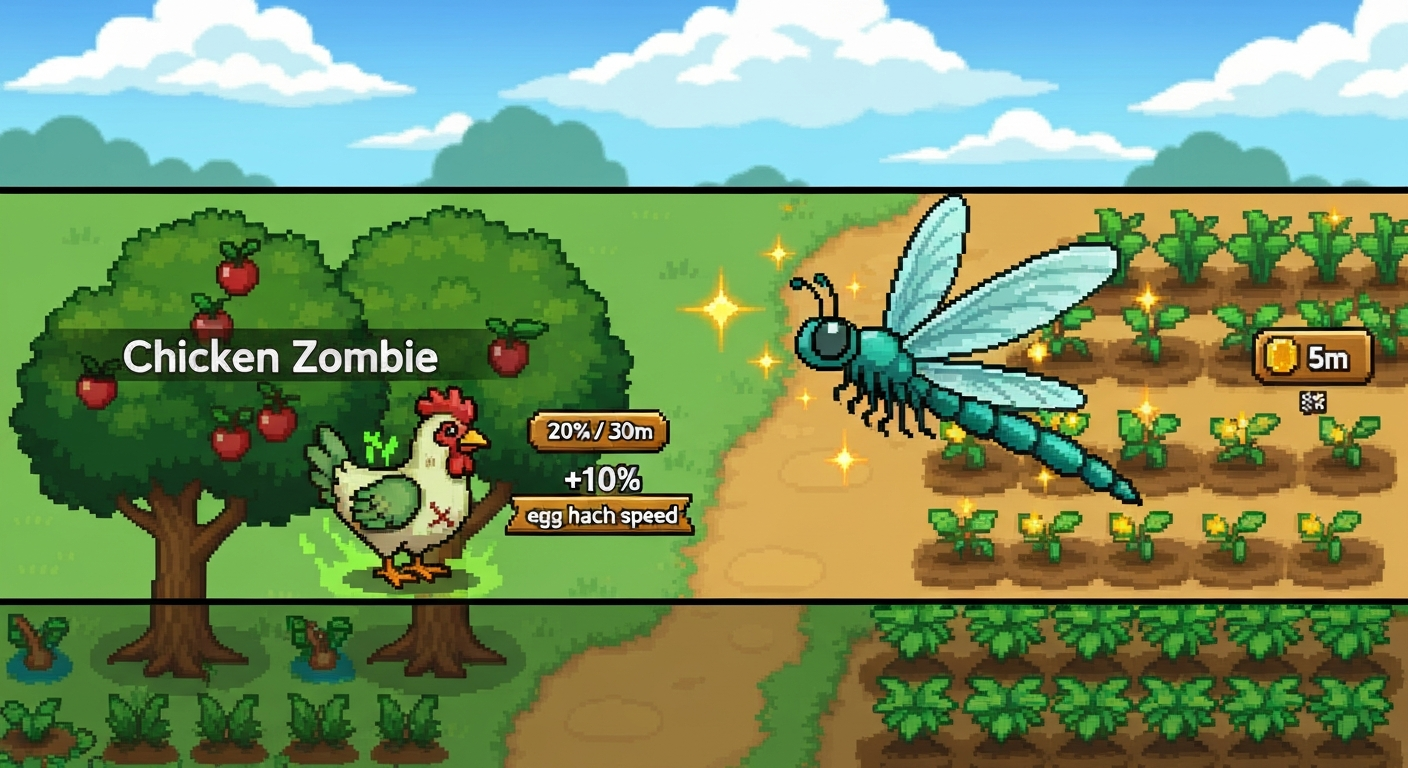
Dragonfly wins on active income potential if you can get it. Every 5 minutes it converts a random crop to Gold, which multiplies sell value by 20x. That passive alone can reshape your farm's output. Chicken Zombie, by contrast, is a mythic-tier event pet that is flat-out unobtainable today outside of trading, and its passive (20% chance every 30 minutes to zombify a nearby fruit) is meaningful but slower and less lucrative than Gold conversion. If you are optimizing a mid-to-hardcore farm right now, Dragonfly is the realistic target to chase. Chicken Zombie is a collector's piece with real utility, not a farming backbone you can build around from scratch.
Head-to-Head Verdict: Which One Actually Matters for Your Farm?
These two pets occupy completely different roles in the current meta. Dragonfly is a Divine rarity pet hatched from the Bug Egg pool with a 1% hatch chance (community-compiled rate, not developer-published). Its Gold crop conversion fires every 5 minutes, making it one of the most consistent passive income tools available to active players right now. Chicken Zombie is a Mythical rarity pet from the Blood Moon Event (Update 1.06.0, May 17, 2025). It was handed to players who were present during that event and has been unobtainable through normal hatching ever since. Its passive zombifies nearby fruit with a 20% chance every 30 minutes and also grants a flat +10% egg hatch speed bonus. The verdict: Dragonfly is the farm-optimization pick for players building a productive setup today. Chicken Zombie is a trophy pet with genuine secondary utility, best treated as a bonus if you already own one, not a target worth spending eggs on, because you cannot hatch it.
At-a-Glance Comparison: Chicken Zombie vs Dragonfly
| Attribute | Chicken Zombie | Dragonfly |
|---|---|---|
| Rarity | Mythical | Divine |
| Hatch Source | Event-only (Blood Moon, Update 1.06.0); unobtainable by egg | Bug Egg (introduced Update 1.22.0, Sept 6, 2025) |
| Hatch Chance | N/A (not in any egg pool) | ~1% from Bug Egg (community-compiled; developer-opaque) |
| Hunger Stat | 35,000 | ~100,000 |
| Core Ability | 20% chance every 30 min to Zombify a nearby fruit | Converts one random crop to Gold variant every ~5 min |
| Bonus Ability | +10% egg hatch speed | None documented |
| Combat Role | None documented | None documented |
| Income Impact | Moderate (Zombify adds mutation value) | High (Gold = 20x sell value multiplier per converted crop) |
| Obtainability | Trade only; extremely rare | Farmable via Bug Eggs (time-intensive but possible) |
| Habitat Upkeep | Low hunger requirement (35,000) | High hunger requirement (~100,000) |
Combat Performance
Neither Chicken Zombie nor Dragonfly are combat-focused pets in Grow a Garden. The game's pet system is designed around farm utility and passive production boosts, not direct combat stats. Chicken Zombie has no documented combat ability, and Dragonfly's kit is entirely centered on crop mutation. If you are evaluating these two specifically for a combat-oriented slot, neither is the correct choice. Their value is entirely economic and passive. Keep this in mind when slotting pets for different farm configurations.
Income, Production, and Utility
This is where Dragonfly pulls ahead in practical farming. The Gold crop mutation multiplies a crop's sell value by 20x. With a 5-minute cooldown, you can see multiple Gold conversions per active session. If you are growing high-base-value crops, the math compounds quickly. For example, a crop worth 1,000 coins base becomes 20,000 after a Gold conversion. Over a 30-minute session, Dragonfly fires roughly 6 times, each hitting a random crop. The randomness is a limitation, but across a dense garden it consistently converts something valuable.
One important rule to know: Gold, Silver, and Rainbow are mutually exclusive variant layers. A crop can only hold one of these at a time, so Dragonfly's Gold conversion will replace an existing Silver or Rainbow if it lands on that crop. Plan your garden's mutation stack with this in mind. If you are running a Rainbow-focused strategy, Dragonfly can actually conflict with your setup. In that case, you would want Dragonfly active during a harvest cycle where Gold is your target tier, not Rainbow.
Chicken Zombie's Zombify passive is less understood by the wider community but adds a mutation layer to nearby fruit every 30 minutes at a 20% trigger chance. That rate is slower and less reliable than Dragonfly's Gold conversion. Its biggest practical bonus may actually be the +10% egg hatch speed, which indirectly accelerates your breeding pipeline regardless of what eggs you are running. For players grinding Bug Eggs specifically, that 10% speed bump has a compounding effect over many egg cycles.
Rarity, Tiers, and How to Get Each Pet
Chicken Zombie sits at Mythical rarity and is a direct artifact of the Blood Moon Event tied to Update 1.06.0 on May 17, 2025. It was never placed in an egg pool. If you did not own one at the time, your only path to it is player-to-player trading, and given how few circulate, the trade cost is steep. There is no legitimate way to hatch one.
Dragonfly is Divine rarity, which is high but still obtainable through the Bug Egg system introduced in Update 1.22.0 on September 6, 2025. The community-compiled hatch table for Bug Egg puts Dragonfly at 1%. This rate comes from aggregated community data across hundreds of egg openings and is not the developer's published internal weight. Treat it as a reliable estimate, not a guaranteed figure. The other pets in the Bug Egg pool are Caterpillar (40%), Snail (30%), Giant Ant (25%), and Praying Mantis (4%), which means Dragonfly sits at the bottom of the probability table.
Habitat Needs and Upkeep
Hunger is the practical upkeep cost for any pet, and these two are significantly different. Chicken Zombie has a hunger stat of 35,000, which is on the lower end for a Mythical pet. Dragonfly sits at approximately 100,000 hunger, nearly three times higher. If you are running multiple high-hunger pets simultaneously, Dragonfly will drain your feeding resources faster than most alternatives. Budget your feeding strategy accordingly. For players who are newer to pet management, prioritize keeping Dragonfly fed consistently since its ability is time-gated and a hungry, inactive Dragonfly loses you Gold conversions that do not retroactively trigger.
Neither pet requires a special biome or habitat tile beyond standard pet plot placement. Both work on normal plots, so there is no additional infrastructure cost beyond feeding.
Dragonfly Breeding Basics: Bug Eggs and How to Get One
Dragonfly comes exclusively from the Bug Egg. Grow A Garden Update Log, GAG Database (fan archive) lists the Blood Moon Event (Update 1.06.0) on May 17, 2025 and the Bug Egg addition (Update 1.22.0) on Sept 6, 2025 blank" rel="noopener noreferrer">Grow A Garden Update Log — GAG Database (fan archive). There is no other documented hatch source. The Bug Egg was added in Update 1.22.0 and has an 8-hour hatch timer. Importantly, the community has confirmed through testing that egg timers count down while you are offline, so you do not need to sit in-game for those 8 hours. Place your Bug Egg on a plot before logging off and it will continue counting down in the background.
Since Dragonfly has a community-estimated 1% hatch rate from Bug Egg, you should plan for a long grind. Statistically, at 1%, you would expect to open roughly 100 Bug Eggs before getting one, though variance means you could get lucky on egg 20 or still be unlocking at egg 200. These odds are developer-opaque and the community flags them as potentially disputed between sources. Do not treat the 1% figure as a guaranteed exact number, but do use it as a planning baseline.
Bug Egg Hatch Table (Community-Compiled)
| Pet | Estimated Hatch Rate | Rarity |
|---|---|---|
| Caterpillar | ~40% | Common |
| Snail | ~30% | Uncommon |
| Giant Ant | ~25% | Rare |
| Praying Mantis | ~4% | Epic |
| Dragonfly | ~1% | Divine |
Note: these rates are community-aggregated estimates, not developer-published values. The internal weighted pool has not been officially disclosed. Cross-check against current community databases before making major farming decisions, as rates can shift with patches.
Step-by-Step: Grinding Bug Eggs for Dragonfly
- Acquire Bug Eggs from their in-game drop source and stockpile as many as you can before starting a hatching session.
- Place each Bug Egg on an available pet plot. The 8-hour timer begins immediately and counts down whether you are online or offline.
- Log back in after 8 hours to collect your hatch. You do not need to be active during the timer.
- If you own a Chicken Zombie, place it on a nearby plot before starting your hatching session. Its +10% egg hatch speed bonus applies passively and will shave time off the 8-hour cycle across many eggs.
- Record your results. Given the 1% estimated rate, tracking your hatch count helps you gauge whether you are within expected variance or whether community rate data has been patched.
- Repeat. Expect to open a large number of Bug Eggs. Budget your resources accordingly and do not expect Dragonfly on your first few attempts.
If you want to dig further into how many Bug Eggs you are likely to need and how the egg mechanics work in detail, the community maintains dedicated guides on egg drop sources and hatch mechanics that are worth reading alongside this comparison. See our focused guide on how many Bug Eggs to get Dragonfly in Grow a Garden for detailed estimates and grind strategies.
How Many Dragonflies Exist and How to Track Your Own
Dragonfly is not a limited-edition or event-only pet, so in theory the total number in circulation grows over time as players open Bug Eggs. There is no developer-published cap on how many can exist. That said, at 1% hatch odds from a time-gated 8-hour egg, Dragonfly remains genuinely rare in practice. The community does not have a reliable public count of total Dragonflies in circulation because the game does not publish this data. For community-tracked totals and ongoing discussion about how many Dragonflies exist in Grow a Garden, see the dedicated tracker page titled "how many dragonflies exist in grow a garden.".
To verify how many Dragonflies you personally own, check your pet inventory directly in-game. If you have experienced inventory desync or traded recently and are unsure whether a Dragonfly transferred correctly, the recommended troubleshooting step is to fully reload your game session and verify your pet slot count. Multiple community reports have flagged cases where Dragonfly appeared to vanish during or after a trade. If yours disappears, the first step is a fresh login. If the pet is genuinely missing after a reload, document your user ID, the approximate time of loss, and any relevant screenshots, then report through the Official Discord, which is the developer-designated support channel listed at playgrow. For step-by-step troubleshooting and reporting advice, see the community guide titled why did my dragonfly disappear in grow a garden which covers common causes and how to escalate missing-pet issues. io.
A community patch summary from the Fall Market update period documented a fix specifically labeled as addressing a 'dragonfly bug.' If you lost a Dragonfly during that window, check whether the patch resolved your issue before submitting a new report. Always verify you are on the current game version before troubleshooting disappearance issues.
Dragonfly Sprite Reference for Fan Art and Visual Guides
If you are looking for a sprite reference, community wikis and fan databases host the official infobox images for both Dragonfly and Chicken Zombie. The Dragonfly sprite shows the characteristic four-wing silhouette with a segmented body, rendered in the game's pixelated style. For fan art, the key identifying features are the two pairs of symmetrical wings (roughly equal in size, upper pair slightly larger), the elongated body, and the compound eye detail. For a step-by-step tutorial and downloadable reference you can follow, see how to draw a dragonfly from Grow a Garden. The Chicken Zombie sprite layers zombie visual cues (discolored feathers, green tint) over the standard chicken model.
Before reusing any sprite images from fan wikis or databases in your own content, check the attribution and permission notes on those pages. Community wikis vary in their licensing rules, and some sprite assets are considered the developer's intellectual property. For purely personal fan art, referencing the sprite as a visual guide is standard practice in the Grow a Garden community.
Bottom Line: Should You Chase Dragonfly or Chicken Zombie?
If you are building a farm right now and want the better income-generating pet between these two, Dragonfly is the correct answer. Its 5-minute Gold conversion cycle at 20x sell value is one of the strongest passive abilities in the current pet roster, and it is actually obtainable through Bug Egg grinding. Yes, 1% odds mean a long grind, but there is a real path to owning one. Chicken Zombie is a better overall pet in some respects, including its rare Mythical status and the hatch speed bonus that benefits any egg pipeline, but it is locked behind a closed event with no current rerun date. Chasing it on the trade market is expensive and uncertain.
The practical recommendation: start stacking Bug Eggs and grinding toward Dragonfly while using whatever pets you have for farm coverage. If Chicken Zombie ever returns in a future event, it is absolutely worth prioritizing. Until then, your time and resources are better spent on the Bug Egg pipeline.
FAQ
What specific data, sources, and step-by-step research process do I need to create a complete, data-focused "chicken zombie vs dragonfly grow a garden" comparison and Dragonfly breeding guide (including odds, troubleshooting, variants, sprites, and SEO elements)?
Summary checklist (high level) - Collect authoritative in-game fields for both pets (hunger, rarity/tier, ability text, cooldowns, hatch sources and listed hatch chance, any secondary/passive effects). - Gather community-aggregated hatch data and egg-pool tables; mark any exact weights or internal selection logic as developer-opaque when not published. - Run controlled breeding/hatch trials for Bug Eggs with full logging (timestamp, egg type, booster/consumables, player boosters, outcome) to produce empirical probabilities and confidence intervals. - Build a side-by-side mechanics/stat table (combat/use-case, income/production, passive effects, mutation interaction, habitat/plot requirements, upkeep costs). - Produce step-by-step breeding recipes and sequences (recommended pairs, expected attempts, best practices for boosting odds) and label any nondisclosed odds as developer-opaque. - Reproduce and document disappearance/desync cases with full reproduction steps and required logs; gather official reporting channels and developer confirmation of fixes. - Catalog variants and owned verification methods (in-game collection screen, inventory IDs, trade history); collect sprite assets and provide a short in-game/fan-art draw guide with image placeholders and attribution. - Create SEO assets: clear, keyword-focused title and ≤160-character meta description; internal links to relevant Grow A Garden resources (breeding guide, egg mechanics, tier list). Required raw data points and why (explicit list) 1) Pet stat fields (both pets) - hunger, rarity/tier, ability description, ability cooldown, hatch chance as listed, egg sources, 'huge' or special flags. - Why: primary comparison matrix and in-game performance math (upkeep, slot value, time-to-utility). - Source: official pet pages (fan DBs that mirror in-game fields) and community databases. Mark as primary. 2) Ability mechanics and concrete in-game effects - E.g., Dragonfly: ability (turns one crop Gold ≈ every 5 minutes) and listed Hatch Chance = 1. Chicken Zombie: passive zombify chance, +egg hatch speed. Confirm cooldown wording and any distance/area conditions. - Why: determines meta role (income multiplier vs passive event). - Source: pet pages, patch notes, community testing posts. 3) Crop mutation math and stacking rules - Gold multiplier (×20), Rainbow (×50), mutual exclusivity rules. - Why: compute economic value of Dragonfly’s Gold conversion vs Chicken Zombie zombify effect. - Source: mutation pages/calculators and community-tested calculators. 4) Egg pool tables and hatch-rate aggregates for Bug Egg - Community-compiled drop table (Caterpillar 40%, Snail 30%, Giant Ant 25%, Praying Mantis 4%, Dragonfly 1%) and Bug Egg parameters (8h timer). Mark as community-derived and developer-opaque where necessary. - Why: to provide realistic breeding/egg expectations and probability notes. - Source: GAGdata, community hatching trackers; note developer has not published exact internal weights. 5) Empirical hatch data (your own or community-collected) - Run/have access to N≥500 Bug Egg openings (or aggregate community pool) to estimate 1% with margin-of-error; record boosters, boosters timings, and whether offline timers ran. - Why: confirm or challenge community numbers and report confidence intervals. - Method: controlled tabulation (CSV) with metadata (player ID anonymized, software version, boosters used, timestamps). 6) Breeding combos and recommended workflows - Which breeding pairs to attempt (best-known combinations in community guides), recommended use of boosters, incubator placement, and timing sequences. - Step-by-step sequences with expected attempts—include probability math (geometric distribution for repeated Bug Egg attempts) and explicit note of undisclosed odds. - Why: for actionable player guidance. 7) Disappearance / bug reproduction data - Collect logs/screenshots of inventory before/after trades, timestamps, trade IDs, server region, steps to reproduce. - Reproduce where possible: trade, relog, move pets between stables, sell, etc., and record outcomes. - Why: to provide troubleshooting, reporting templates, and to identify patterns (sync, trade edge-cases). - Source: Reddit/Discord reports, patch notes, official support channels. Use official Discord and support form for bug reports. 8) Variant catalog and verification methods - Full list of Dragonfly variants (base, shiny/huge/divine, seasonal recolors) and how to confirm ownership: pet collection UI, item IDs, trade history, account inventory export if available. - Why: players need to audit their collections and verify duplicates. 9) Sprite & visual references - Capture in-game sprite frames, infobox images, egg UI screenshots, and breeding combo UI images (placeholders if you cannot embed official art). Record attribution and permission for reuse. - Provide a short step-by-step "how to draw a Dragonfly" in pixel-sprite terms (color palette, frame count, wing shapes, typical poses). 10) Patch history and official statements - Collect update logs proving when Chicken Zombie and Bug Egg/Dragonfly were introduced and any patch notes that fixed the Dragonfly disappearance bug. - Why: provenance, unobtainable status, and to support rarity claims. 11) Community consensus & dispute flags - Gather contradictory sources and flag disputed values (e.g., some trackers list slightly different Bug Egg weights). Always mark them developer-opaque when internal weights are not public. Data sources to consult (ordered priority) - Official support/contact: Grow a Garden official site (playgrow.io) — for bug reporting and canonical support guidance (authority Tier1). - Official/Dev release notes & Discord — authoritative confirmations of introduced pets and bug fixes; use to mark developer-confirmed info. - Fan databases and community trackers (GAGdata, Grow a Garden Wiki, Fandom, fan calculators) — primary place to collect pet fields, community-aggregated hatch rates, sprite images (Tier2 sources). Cite them and mark opinions/aggregates as community-derived. - Community reproducibility threads (Reddit, Discord logs) — for disappearance reports and reproduction steps (mark as anecdotal unless reproducible). - Patch roundups / community news sites (RoCodes, fan blogs) — secondary confirmation of fixes and event history. Step-by-step research & testing methodology (detailed protocol) 1) Baseline capture - Record current app version, platform, account ID (anonymized for public posting), and in-game pet pages screenshots for Chicken Zombie and Dragonfly. 2) Verify listed pet fields - Pull the pet stat fields from fan DBs and in-game UI; copy exact wording for abilities and cooldowns. Note differences between sources. 3) Egg-pool audit - Compile all community-reported Bug Egg outcomes into a master CSV (columns: timestamp, player, egg_type, boosters, outcome, client_version). - If you cannot access community logs, plan and run your own opening campaign. 4) Controlled hatch trial (recommended minimal sample sizes) - Aim for N≥500 Bug Eggs opened (community-aggregate acceptable if you clearly describe aggregation). For rare outcomes (~1%), N≥500 gives a rough estimate; N≥2000 is better for tighter CIs. - Record any boosters (e.g., Golden Egg, hatch boosters), whether eggs hatched online or progressed offline, and full metadata. - Compute point estimates and 95% confidence intervals for Dragonfly and other bug pet rates. 5) Breeding sequence testing - Execute recommended breeding pairs from community guides in controlled batches (e.g., 50 attempts per pairing). Log results and compute empirical success per pairing. - If Bug Egg is the only source, test methods to obtain Bug Eggs reliably (events, market, breeding combos) and document expected throughput per day. 6) Ability-economic modeling - Use mutation multipliers (Gold ×20) and Dragonfly cooldown (~5 minutes) to compute expected additional gold income per hour on a representative garden (e.g., 100 crop beds, average base sell price). Compare against Chicken Zombie zombify expected value (20% chance every 30 min to zombify a nearby fruit) to compute expected marginal value per hour. - Present both absolute value and use-case (e.g., gold-farming vs passive prestige/event farming). 7) Disappearance reproduction & reporting - Reproduce common workflows that users reported (trade, move to stable, relog in different region) with Dragonfly present; document any desync or loss. - If you reproduce loss, immediately collect logs, screenshots, and create a step-by-step bug report to post on official Discord and submit via playgrow.io support with timestamps and trade IDs. 8) Variant cataloging - Scrape collection UI and community lists for all known Dragonfly variants. Cross-check with patch notes for seasonal/limited variants. 9) Sprite capture & art guide - Capture the in-game sprite frames at native resolution. If you cannot include official assets, create a fan-pixel guide: palette (hex values), frame count (wings: 4 frames typical), dimensions (e.g., 64×64), and basic drawing steps. 10) Documentation & presentation - Build tables: quick stat comparison, egg pool summary, breeding sequence steps. Include placeholders for screenshots (sprite, egg UI, breeding combo). - Clearly label any developer-opaque values and annotate probability notes. Probability and statistical notes to include in the article - Mark any exact inside-weights as developer-opaque if not published by the developers. - For community-derived hatch rates (e.g., Dragonfly ≈1% from Bug Egg), state sample sizes and 95% confidence intervals from your trials or aggregate data. Example phrasing: "Observed rate: 1.03% (95% CI: 0.58%–1.73%) from N=970 Bug Eggs — developers have not published exact internal weights; treat as empirical estimate." - When recommending expected attempts, show the geometric distribution math: e.g., expected number of Bug Eggs to get at least one Dragonfly with p=0.01 is ~ln(0.05)/ln(1−0.01) ≈ 299 (for 95% chance), and explicitly note p is community-derived. Breeding guide deliverables (must be in article) - Step-by-step breeding sequences and recommended pairs (with any community-proven combos). - Exact egg sources and incubation timers (Bug Egg = 8h) and boosters to use. - Expected attempt counts and practical daily throughput (eggs obtainable per day via market/events/ breeding), with probability math. Troubleshooting/disappearance section deliverables - Reproduction checklist and likely causes (trade desync, server rollback, inventory limit, pet binding/unobtainable event pets). - Required logs and screenshots to collect. - Official reporting template (what to paste to Discord/support: timestamps, player ID, trade ID, screenshots, reproduction steps). - Known fixes and patch-note references; mark unresolved cases and link to threads. Variant catalog & verification deliverables - Enumerated list of Dragonfly variants with source (base/huge/shiny/divine/seasonal), how to visually verify, and where they appear in the collection UI. - Steps to export/verify ownership (collection UI screenshot, trade history check). Sprite/fan-art guide deliverables - Keep a small pixel-sprite how-to: canvas size, palette colors, wing frame count, main body shapes, common poses. Include placeholders where you’ll place the in-game sprites and breeding UI screenshots. SEO & article framing - SEO-friendly title (example): "Chicken Zombie vs Dragonfly — Complete Grow A Garden Comparison, Dragonfly Breeding & Bug Egg Guide" - Meta description (≤160 chars): "Head-to-head Chicken Zombie vs Dragonfly in Grow A Garden — stats, breeding (Bug Egg), odds, disappearance fixes, variants, and sprite guide." - Include internal links (anchor text and URLs) to: breeding guide, egg mechanics, tier list, mutation calculator pages on your site. Presentation checklist (what to include in the final article) - Tables for quick comparisons: (1) Pet stat table, (2) Egg pool table, (3) Economic/value-per-hour calculations, (4) Breeding step sequences. - Step-by-step breeding sequences clearly numbered. - Probability notes with sample sizes and CIs. - Image placeholders (sprite, egg UI, breeding combo) with captions and attribution notes. - Clear head-to-head verdict with use-cases/meta role (gold-farming vs event/collection), supported by the economic model and ability comparisons. - Troubleshooting recipe and official-report template. Caveats and transparency rules - Where the developer has not published internal egg weights or exact ability RNG, mark those statements "developer-opaque" and present empirical estimates with sample sizes and confidence intervals. - For any community-sourced numbers, cite the source and indicate whether it’s aggregated community data or your own test runs. Example sources to cite in your article - Official support/contact and patch notes (playgrow.io / official Discord) — for bug reporting and developer confirmations. - GAGdata hatching guide (Bug Egg table, community rates). - Grow a Garden Wiki / Fandom (pet pages for Chicken Zombie / Dragonfly; sprite references). - Community reproducibility threads (Reddit/Discord) for disappearance reports. - Fan mutation calculators and economic pages for Gold ×20 and mutation stacking rules. Final recommended workflow to produce the article 1) Compile the cited sources and screenshots. 2) Run/aggregate hatch trials (or partner with community collectors) to reach reasonable sample size for Dragonfly (~N≥500–2000 if possible). 3) Build the economic model comparing Dragonfly Gold conversions vs Chicken Zombie zombify events in concrete gold/hour for a sample garden. 4) Draft tables, breeding steps, troubleshooting steps, and sprite guide; mark developer-opaque items. 5) Post reproducible disappearance reports to official Discord/support if you reproduce any bug; link to developer replies/patch notes in article. 6) Publish with internal links, image attributions, SEO title and meta description. If you want, I can: 1) create the exact table templates and CSV schema for logging hatch trials; 2) draft the step-by-step breeding sequences based on community combos; or 3) draft the final SEO title/meta and article outline with placeholders for your collected screenshots.
Can you provide ready-to-use table templates, CSV logging schema, and the breeding step sequences mentioned above?
Yes — I can generate (A) CSV schema for hatch logging, (B) table templates for the article (pet stat comparison, egg pool), and (C) numbered breeding sequences (recommended pairs and exact steps). Tell me which of these you want first and whether you already have any collected hatch data to import.
Will you mark developer-opaque items and compute confidence intervals for empirical hatch results?
Yes. For any empirical hatch data you provide (or community aggregates we compile), I will compute point estimates and 95% confidence intervals and prominently label any values as "developer-opaque" when the game developers have not published internal weights or RNG formulas. Provide your CSV or allow me to draft the trial plan to collect data.
Next Article
How Many Dragonflies Exist in Grow A Garden, Exact Numbers
Exact dragonfly counts, spawn sources, breeding odds, farm setups, fixes and strategic tips for Grow A Garden.