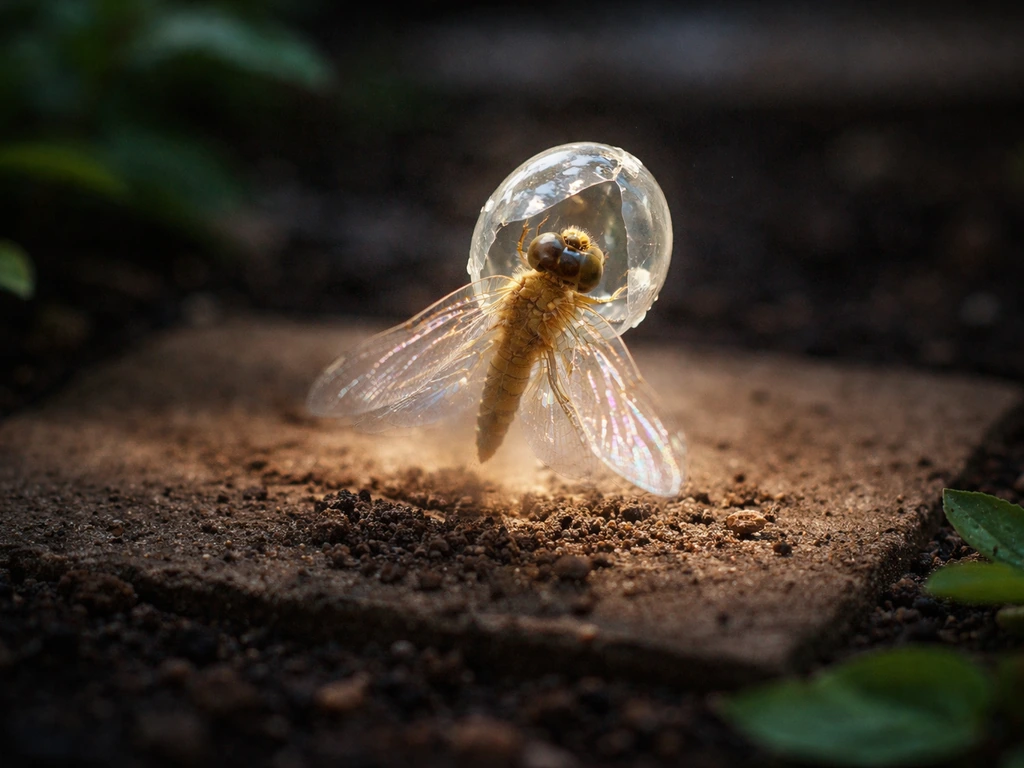
There are 2 ways to count dragonflies in Grow A Garden: by unique variants (the base Dragonfly plus mutations like Golden, Shiny, Rainbow, Silver, and about 33 named mutation entries tracked on the community wiki) or by active population per farm (which is entirely up to you, since there is no server-wide dragonfly cap). Each hatch from a Bug Egg or Exotic Bug Egg gives you a 1% chance of landing one, the Silver Dragonfly is a separate pet that was a Season 1 Pass reward at Level 40, and you can run up to 13 eggs simultaneously in a single garden to maximize your throughput.
How Many Dragonflies Exist in Grow A Garden, Exact Numbers

Julian Russo
16 Jul 2026
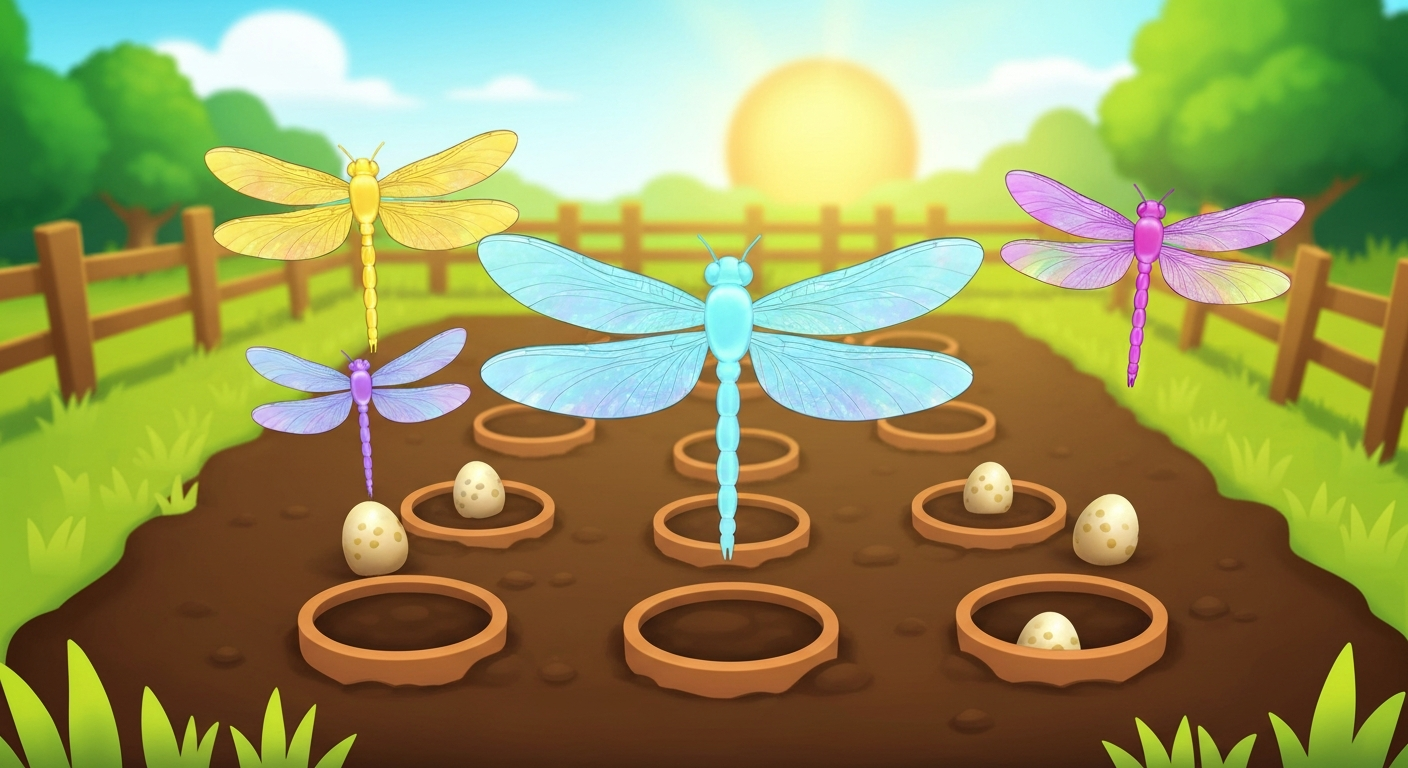
What 'how many dragonflies' actually means
The question splits into two very different things, and mixing them up leads to confusion when you are reading guides or asking in community discords.
The first meaning is unique dragonfly variants: how many distinct versions of the Dragonfly pet exist in the game. The base Dragonfly is one pet entry. On top of that, pets in Grow A Garden can roll mutations (Aromatic, Golden, Shiny, Rainbow, Spectral, Venom, Windy, and many more), and the community wiki currently tracks 33 named mutation gallery entries for the Dragonfly alone. The Silver Dragonfly is treated as its own separate pet entry, not just a mutation of the base, because it came from the Season 1 Pass at Level 40 rather than from egg hatching. So counting all dragonfly-adjacent entries, you are looking at the base Dragonfly, the Silver Dragonfly, and 33 documented mutation variants.
The second meaning is active population per farm or world: how many dragonfly pets you personally have incubating or placed at any one time. This is not a fixed number. It scales with how many eggs you hatch and how many egg slots you have unlocked. There is no server-enforced dragonfly cap, and Roblox's server architecture for Grow A Garden does not expose a live global dragonfly census to players anyway. Your farm's dragonfly count is purely a function of your hatch luck and slot management.
Hard numbers and caps the game does set
Even though there is no dragonfly-specific cap, there are real limits that constrain how fast you can accumulate them. The most important one is egg slot capacity. A single garden starts with 3 egg slots. You can add up to 5 more through trading or Robux purchases, and up to 5 additional slots through Ascension egg-slot upgrades, bringing the absolute maximum to 13 simultaneous eggs on one farm. That 13-slot ceiling is the real bottleneck for anyone trying to mass-hatch Dragonflies.
| Data Point | Value |
|---|---|
| Base Dragonfly hatch chance (Bug Egg) | 1% |
| Base Dragonfly hatch chance (Exotic Bug Egg) | 1% |
| Bug Egg incubation time (Sheckles purchase) | ~8 hours |
| Bug Egg incubation time (Robux skip) | ~30 seconds |
| Max egg slots per garden | 13 |
| Named Dragonfly mutation variants (wiki gallery) | 33 |
| Silver Dragonfly source | Season 1 Pass, Level 40 reward |
| Dragonfly passive ability | Converts a random non-variant fruit to Gold (~4m 50s interval) |
One thing worth flagging: event drops can and do shift the effective rarity. There have been documented cases on community forums of developers gifting eggs during events, which flooded supply and briefly moved dragonfly trading values. Those population spikes are real but temporary, and there is no player-facing count to track them.
How to estimate your dragonfly count from your own hatch logs
Since the game does not show you a live dragonfly population dashboard, the practical approach is logging your own hatches. Here is exactly how to do it and how to sanity-check the 1% rate against your personal data.
- Open a simple spreadsheet (Google Sheets works fine) and create two columns: Hatch Number and Result (Dragonfly = 1, anything else = 0).
- Every time you hatch a Bug Egg or Exotic Bug Egg, log the result immediately. Do not batch-record from memory; recall bias will skew your data.
- After at least 100 hatches, calculate your observed rate: sum the Result column and divide by total hatches. Example: 2 Dragonflies in 150 hatches = 2/150 = 0.0133, or about 1.3%.
- To check whether your observed rate is consistent with the published 1%, compute a simple Wilson score interval. For 2 successes in 150 trials at 95% confidence, the interval runs roughly 0.2% to 4.7%, which comfortably contains 1%. You are not being cheated by RNG.
- To estimate how many dragonflies you should expect over future hatches, multiply planned hatches by 0.01. Planning 300 more Bug Egg hatches? Expected dragonfly yield = 300 × 0.01 = 3. That is a mean, not a guarantee; actual results follow a Binomial(300, 0.01) distribution.
Sample calculation
Say you want to collect 5 Dragonflies. For a focused walkthrough on how many Bug Eggs to get a Dragonfly in Grow A Garden and practical hatch-count estimates, see the guide titled how many bug eggs to get dragonfly grow a garden. Expected number of Bug Eggs needed = 5 / 0.01 = 500 eggs. With 13 slots running 8-hour cycles, that is 13 eggs per cycle, roughly 38 to 39 cycles, which works out to about 308 to 312 hours of incubation time if you are using Sheckles-purchased Bug Eggs. Using Robux skips (30-second hatch), 500 eggs takes roughly 19 minutes of active skipping. That gap in efficiency is enormous, which is why Robux-skip players can build dragonfly collections that free-to-play players genuinely cannot match in the same timeframe.
Where dragonflies come from
The base Dragonfly has two egg sources: the Bug Egg and the Exotic Bug Egg, both at 1%. Beyond those, the Silver Dragonfly was obtainable exclusively through the Season 1 Pass at Level 40, making it unavailable to players who missed that season unless trading becomes a viable acquisition path. There are no documented overworld or field spawns for Dragonfly as a wild creature the way some other games handle rare mobs. The only reliable path to the base Dragonfly is grinding Bug Eggs or Exotic Bug Eggs.
Event sources are a wildcard. Developer-gifted egg drops during special events have historically included Bug Eggs, and those events temporarily increased the supply of Dragonflies in the player economy. Watch official Grow A Garden announcements and community Discord servers for event notices, because a timed egg gift can be the most efficient free acquisition window you will get.
Bug Egg mechanics: pools, hatch windows, and incubation rules
Every Bug Egg hatch is an independent RNG draw from a fixed weighted pool. The weights as documented by the community wiki and cross-verified by community hatch aggregators are:
| Pet | Hatch Chance |
|---|---|
| Caterpillar | 40% |
| Snail | 30% |
| Giant Ant | 25% |
| Praying Mantis | 4% |
| Dragonfly | 1% |
The Exotic Bug Egg shares the same pool and the same 1% Dragonfly rate. Mechanically, there is no advantage to the Exotic Bug Egg over the Bug Egg for Dragonfly hunting specifically, though the Exotic variant may carry other differences in cost or availability depending on the current shop rotation. Each hatch result is independent: a run of 50 Caterpillars does not make a Dragonfly more likely on hatch 51. The RNG does not track your bad luck streak.
Incubation timing: Bug Eggs purchased with Sheckles incubate for approximately 8 hours per egg. The Robux-paid skip reduces this to roughly 30 seconds. You cannot speed up Sheckles-purchased eggs through in-game mechanics short of the Robux skip. Slot management matters: always keep all available egg slots filled. An empty slot is a wasted hatch cycle.
Probability of getting a dragonfly: the math you actually need
Each Bug Egg hatch is a Bernoulli trial with p = 0.01. The number of Dragonflies you get from n hatches follows a Binomial(n, 0.01) distribution. Here are the key numbers to internalize:
| Hatches (n) | Expected Dragonflies (n × 0.01) | P(at least 1 Dragonfly) | P(zero Dragonflies) |
|---|---|---|---|
| 50 | 0.5 | ~39.5% | ~60.5% |
| 100 | 1.0 | ~63.4% | ~36.6% |
| 200 | 2.0 | ~86.6% | ~13.4% |
| 300 | 3.0 | ~95.0% | ~5.0% |
| 500 | 5.0 | ~99.3% | ~0.7% |
P(zero Dragonflies after n hatches) = (0.99)^n. So after 100 hatches you still have a 36.6% chance of walking away empty-handed. After 300 hatches that drops to about 5%. If you want 95% confidence of getting at least one Dragonfly, plan for at least 300 Bug Egg hatches. For two Dragonflies at 95% confidence, you are looking at roughly 480 to 500 hatches.
For players wanting to verify the 1% rate empirically with decent precision: to measure p = 0.01 with a margin of error of ±0.002 at 95% confidence, the Wald approximation requires roughly 9,425 hatches. Authoritative guidance on planning sample sizes for binomial proportions and preferring Wilson or exact intervals over the Wald for low probabilities is provided by NIST/Handbook, Sample sizes required for proportions (statistical planning) NIST/Handbook — Sample sizes required for proportions (statistical planning). That is not practical for a single player, which is why community aggregation projects that pool thousands of hatch logs across many players exist and are more reliable than any individual data set. If you see a guide claiming a wildly different hatch rate, check the sample size before believing it.
Getting dragonflies: egg setup and maximizing your hatch rate
Grow A Garden does not have a traditional breeding system where two parent pets produce offspring. You cannot pair two Dragonflies to breed a third one. The pet-crafting mechanic (used for things like the Chimera, which requires a Chimera Stone ritual with specific equipped pets) is a documented exception to pure egg hatching, but Dragonfly is not part of any known crafting recipe. For Dragonfly specifically, all roads lead back to Bug Egg hatching.
That said, there is still an optimized setup for getting Dragonflies efficiently. Think of it less as a breeding recipe and more as an incubation throughput strategy.
Optimized Bug Egg incubation setup
- Unlock all 13 egg slots: prioritize trading and Ascension upgrades that add egg slots. Each extra slot is a direct multiplier on your hatch rate per day.
- Fill every slot with Bug Eggs at the start of each 8-hour window. Set a timer so you do not miss a cycle. Three missed cycles a day means you are leaving 39 hatches (and statistically 0.39 expected Dragonflies) on the table every day.
- If you are using Robux skips, batch your skips in sessions. Skipping 13 eggs back-to-back takes about 6.5 minutes and resets all 13 slots immediately.
- Track every result in a log (see the estimation section above). After 50 to 100 hatches you will have a personal baseline to know if your luck is trending well or poorly.
- During dev-gift events, stock up on any free or discounted Bug Eggs distributed. These are the highest expected-value acquisition windows for free-to-play players.
Incubation order for reliability
Since each egg is independent, there is no meaningful 'order' that changes your odds. However, for practical reliability, load your highest-priority egg type (Bug Egg for Dragonfly hunting) into slots first, before filling remaining slots with other egg types you are running for other pets. This prevents accidentally locking all slots with a 24-hour rare egg and losing a full day of Bug Egg cycles.
Dragonfly value and where it fits in the meta
The Dragonfly's passive, Transmutation, converts a random non-variant fruit to Gold roughly every 4 minutes and 50 seconds. Gold variants are worth significantly more than base fruits, so the Dragonfly is a genuine passive income pet if your farm is actively growing high-value crops. The more valuable your fruit pool, the more impactful each Transmutation tick becomes.
Compared to something like the Chicken Zombie (a pet with a different passive focused on different mechanics), the Dragonfly wins specifically in farming contexts where you are growing large quantities of premium crops and want consistent gold-variant generation without manual input. If your farm strategy centers on volume and passive value conversion, Dragonfly is a strong pick. If your strategy leans toward combat mechanics or different passive effects, the comparison shifts. The Chicken Zombie serves a different niche, so the two are not direct substitutes.
| Feature | Dragonfly | Silver Dragonfly |
|---|---|---|
| Source | Bug Egg / Exotic Bug Egg (1%) | Season 1 Pass, Level 40 |
| Passive ability | Transmutation (fruit to Gold) | Separate pet entry; specific passive may differ |
| Acquisition difficulty | RNG-gated, farmable | Time-gated, no longer directly available |
| Mutation variants | 33 named entries in wiki gallery | Separate entity, own mutation pool |
| Trading value | Moderate, affected by event supply shocks | Higher scarcity floor due to Season Pass lock |
Why dragonflies disappear and how to prevent it
Dragonfly disappearance is one of the more-searched pain points in the community, and it almost always comes down to one of a few causes. If your Dragonfly vanishes, run through this checklist before assuming a bug. If you’re asking why did my dragonfly disappear in Grow A Garden, check this troubleshooting guide on dragonfly disappearance for diagnostic steps and fixes.
- Pet slot overflow: if you hatch a new pet and your active pet slots are full, pets can be displaced or lost depending on game version. Always confirm you have an open pet slot before popping a new egg.
- Accidental trade or sale: some players trade pets in sessions and forget individual pets in the stack. Check your trade history if you have been active in the trading scene.
- Game update resets: patch notes occasionally mention pet data fixes that can interact with saved pet states. After major updates, verify your pet inventory against your hatch logs.
- Server desync: Roblox's server architecture can cause brief inventory desyncs. Log out completely and back in before reporting a pet as truly missing.
- Mutation rollover confusion: a Dragonfly that rolled a visible mutation (e.g., Golden Dragonfly) might look like a different pet in your inventory list. Sort by pet type, not by appearance, when auditing your collection.
Recognizing your dragonfly: a quick visual reference
The base Dragonfly pet in Grow A Garden uses a classic four-winged dragonfly silhouette with iridescent wing detail and a segmented body. The key visual markers that distinguish it from other Bug Egg outcomes are the double wing pairs (Praying Mantis has folded forearms and a narrower build; Giant Ant is obviously insect-like but ground-based; Snail has a shell; Caterpillar is multi-segmented and wingless). When a mutation applies, the body and wing colors shift dramatically: Gold variants show a full metallic gold tint, Rainbow variants cycle through hues, and Spectral variants have a semi-transparent ghostly appearance. If you are hunting a specific mutation, those color cues are your fastest in-inventory identifier. If you want a step-by-step visual guide, see our short tutorial on how to draw a dragonfly from Grow A Garden for clear lineart and color references. The Silver Dragonfly has a consistent metallic silver coloring across its base form, distinguishing it immediately from the standard Dragonfly even at a glance.
FAQ
Quick answer: how many Dragonflies exist in Grow a Garden (variants vs active counts)?
Variants: community galleries list ~33 named Dragonfly mutations plus base and at least one special Silver Dragonfly (season reward), so expect ~34+ unique Dragonfly variants. Active population per farm/world: there is no server‑wide public counter. For a single player/farm the expected Dragonflies equals 0.01 × (number of Bug Egg or Exotic Bug Egg hatches) because each hatch is an independent Bernoulli trial with p≈1%.
What does “how many Dragonflies” mean (definitions used here)?
Two definitions used in this guide: (1) Unique variants — distinct Dragonfly pet entries/mutations (community lists ~34+). (2) Active population — count of Dragonfly pets currently owned/placed in a farm or across a world. Active population must be estimated from hatch counts, event distributions, and trade data because no official global counter is public.
Definitive in‑game numbers and where they come from
Sourceable numbers: Bug Egg / Exotic Bug Egg hatch table lists Dragonfly at 1% and Bug Egg hatch time ≈8 hours. Max incubating eggs per farm = 13. Use the documented 1% rate (community + Fandom + Beebom corroboration) for calculations. No official global active count is exposed by the game.
How to calculate expected Dragonflies for my farm — exact method and example
Model: each Bug/Exotic Bug Egg hatch = independent Bernoulli trial, p=0.01. Expected value E = n × p. Variance = n×p×(1−p). Example: if you hatch 500 Bug Eggs, expected Dragonflies = 500×0.01 = 5. Probability of at least one Dragonfly = 1 − (1−0.01)^500 ≈ 0.993. Use binomial distribution for confidence intervals and Wilson/Clopper–Pearson CIs for low p.
How many egg hatches do I need to reliably get a Dragonfly?
Probability of at least one Dragonfly after n hatches = 1−(0.99)^n. For 95% chance solve 1−0.99^n ≥0.95 → n ≥ ln(0.05)/ln(0.99) ≈ 298 hatches. Expected number for target precision: to estimate p=0.01 within ±0.002 (95% CI) you need about 9,400 hatches (Wald approx) — use Wilson sample‑size calculators for exact planning.
Which egg contains Dragonflies and how do I obtain those eggs?
Eggs: Dragonfly appears in Bug Egg and Exotic Bug Egg with 1% weight. Obtain eggs via: in‑game shop (Sheckles or Robux slots), event gifts, merchant/trader rotations, season rewards, or community giveaways. Robux-purchased eggs can be hatched immediately with skip (shortened hatch time); Sheckles eggs take ~8 hours to hatch.
Next Article
Bug Egg to Dragonfly in Grow a Garden: How to Hatch
Find the correct bug egg for a dragonfly in Grow a Garden, hatch reliably, and troubleshoot setup failures.