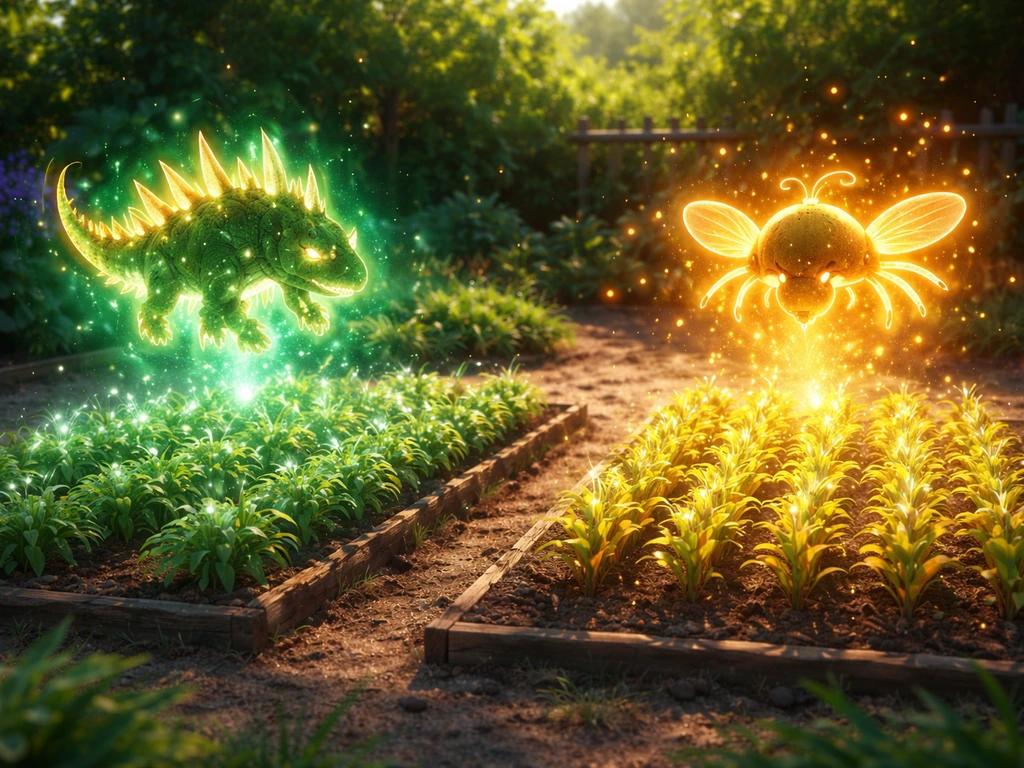
If you are running a crop-value farm and want steady income across every harvest, Dragonfly is the stronger pick. Its Transmutation ability quietly converts one random fully-grown crop to Gold roughly every 5 minutes, which compounds fast across a large plot. Spinosaurus does something fundamentally different: it hoovers up mutations from several fruits and dumps them all onto one priority fruit, making it a single-fruit stacking tool rather than a farm-wide booster. Both are Divine-tier, both are expensive to obtain, and both deserve a slot in a mature farm, but they are not interchangeable, and choosing the wrong one for your current goal wastes a pet slot. Community-maintained Grow a Garden Pet pages list Dragonfly and Spinosaurus as Divine-tier pets, and are commonly used by traders and meta lists to rank mid/late-game farm choices.
Dragonfly vs Spinosaurus: What Is Better in Grow A Garden

TL;DR: Which One Should You Pick Right Now?
Pick Dragonfly if you want consistent, passive Gold-mutation generation across your entire garden with minimal setup. Pick Spinosaurus if you are specifically trying to build one hyper-mutated showcase fruit or stack mutations for a prestige trade. If you only have one open slot, Dragonfly wins for most farm goals because it scales with crop count and triggers far more frequently. Spinosaurus shines in a dedicated mutation-stacking lineup, ideally once you already have a Gold-mutation pipeline running.
- Breeding farm or passive income focus: Dragonfly
- Single-fruit mutation stacking or prestige trades: Spinosaurus
- New to Divine pets, limited slots: Dragonfly first
- Advanced farm with multiple slots and an existing mutation pipeline: run both
At-a-Glance Comparison Table
| Attribute | Dragonfly | Spinosaurus | Edge |
|---|---|---|---|
| Tier | Divine | Divine | Tied |
| Egg source | Bug Egg / Exotic Bug Egg | Primal Egg (event/crafted) | Dragonfly (more accessible) |
| Hatch chance | ~1% from Bug Egg | ~0.5% from Primal Egg | Dragonfly |
| Hatch timer | Standard Bug Egg timer | 4 hrs 10 min (Primal Egg) | Dragonfly |
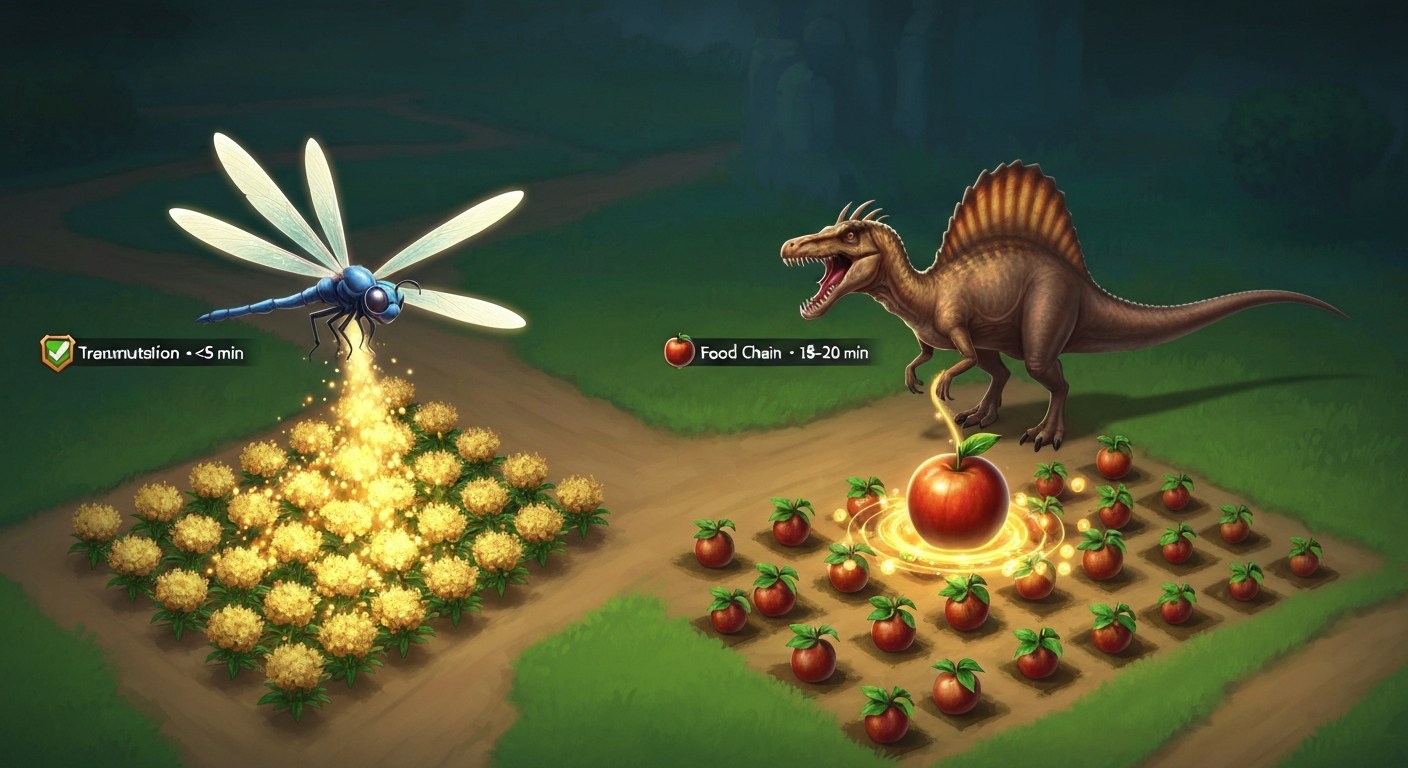
| Core ability | Transmutation: converts 1 random fully-grown crop to Gold ~every 5 min | Food Chain: devours mutations from multiple fruits, concentrates onto 1 priority fruit ~every 18–20 min | Role-dependent |
| Farm-wide impact | High — touches many crops over time | Low — targets one fruit | Dragonfly for breadth |
| Single-fruit impact | Low to moderate | Very high | Spinosaurus for depth |
| Trigger frequency | Every ~5 minutes | Every ~18–20 minutes | Dragonfly |
| Best farm role | Passive Gold-mutation generator | Mutation concentrator / prestige builder | Role-dependent |
| Date added | May 3, 2025 (Animal Update) | July 12, 2025 (Pet Mutations Update) | Dragonfly (more established meta) |
| Verdict | Bread-and-butter farm pet for most players | Specialist tool for mutation stackers | Dragonfly wins general use |
Creature Profiles
Dragonfly
Dragonfly is a Divine-tier insect pet introduced in the Animal Update on May 3, 2025. It hatches from the Bug Egg or Exotic Bug Egg at approximately a 1% chance per roll. Its defining passive is Transmutation, which fires every roughly 5 minutes and selects one random fully-grown crop in your garden, converting it to the Gold mutation. Gold is one of the highest-value mutation multipliers in the game, listed at around 15x baseline value in community trackers, so every trigger is a meaningful income event. Dragonfly also carries a reported hunger stat of 100,000 in community databases, which effectively means it stays active and engaged without constant player intervention. Its market value sits among the top Divine pets precisely because Transmutation is always working in the background, regardless of what else you are doing.
Spinosaurus
Spinosaurus is a Divine-tier dinosaur pet added in the Pet Mutations (Prehistoric) update on July 12, 2025. It hatches from the Primal Egg at roughly a 0.5% chance per roll. The Primal Egg itself is crafted or obtained through the upgraded Dino/DNA machine (one documented recipe: 1x Dinosaur Egg plus 1x Bone Blossom plus 5,500,000 Sheckles), and the egg has a 4-hour 10-minute hatch timer, making it one of the more demanding eggs in the game to farm repeatedly. Spinosaurus's passive, Food Chain, triggers every 18 to 20 minutes. When it fires, it devours existing mutations from multiple fruits across your garden, then roars to transfer and concentrate all those devoured mutations onto a single favorited-priority fruit. This makes Spinosaurus a mutation aggregator rather than a mutation generator. It does not create Gold mutations, it moves and stacks whatever mutations already exist.
How We Compare These Two: Evidence and Metrics
To make this comparison actionable rather than opinion-based, the evaluation focuses on in-game mechanics that players can observe and verify themselves. Here is what to check and why each metric matters for real farm decisions.
- Ability trigger frequency: how often a passive fires determines how much it influences a session. Dragonfly's ~5-minute cadence means roughly 12 Gold conversions per hour. Spinosaurus at ~18–20 minutes means 3 triggers per hour, each affecting only one fruit.
- Mutation type generated vs. transferred: Dragonfly creates new Gold mutations on previously clean crops. Spinosaurus redistributes mutations that already exist. A farm with no existing mutations gives Spinosaurus nothing to work with.
- Farm width vs. single-fruit value: larger plots with many crops benefit more from Dragonfly's broad distribution. Players targeting one prize fruit benefit from Spinosaurus's concentration mechanic.
- Egg accessibility and hatch rate: a higher hatch chance from a more accessible egg means faster acquisition and easier breeding replacement. This matters for long-term farm maintenance.
- Slot efficiency: with a starting roster of 3 equip slots (expandable through gameplay), every slot needs to justify itself. A pet that fires 12 times per hour beats one that fires 3 times per hour in a general-use slot.
- Community meta consensus and trade value: Divine pets that are widely sought in trading communities retain value for slot rotations and trades, which matters for mid-to-hardcore players managing a living roster.
Role and Best Uses Broken Down
Passive Income and Harvesting
Dragonfly wins this category cleanly. Every 5 minutes it applies the Gold mutation to a random fully-grown crop, and since Gold is worth approximately 15x baseline value, each trigger is a direct income multiplier. Over a 1-hour farming session, expect around 12 separate Gold conversions across your plot. On a larger farm with 20 or more crops, that means a meaningful percentage of your harvest carries Gold value without you doing anything. Spinosaurus does not generate income passively in the same way: it strips mutations from other fruits (temporarily reducing their value during the collection window) and concentrates them, which helps only if you are actively trading or showcasing that one target fruit. Community consensus in threads such as Reddit discussion: 'Can I have your Dragonfly?' (example community comments comparing pet roles) describes Dragonfly as favoring frequent, distributed Gold-mutation production while Spinosaurus concentrates and transfers multiple mutations onto a single fruit.
Mutation Stacking and Prestige Builds
Spinosaurus is the specialist here. If your goal is to build a single fruit with as many stacked mutations as possible, Food Chain accelerates that process significantly. The favorited-fruit priority mechanic lets you designate a target, and every Spinosaurus cycle funnels mutations toward it. For players building prestige items for high-tier trades or collection goals, this is a powerful tool. Just be aware that the fruits being harvested of their mutations temporarily lose value, so running Spinosaurus in a purely passive income setup actually hurts your overall crop values between triggers.
Base Defense and Combat
Neither Dragonfly nor Spinosaurus are primarily combat or base defense pets. Their value is entirely in their passive farm abilities. If combat or defense is your priority, you would be looking at different creature classes. For this specific matchup, both pets are effectively equal at zero defensive utility, so base defense should not factor into your choice between them.
Utility and Slot Flexibility
Dragonfly is the more flexible utility pet because its Gold-generation benefit applies regardless of what other pets you are running. It does not depend on other mutations existing first. Spinosaurus is context-dependent: it needs other mutation sources already active in your garden to be effective. Running Spinosaurus in an early or mid-stage farm where mutations are rare means Food Chain fires and finds little to work with. Dragonfly works from day one of having it equipped.
Stats to Inspect In-Game
When you check these pets in your collection or on community databases, here are the specific numbers and fields that matter most for farm decisions.
| Stat | Dragonfly | Spinosaurus | What to Look For |
|---|---|---|---|
| Tier | Divine | Divine | Both are end-game tier; neither is a stepping stone |
| Ability trigger interval | ~5 minutes | ~18–20 minutes | Lower = more frequent benefit; Dragonfly wins |
| Ability scope | 1 random fully-grown crop (Gold mutation) | Multiple fruits devoured, 1 fruit boosted (favorited priority) | Scope determines farm strategy fit |
| Hunger stat | 100,000 (community reported) | Not widely reported; check in-game pet page | High hunger = stays active longer without management |
| Special ability | Transmutation (Gold mutation generation) | Food Chain (mutation concentration) | Core identity of each pet |
| Hatch rate | ~1% (Bug Egg) | ~0.5% (Primal Egg) | Affects how long it takes to acquire multiples |
| Egg hatch time | Standard Bug Egg timer | 4 hrs 10 min (Primal Egg) | Longer hatch = slower acquisition loop |
One practical note: always verify current stats directly in-game or on the latest community wiki pages, as ability timers and mechanics have been subject to adjustments in post-launch patches. The ~5-minute Dragonfly interval and ~18–20-minute Spinosaurus interval are the figures cited across community sources as of this writing, but patch notes for any given update week can shift these.
Breeding, Egg Costs, and How to Actually Get These Pets
Getting a Dragonfly
Dragonfly drops from the Bug Egg and the Exotic Bug Egg. The hatch chance sits at approximately 1%, which is low but significantly higher than Spinosaurus. Bug Eggs appear in shop rotations and through normal egg-acquisition channels, making them the more repeatable grind. If you are farming Bug Eggs consistently, your odds of hitting a Dragonfly within a reasonable session are real. The Exotic Bug Egg typically offers improved odds on insect-type pets, so prioritizing those when they appear is the smart move. Community egg-timer trackers are useful here for timing your hatching sessions around shop refreshes.
Getting a Spinosaurus
Spinosaurus is a noticeably harder get. The Primal Egg has a documented 4-hour 10-minute hatch timer and requires either event access or crafting through the upgraded Dino/DNA machine (recipe: 1x Dinosaur Egg, 1x Bone Blossom, 5,500,000 Sheckles per documented community reports). At a 0.5% hatch rate, you are likely to go through many Primal Eggs before landing a Spinosaurus. That Sheckle cost per craft attempt is substantial, and the 4-hour wait per attempt means acquisition is measured in days or weeks of dedicated effort rather than a single grind session. This also makes Spinosaurus significantly more expensive to acquire through trades, which is reflected in its community value listings.
Egg Accessibility Side-by-Side
| Factor | Dragonfly (Bug Egg) | Spinosaurus (Primal Egg) |
|---|---|---|
| Egg source | Bug Egg / Exotic Bug Egg (shop rotation) | Primal Egg (crafted via Dino/DNA machine or event) |
| Craft cost | Standard shop purchase | ~5,500,000 Sheckles + 1 Dinosaur Egg + 1 Bone Blossom per attempt |
| Hatch timer | Standard (shorter) | 4 hours 10 minutes |
| Hatch rate | ~1% | ~0.5% |
| Expected egg attempts to hit pet | Lower (~100 average) | Higher (~200 average) |
| Event dependency | No | Yes (Prehistoric expansion access) |
Breeding Efficiency, Long-Term Farm Value, and Slot Viability
Players start with 3 pet equip slots and can unlock more through progression and aged-pet trades. Every slot decision is a tradeoff, so understanding the long-term return on each pet matters as your farm scales.
Long-Term Income Projection
Dragonfly's value compounds over time in a straightforward way. More crops in your garden means more potential Gold-mutation targets per trigger cycle. A 20-crop farm getting 12 Dragonfly triggers per hour means a meaningful share of your harvest regularly rolls with Gold value. The Gold mutation at roughly 15x baseline is not just an income bump, it is a fundamental shift in per-harvest returns. Spinosaurus, by contrast, is better modeled as a one-time amplifier for a specific fruit rather than a recurring income generator. Its long-term farm value depends entirely on how often you are turning over and trading those hyper-mutated single fruits.
Slot and Tier Viability Analysis
For a 3-slot farm roster, Dragonfly deserves a permanent slot from the moment you acquire one. Its passive is always producing value regardless of your other pets or your current activity. Spinosaurus earns a slot in a more advanced roster where you already have Gold-mutation generation covered (by Dragonfly or another source) and are actively working toward a prestige or trade build. Running both in the same lineup is actually quite effective: Dragonfly generates Gold mutations broadly, and Spinosaurus then concentrates and stacks mutations on your target fruit. That two-pet combo is an efficient use of 2 of your 3 base slots if mutation-stacking is your active goal.
Breeding Line Viability
Since Dragonfly has a higher hatch rate from a more accessible egg, building a supply or breeding line of Dragonflies is more realistic for most players. If you want spares for trades or to run multiples in rotation, grinding Bug Eggs is a sustainable loop. Spinosaurus is unlikely to become a breeding-line pet for most players given the Primal Egg craft cost and hatch probability, it is realistically a one-per-farm pet or an acquisition-target for high-value trades. When evaluating Dragonfly against other insect or high-tier pets in breeding decisions, it is also worth comparing it against closely related matchups like Raccoon or T-Rex, which occupy overlapping farm roles and trading tiers.
Recommended Setups by Player Goal
| Player Goal | Recommended Setup | Notes |
|---|---|---|
| Passive income / crop value farm | Dragonfly as primary, fill other slots with Gold Bee or value-boosting pets | Dragonfly's 5-min Gold triggers drive steady revenue |
| Mutation stacking / prestige build | Dragonfly + Spinosaurus together, favorited-fruit set to target | Dragonfly generates mutations; Spinosaurus concentrates them |
| Collection / prestige showcase | Spinosaurus in dedicated slot alongside mutation generators | Food Chain makes the most sense here |
| Early Divine pet acquisition | Dragonfly first — more accessible egg, higher hatch rate, immediate farm value | Spinosaurus can wait until Bug Egg grind is established |
| Trade value / ROI optimization | Dragonfly for consistent value; Spinosaurus for single hyper-value fruits to trade | Both are high-value Divine pets; Dragonfly trades more frequently |
How Dragonfly and Spinosaurus Stack Up Against Related Creatures
Both pets exist in a broader Divine-tier ecosystem, and understanding where they sit relative to other creatures helps sharpen your slot decisions. Raccoon and T-Rex occupy different niches (Raccoon is often discussed as a utility or gathering pet, T-Rex as a high-impact dinosaur option), and Raiju represents another high-tier choice that some players pit against Dragonfly directly. If you are weighing Dragonfly against Raccoon or assessing whether Dragonfly beats T-Rex for your setup, those are separate head-to-head decisions worth checking in dedicated comparisons. For a focused head-to-head, see Is Dragonfly Better than T-Rex on Grow a Garden for that specific matchup and data-driven recommendations Is Dragonfly Better than T-Rex (Grow a Garden). For a focused head-to-head take, see is dragonfly better than raccoon in grow a garden, which compares their utilities and best uses. Similarly, the Spinosaurus vs. For a focused breakdown on whether Spino is better than Dragonfly in Grow a Garden, see our dedicated comparison titled "is spino better than dragonfly in grow a garden". Dragonfly question (sometimes framed as 'is Spino better than Dragonfly') is addressed here, but Raiju vs. Dragonfly involves a different set of ability tradeoffs worth its own deep dive.
The consistent thread across all those matchups is that Dragonfly's Gold-mutation generation is a broadly applicable, frequently-triggering benefit that holds up well across most comparison scenarios. Spinosaurus is the outlier in this group because it is not competing on the same axis, it is a mutation manipulator, not a mutation generator, which is why it complements Dragonfly better than it competes with it.
Final Recommendation by Player Type
If you are a mid-tier player building out your first Divine lineup, get Dragonfly first. The Bug Egg grind is sustainable, the 1% hatch rate is workable, and the moment you equip it your farm starts generating Gold mutations passively every 5 minutes. That translates directly to higher harvest values and better trade fodder with zero additional setup.
If you are a hardcore player with an established farm and multiple pet slots, Spinosaurus earns its place alongside Dragonfly rather than replacing it. The Primal Egg craft cost is steep and the 0.5% hatch rate means a longer acquisition grind, but for a player who is actively building prestige fruits or stacking mutations for high-value trades, Food Chain is a powerful tool. The two-pet combo of Dragonfly generating Gold broadly and Spinosaurus concentrating mutations onto a priority fruit is one of the more efficient mutation-farming setups you can run.
Bottom line: Dragonfly is the better general farm pet. Spinosaurus is the better specialist tool. Most players should get Dragonfly first and treat Spinosaurus as the next upgrade once the Gold pipeline is already running.
FAQ
TL;DR — Which is better for mid‑to‑hardcore farms: Dragonfly or Spinosaurus?
Short answer: Pick Dragonfly if you want steady, frequent per-harvest income uplift across large numbers of plots (better for broad, high-throughput farms and passive gold mutation pressure). Pick Spinosaurus if your goal is to concentrate high-value mutations into individual fruits for prestige sells, trophy fruits, or targeted high-value harvests (better for focused, high-ticket output). Both are top-tier Divine pets; choice depends on your farm design and goals.
What methodology and evidence were used for this comparison?
I compared player-facing decision points using: documented pet abilities and official/ community patch notes (ability descriptions and introduction dates), egg/obtainment sources (egg types and crafting/upgrades), community databases for tier and rarity, community consensus threads for strategic usage, and practical constraints (pet slots). Metrics used include role (combat/utility/harvest/defense), mutation behavior (frequency vs concentration), breeding/egg path and availability, long-term farm value (steady vs concentrated returns), slot/tier viability, and matchup interactions versus Raccoon, T‑Rex, and Raiju. Where numeric values exist in community sources I reference them qualitatively and avoid unsupported numeric extrapolation.
Creature profile — Dragonfly (concise)
Role and core use: Mutation amplifier focused on producing Gold mutations periodically across multiple, fully-grown crops. Best for high-throughput harvest farms that benefit from many slightly-upgraded yields rather than single enormous fruits. Obtainment and rarity: Divine-tier insect pet obtained from Bug-type eggs (Bug/Exotic Bug Egg) per community egg tables and databases. Strengths: Frequent distributed Gold mutation pressure, low-maintenance (long hunger), excellent steady ROI on many plots, synergizes with broad harvesting automation. Weaknesses: Not designed to concentrate many mutations into one fruit; less useful for trophy fruit builds.
Creature profile — Spinosaurus (concise)
Role and core use: Mutation concentrator that devours and transfers multiple mutations to a single favorited fruit at long intervals, used to build ultra-high-value single fruits or focused prestige items. Obtainment and rarity: Divine-tier dinosaur pet introduced with prehistoric pet updates and available from Primal/Primal‑type eggs (community guides list low hatch chances and upgrade-dependent craft/obtain paths). Strengths: Best for creating extremely high-value individual fruits, ideal for targeted prestige or sell strategies. Weaknesses: Slower cadence, requires more planning/slot investment, less consistent per-harvest boost across many plots.
Head-to-head breakdown by criterion (summary)
Role & best uses: Dragonfly — distributed Gold mutation & steady income; Spinosaurus — concentrated mutation transfer & trophy fruits. Harvesting efficiency: Dragonfly increases per-harvest average across many crops; Spinosaurus increases peak value on single or a few fruits. Base defense & combat utility: Neither is primarily a combat pet; both are mid/late-game utility pets — use dedicated combat pets (T‑Rex, Raiju) for defense. Breeding/egg costs & availability: Dragonfly from Bug eggs (more commonly accessible egg pools); Spinosaurus from Primal/Primal-type eggs (upgrade-dependent, rarer/limited). Rarity & spawn mechanics: Both Divine-tier; Dragonfly appears in bug egg pools, Spinosaurus in Primal egg pools with lower hatch rates. Stats to monitor: HP/damage rarely matter for their mutation roles — prioritize hunger, ability cooldown/trigger behavior, and mutation targeting. Breeding efficiency & long-term farm value: Dragonfly scales better with wide farms; Spinosaurus scales better with targeted trophy pipelines. Slot/tier viability: Both occupy high-value Divine slots — choose based on role fit. Matchup tradeoffs: Dragonfly synergizes poorly with pets that need concentrated mutation targets; Spinosaurus synergizes with systems that prioritize single-fruit development (e.g., focused pollination or manual favoritism).
Comparison table (concise, decision-focused)
Criterion — Dragonfly vs Spinosaurus Best use — Broad farm income vs Trophy/targeted fruits Mutation behavior — Frequent distributed Gold mutations vs Rare concentration/transfer of multiple mutations Obtainment — Bug‑egg pools (more common) vs Primal‑egg pools (rarer, upgrade required) Ease of use — Low planning, passive vs Requires favoritism and timing Scaling with farm size — Scales linearly with many plots vs Scales with focused plot investment Ideal player goal — Steady cashflow/continuous ROI vs Prestige/record fruits Synergy with other pets — Pairs with harvest boosters & automation vs Pairs with concentration/pollination pets When to choose — If you run many plots/automation choose Dragonfly; if you run curated trophy builds choose Spinosaurus.
Is Spino Better Than Dragonfly for Grow a Garden?
Spino vs Dragonfly for Grow a Garden: roles, stats, breeding efficiency, and which choice boosts farming output fast.