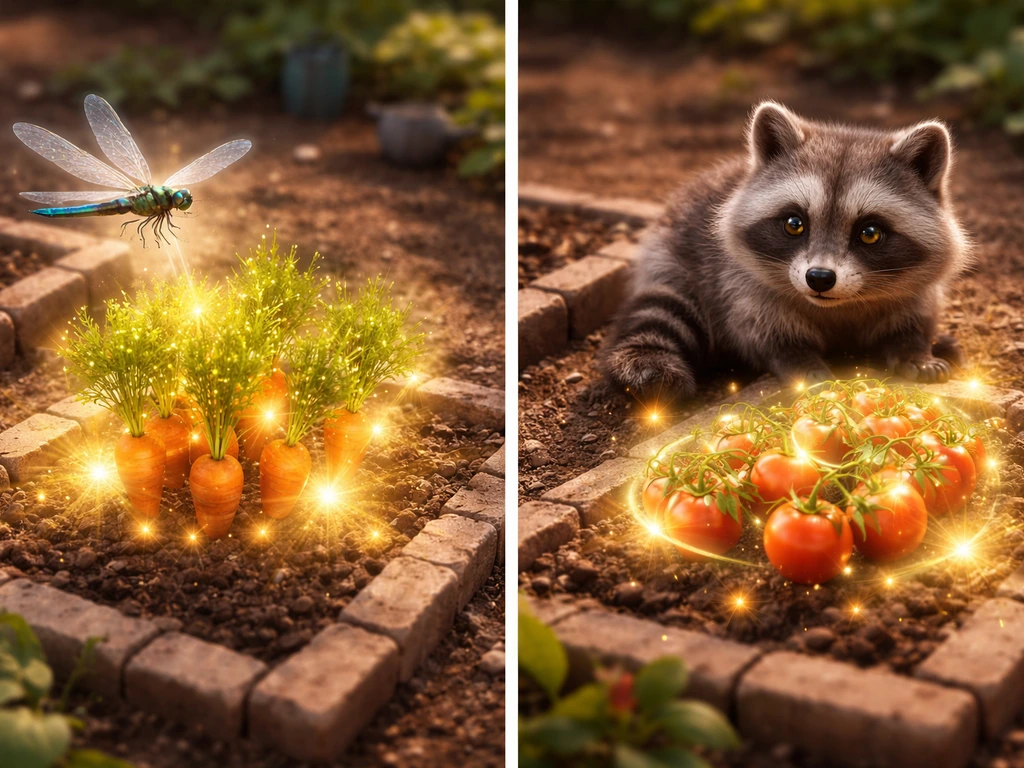
Quick verdict: dragonfly wins for gardening, raccoon wins for passive income
If your goal is directly improving your own garden's yield, the Dragonfly is the better choice. It actively transforms your crops into golden variants every 5 minutes, applying a 20x value multiplier to whatever it touches. The Raccoon does something completely different: it duplicates a crop from another player's plot and gives it to you every 15 minutes. That's useful for accumulating crop variety or volume, but it doesn't boost the value of what you already have growing. So the short answer is: Dragonfly for garden optimization, Raccoon for passive crop collection from other players.
What each creature actually does in the game
Both the Dragonfly and the Raccoon are Divine-tier pets, which already tells you they're not easy to obtain. But their roles couldn't be more different, and mixing them up is one of the most common mistakes players make when comparing them.
Dragonfly: the golden crop machine

Every 5 minutes, the Dragonfly randomly selects one crop in your garden and transforms it into its golden variant. Gold crops carry a 20x value multiplier, which is massive. To put that in perspective: a crop that normally sells for 100 coins becomes worth 2,000 coins in its golden form. Under normal RNG, you'd have a 1% chance of a crop growing golden on its own. The Dragonfly bypasses that entirely and guarantees golden transformations on a fixed cycle. The randomness is in which crop gets selected, not whether it happens. Over time, with a well-stocked garden, this compounds into serious income.
Raccoon: the cross-plot duplicator
The Raccoon's ability fires every 15 minutes and duplicates a crop from a random other player's plot, dropping that copy into your garden. Notice the key word: duplicates, not steals. The other player doesn't lose anything. What you get depends entirely on what other players are growing nearby. On a public server, you might get a pile of common carrots. On a private server with friends who are growing rare, high-value crops, the Raccoon becomes a lot more interesting. The wiki's strategy section specifically recommends private servers with coordinated players for this reason.
Getting these pets: eggs, odds, and patience

Both pets are rare, but they come from different egg sources with different hatch times and odds. Here's how they compare side by side:
| Attribute | Dragonfly | Raccoon |
|---|
| Rarity | Divine | Divine |
| Egg source | Bug Egg | Night Egg (or Exotic Night Egg) |
| Hatch time | 8 hours | 4 hours 10 minutes (Night Egg) |
| Hatch chance | 1% from Bug Egg | 1% from Night Egg / 3% from Exotic Night Egg |
| Ability cooldown | Every ~5 minutes | Every ~15 minutes |
| Ability type | Transforms your crop to Golden | Duplicates a crop from another player |
The Raccoon is slightly more accessible statistically, especially if you can get your hands on Exotic Night Eggs (3% chance versus the flat 1% from a standard Night Egg). The Dragonfly's Bug Egg has a longer hatch time at 8 hours, and the 1% chance makes it a grind either way. If you're deep into the Dragonfly vs. other high-tier pet debates, it's worth checking out whether Raiju outperforms Dragonfly once you've secured one, since the comparison gets more nuanced at higher stages.
What you actually gain in your garden (and when it matters)
The Dragonfly's value scales directly with two things: how many crops you have planted, and how valuable those crops are individually. More plots mean more chances for the golden proc to land on something expensive. With a dense garden full of high-tier crops, the Dragonfly is basically printing 20x multiplied value every 5 minutes. Over an hour, that's 12 guaranteed golden transformations landing somewhere in your garden.
The Raccoon's value scales with what other players are growing. In a private server where everyone is farming legendary or rare crops, duplicating those every 15 minutes builds up volume fast. That's 4 duplicated crops per hour from other players' hard work. But in a public server, you're at the mercy of whoever happens to be nearby, and there's a real chance you're just accumulating low-tier filler. The Raccoon also doesn't help your existing crops grow faster or become more valuable. It's purely an acquisition tool.
There's also a question of how the Dragonfly compares when you start climbing the pet tier list. Players evaluating the Dragonfly often wonder how the Dragonfly stacks up against T-Rex for raw garden impact, which gives useful context for where it sits in the broader meta.
Cost, time, and opportunity cost: the real trade-offs

Both pets cost you the same fundamental resource: time waiting on egg hatches and luck at 1% odds. But their ongoing costs diverge after you have them.
- Dragonfly: No ongoing cost once you have it. Runs automatically every 5 minutes. Works best with a densely planted, high-value garden, so your opportunity cost is investing in planting good crops to maximize the golden procs.
- Raccoon: Also runs automatically, but its value is partially out of your control. The opportunity cost is the server environment: you need to either join the right public server or organize a private server with friends who are growing quality crops. Without that setup, the Raccoon underperforms.
- Cooldown gap: The Dragonfly fires 3x more frequently than the Raccoon (every 5 vs. every 15 minutes). Over an 8-hour session, that's roughly 96 golden transformations from the Dragonfly versus 32 duplications from the Raccoon.
- Risk: The Raccoon has situational risk tied to server composition. The Dragonfly's only variability is which crop gets selected, but the benefit always lands in your garden.
For players who are optimizing around specific crop types, the Dragonfly also invites comparisons to other dinosaur-tier pets. If you're wondering what's better between Dragonfly and Spinosaurus for garden output, that's a worthwhile read once you're past the basics, since each excels in different conditions.
Which one to pick based on where you are in the game
Early game
Honestly, neither pet is early-game material. Both have 1% hatch odds from specific eggs, and spending your time chasing them before you have a solid garden foundation is inefficient. Focus on expanding your plots and building crop variety first. If you happen to hatch a Raccoon early, use it on servers with active players to pad your crop collection. A Dragonfly at this stage is wasted on a small garden with low-value crops since the 20x multiplier on cheap produce doesn't move the needle much.
Mid game
This is where the Dragonfly starts pulling ahead. Once you have a decent number of plots planted with mid-to-high tier crops, those 5-minute golden procs are making a real difference in your sell totals. If you're running a private server with a coordinated group, the Raccoon can also shine here for crop variety. But solo or on public servers, go Dragonfly every time.
Late game
Late-game players with large, high-value gardens benefit enormously from the Dragonfly. The compounding effect of 12+ golden mutations per hour on expensive crops is where the pet truly justifies its rarity. The Raccoon becomes more of a complementary tool here, useful for filling gaps in your collection or duplicating rare crops from well-coordinated server partners. Some players run both if they've managed to acquire them. For advanced comparisons at this stage, understanding whether Spino beats Dragonfly in late-game efficiency is a natural next question.
How to decide right now and what to try first
Ask yourself one question: are you trying to make your existing crops more valuable, or are you trying to accumulate more crops from other players? If it's the former, the Dragonfly is your answer. If it's the latter, and you have the right server setup to make it work, the Raccoon has its place.
- If you have neither pet: prioritize the Dragonfly by farming Bug Eggs. The 20x golden multiplier is a direct gardening boost that works regardless of server type.
- If you already have a Raccoon: use it now on the best server you can find (private with good players is ideal), and keep grinding for a Dragonfly in parallel.
- If you have both: run the Dragonfly as your primary garden booster and let the Raccoon passively collect in the background.
- To evaluate whether to switch: track your sell totals over a 1-hour session with each pet active. If the Raccoon's duplicated crops aren't adding meaningful value, the Dragonfly almost certainly will.
One thing worth noting: community threads have flagged an open question about whether the Dragonfly's cooldown changes with pet age or level. As of now, the confirmed mechanic is the ~5-minute cycle, but keep an eye on patch notes since this is the kind of thing that gets adjusted. If the Dragonfly ever gets a cooldown reduction at higher levels, its lead over the Raccoon for gardening purposes only grows wider.