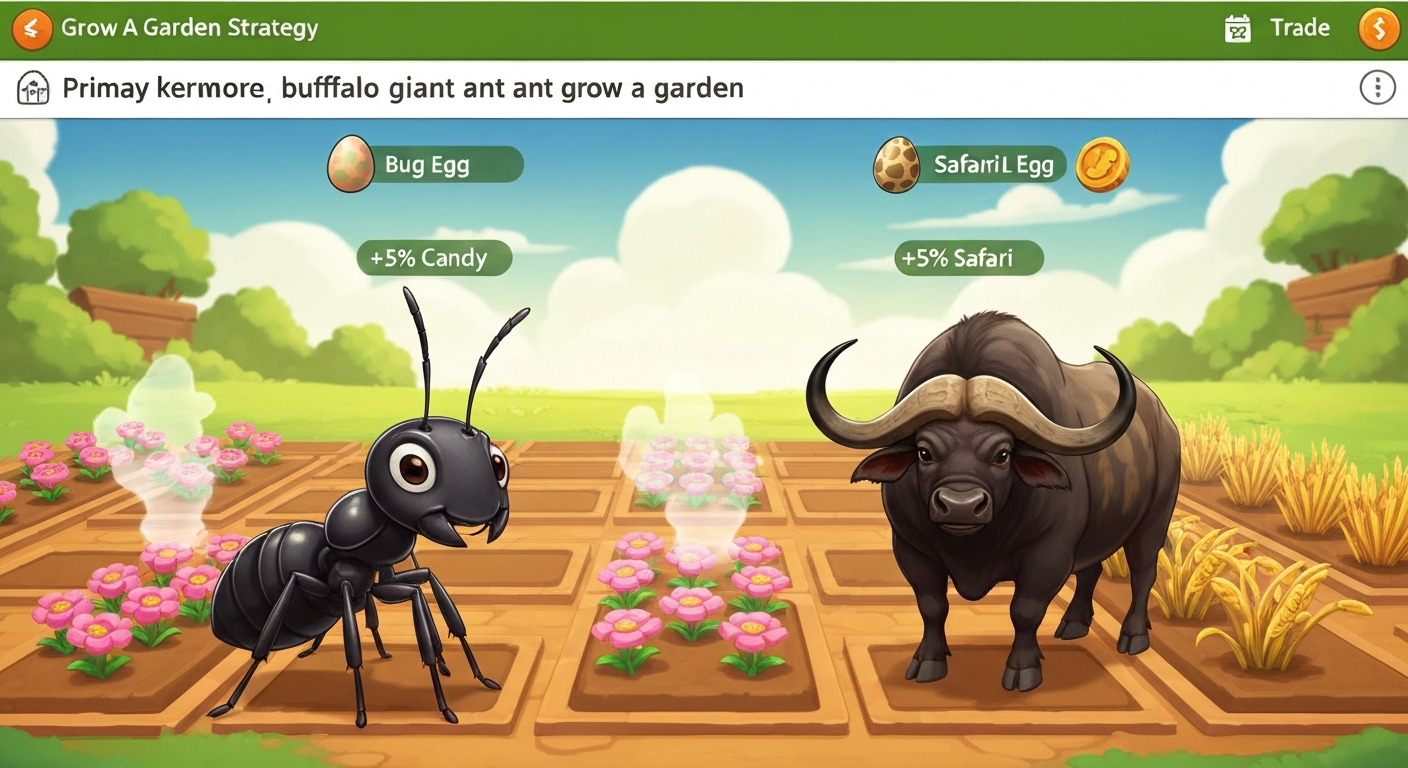
Giant Ant is the better all-around pick for most farms. It has a higher base duplication chance (~10% per harvest) than Cape Buffalo, it's obtainable any time through Bug Eggs and Exotic Bug Eggs, and stacking multiples scales your dupe odds noticeably. Cape Buffalo matches the 10% base dupe rate and gets a +5% bonus for Safari-type plants, but it's event-limited, trades at a premium, and offers almost no practical advantage over Giant Ant unless you're running a Safari-heavy crop setup or treating it as a value asset. If you're optimizing a farm right now, start with Giant Ant and revisit Cape Buffalo only if you have event access or a trade opportunity.
Cape Buffalo vs Giant Ant Grow A Garden: Farm Guide Builds & Breeding

Julian Russo
11 Aug 2026
Quick takeaways and the one-line verdict
- Giant Ant: ~10% base harvest duplication, +5% bonus for Candy-type plants, obtainable from Bug Egg (~25% odds) and Exotic Bug Egg (~30% odds) at any time.
- Cape Buffalo: ~10% base harvest duplication, +5% bonus for Safari-type plants, event/merchant-limited (Safari Harvest event), not available via standard egg pool.
- Red Giant Ant: ~5% base dupe + 5% Fruit bonus, lower hunger (~15,000), rarer — hatches from Mythical Egg at ~9% odds.
- Stacking multiples of either duplicator pet raises total dupe output. Community tests suggest Giant Ant scales well at high stack counts.
- Cape Buffalo carries higher trade/collector value because of its limited availability, not because of superior mechanics.
- If you don't have Safari-type crops as your primary farm output, Cape Buffalo offers no practical edge over Giant Ant.
- Verify all numeric dupe rates, hunger values, and egg odds in current live data before major investment — the meta updates regularly.
One-line verdict: Giant Ant wins on accessibility and consistent farm ROI; Cape Buffalo wins only in Safari-crop specialist farms or as a high-value trade chip.
Head-to-head by farm role
| Farm Role | Cape Buffalo | Giant Ant | Winner |
|---|---|---|---|
| General harvest duplicator | ~10% dupe, no crop restriction | ~10% dupe, no crop restriction | Tie (Giant Ant wins on cost) |
| Safari-type crop specialist | +5% bonus for Safari plants | No Safari bonus | Cape Buffalo |
| Candy-type crop specialist | No Candy bonus | +5% bonus for Candy plants | Giant Ant |
| Stacking (multiple pets) | Scales well, costly to stack | Scales well, easy to stack cheaply | Giant Ant |
| Breeding stock / egg source | Event-only, not re-hatchable normally | Bug Egg / Exotic Bug Egg any time | Giant Ant |
| Trade / collector value | High — event-limited rarity | Moderate — widely available | Cape Buffalo |
| Budget farm setup | High acquisition barrier | Low-to-moderate via Bug Eggs | Giant Ant |
| Hunger efficiency | Large hunger pool (verify live) | ~18,000 hunger (verify live) | Check live data |
The table makes the pattern clear. Cape Buffalo and Giant Ant do the same core job at the same base rate, but Giant Ant is accessible and stackable in ways Cape Buffalo simply isn't for most players. The one scenario where I'd actively choose Cape Buffalo over Giant Ant is a dedicated Safari-plant farm where that +5% specialty bonus compounds meaningfully across a large number of harvests.
In-depth stat comparison
Here's what the community-sourced data currently shows for the three creatures you'll most likely be comparing in this space. All numbers below are community-reported and should be cross-checked against live wiki data before you make a large egg investment, since Grow A Garden patches do shift these values.
| Stat | Giant Ant | Red Giant Ant | Cape Buffalo |
|---|---|---|---|
| Base dupe chance | ~10% | ~5% | ~10% |
| Specialty crop bonus | +5% Candy-type | +5% Fruit-type | +5% Safari-type |
| Hunger value | ~18,000 (verify live) | ~15,000 (verify live) | Large pool (verify live) |
| Primary egg source | Bug Egg / Exotic Bug Egg | Mythical Egg | Event/Merchant (Safari Harvest) |
| Hatch odds (primary source) | ~25% Bug Egg / ~30% Exotic Bug Egg | ~9% Mythical Egg | Not hatchable (event reward) |
| Rarity tier | Common-Uncommon | Rare (Mythical pool) | Event-Limited |
| Trade value | Moderate | Moderate-High | High (limited supply) |
The stat comparison highlights one important nuance: Red Giant Ant has exactly half the base dupe rate of Giant Ant but comes with a Fruit bonus instead of a Candy bonus. If your farm leans heavily into Fruit-type crops, Red Giant Ant can actually compete on specialty outputs despite the lower base rate. That said, two Giant Ants almost always outperform one Red Giant Ant in raw duplication volume. More on that in the breeding section below.
Abilities and mechanics: how these skills actually play out on your farm
Both Giant Ant and Cape Buffalo use a passive harvest-duplication mechanic. Every time a crop you own is harvested, each duplicator pet you have placed rolls its independent duplication chance. These rolls happen separately, so placing multiple duplicator pets stacks the overall probability without the pets interfering with each other. Community datamines confirm that pet ability triggers are not tile-adjacency limited, meaning placement position on your farm doesn't restrict which crops they can proc on.
The math on stacking is straightforward once you know the base rates. With a single Giant Ant at 10%, you duplicate roughly 1 in every 10 harvests. Place three Giant Ants and the probability of at least one duplication proc per harvest rises substantially. Community calculators (like GAGdata's pet ability calculator) let you model exact multi-pet combos. I'd recommend running your specific setup through one of those before committing eggs, especially if you're choosing between stacking Giant Ants versus mixing in a Cape Buffalo or Stegosaurus.
One caveat that's worth flagging directly: community reports from certain event periods noted that ant and buffalo duplication effects did not trigger on some event-specific crop types. If you're farming a new event crop, test your pets on it before assuming the standard dupe rates apply. This is a known quirk and has affected player strategies more than once.
Pet ability stacking and value multipliers
Community guides and calculators treat value-multiplier pet effects as multiplicative, while XP and cooldown-reduction boosts stack additively. For duplicator pets specifically, the duplication procs are independent rolls, not a single combined roll. This means running a Giant Ant alongside a Cape Buffalo doesn't average them into a single ~10% roll. Each pet fires its own 10% roll per harvest, which is why stacking duplicators is a genuine efficiency multiplier rather than just redundancy.
Feeding preferences and best food pairings
Giant Ant's feeding behavior is one of the most practically useful things to know about this creature. Community tests consistently report that Giant Ant gains a disproportionately large hunger restoration from Candy Blossom and Lilac, with a base Candy Blossom restoring roughly 90-100% of its 18,000 hunger in a single feeding. That's an excellent return per food item. If you're feeding Giant Ant manually and want to minimize food expenditure, Candy Blossom is the go-to.
For Cape Buffalo, community listings don't point to a single standout food equivalent to Candy Blossom for Giant Ant. Cape Buffalo has a large hunger pool, so efficient feeding matters even more to avoid wasted resources. Check the current feeding guide pages and community hunger tables for exact values on Cape Buffalo food pairings, as these can shift with game updates.
- Giant Ant best foods: Candy Blossom (restores ~90-100% hunger per feed, community-tested), Lilac (strong hunger gain reported).
- Feed timing: pets level and age through food consumed, not just time elapsed, so consistent feeding accelerates trait development.
- Candy Blossom is also a Candy-type plant, meaning a Giant Ant farm can be partially self-sustaining for feeding stock if you grow Candy Blossom as a crop.
- Exact food values for Cape Buffalo should be confirmed in current live data — community hunger tables are the most reliable reference.
- Avoid over-feeding past max hunger; excess food doesn't carry over and wastes resources.
The synergy between Giant Ant's +5% Candy bonus and Candy Blossom as its best food source is not a coincidence. If you build a Candy Blossom section on your farm, you're simultaneously producing optimal Giant Ant food and benefiting from the ant's Candy-crop specialty bonus on those same plants. That's a tight, efficient loop that Cape Buffalo simply doesn't replicate at the same food cost.
Giant Ant variants: Red Giant Ant vs Giant Ant
The Giant Ant and Red Giant Ant look similar on a roster screen but play differently enough that choosing between them is a real decision. Giant Ant offers a ~10% base duplication rate with a +5% Candy bonus, while Red Giant Ant drops to ~5% base but swaps to a +5% Fruit bonus. Red Giant Ant also has a lower hunger value (~15,000 versus ~18,000), which means it costs slightly less to maintain. For a detailed Red Giant Ant vs Giant Ant comparison on Grow A Garden, see the dedicated comparison page that covers acquisition, dupe rates, and ideal farm roles.
The practical trade-off comes down to what your farm grows and how many pets you can afford. If you're growing Fruit-type crops and can only place one ant, Red Giant Ant's combined effective rate on those crops (~10% when you count the specialty bonus) matches Giant Ant's baseline. But if you're growing mixed or Candy-type crops, Giant Ant is the stronger pick every time. Red Giant Ant is also harder to obtain, it's locked behind the Mythical Egg at roughly 9% odds, compared to Giant Ant's much higher probability from Bug Eggs and Exotic Bug Eggs.
| Factor | Giant Ant | Red Giant Ant |
|---|---|---|
| Base dupe rate | ~10% | ~5% |
| Specialty bonus | +5% Candy-type crops | +5% Fruit-type crops |
| Effective rate on specialty crop | ~15% | ~10% |
| Hunger | ~18,000 | ~15,000 |
| Obtain method | Bug Egg / Exotic Bug Egg | Mythical Egg |
| Hatch odds | ~25-30% depending on egg | ~9% from Mythical Egg |
| Acquisition difficulty | Low-Moderate | High |
| Best for | Candy farms, general use, stacking | Fruit farms, if Mythical Eggs are available |
My recommendation: unless you specifically farm Fruit-type crops and have reliable Mythical Egg access, Giant Ant is the smarter investment. Red Giant Ant is a solid pet, but its halved base rate means you need to be really committed to a Fruit build to justify the harder acquisition path.
Breeding and egg sources: where eggs come from and what they cost
Giant Ant is one of the more accessible pets in the game from an egg-sourcing standpoint. It appears in both the Bug Egg and Exotic Bug Egg pools at meaningful odds (~25% and ~30% respectively, per community egg tables). That means if you're running Bug Eggs regularly, you'll pick up Giant Ants at a reasonable clip without needing to farm rare or event-specific drops. Exotic Bug Eggs give you slightly better odds and are worth prioritizing if you're specifically targeting Giant Ant.
Red Giant Ant sits in the Mythical Egg pool at roughly 9%. Mythical Eggs are harder to come by and more valuable, so Red Giant Ant hunting is a deliberate investment rather than a byproduct of normal play. Budget your Mythical Eggs carefully if you're going for this variant.
Cape Buffalo is a different situation entirely. It's not available through a standard egg pool. Community guides consistently list it as an event or merchant reward tied to the Safari Harvest event. Community marketplaces and event guides note that Cape Buffalo was only obtainable during the Safari event and therefore commonly commands a premium on trading channels when it appears. That means if the event isn't currently running and you can't find one in the trade market, you simply cannot obtain it through normal gameplay. This is the single biggest practical argument against building a Cape Buffalo-centric farm strategy for most players.
- Giant Ant: Bug Egg (~25% listed), Exotic Bug Egg (~30% listed) — both available through normal gameplay.
- Red Giant Ant: Mythical Egg (~9% listed) — harder to farm, higher opportunity cost per attempt.
- Cape Buffalo: Event/Merchant only (Safari Harvest event) — not re-hatchable from a standard egg pool.
- Egg hatch times vary by egg type; community hatch-speed calculators document per-egg durations and the effect helper pets have on speeding up incubation. Check those tools for current timing before planning a batch hatch.
- Exact egg costs in coins/gems and precise hatch windows should be verified in current live data — these figures are frequently updated.
Breeding efficiency and ROI: making your eggs work harder
When you're spending eggs to build a duplicator pet roster, the math you care about is: how many eggs does it take to get the pets you need, and how much additional harvest value do those pets generate? For Giant Ant, the answer is relatively tight. With ~25-30% odds per Bug/Exotic Bug Egg, you're averaging roughly 3-4 eggs per Giant Ant. If you're targeting a stack of three Giant Ants to run a high-duplication farm, expect to go through around 9-12 Bug Eggs on average. That's a manageable investment compared to, say, chasing Red Giant Ant through Mythical Eggs at 9%, where you'd average roughly 11 Mythical Eggs per Red Giant Ant.
For ROI on the farm side, consider what each duplicator pet actually adds to your harvest volume over time. A single Giant Ant at 10% dupe adds roughly 1 bonus crop per 10 harvests. Over a long session with fast-cycling crops like Candy Blossom, that compounds into a meaningful yield boost. Three Giant Ants stacked increase your probability of at least one duplication proc per harvest significantly, making the third ant's marginal value still positive even after the first two. Cape Buffalo contributes the same per-harvest value as Giant Ant in general crop setups, but at far greater acquisition cost. Unless you already own Cape Buffalo, it is not an efficient egg investment.
Important: the exact hatch rates, egg odds, and cooldown durations listed above are community-sourced and should be verified against current in-game data and live egg odds tables before you plan a large hatching session. The game patches these values periodically, and even small shifts in odds change the eggs-per-pet math meaningfully.
Best breeding order for optimization
- Start with Exotic Bug Eggs if you can access them — the ~30% Giant Ant odds give better per-egg value than standard Bug Eggs.
- Hatch in batches rather than one at a time. Batching lets you use hatch-speed helper pets across multiple eggs simultaneously, reducing total wait time.
- Once you have your first Giant Ant, use it actively on your farm to start generating harvest duplication while you continue hatching for additional ants.
- If Mythical Eggs are available and you're farming Fruit-type crops, reserve a portion of your Mythical Egg supply for Red Giant Ant attempts alongside other high-value targets in that pool.
- For XP funneling, feed pets consistently using their preferred food (Candy Blossom for Giant Ant) to age them up faster, unlocking trait progression without waiting on passive time decay.
- Don't invest Mythical Eggs chasing Cape Buffalo — it's not in that pool. Focus Mythical Egg budgets on Red Giant Ant or other Mythical-pool targets.
Step-by-step breeding tips for mid-to-hardcore players
Here's how I'd approach building a Giant Ant stack efficiently if I were starting from scratch or rebuilding after a major update rebalance.
- Audit your current egg inventory. Separate Bug Eggs, Exotic Bug Eggs, and Mythical Eggs. Don't mix your budget across all three at once.
- Open Exotic Bug Eggs first, watching for Giant Ant hits. Record your results over 10+ eggs to confirm current odds match community tables — patches can silently shift hatch rates.
- Place each Giant Ant you hatch on the farm immediately. Even a single ant starts contributing dupe procs on your Candy Blossom or primary crop while you work toward your target stack count.
- Use Candy Blossom as your primary Giant Ant food. It covers close to 100% hunger in a single feeding, keeping your ants aged up at minimal food cost. Grow a Candy Blossom plot specifically for feeding stock if you don't already.
- Target a minimum of three Giant Ants for your main duplicator setup. Below three, the dupe proc rate is noticeable but not a farm-defining boost. At three or more, you'll feel the compound effect on high-harvest crops.
- If you have Cape Buffalo from a past Safari Harvest event, slot it alongside your Giant Ants only if you're growing Safari-type crops. Otherwise, hold it as a trade asset — its market value exceeds its practical farming value in mixed-crop setups.
- Check stacking output every time you add a new duplicator pet using a community pet ability calculator (GAGdata or similar). Marginal returns do taper, so there's an optimal stack count beyond which further duplicators give diminishing ROI.
- Time your XP funneling sessions around your available food stock — bulk-feed pets when you have a surplus of Candy Blossom rather than feeding one item at a time. This accelerates trait development without wasting food on partial hunger fills.
- Keep a note of the patch version when you record your personal hatch results. If numbers stop matching community tables after an update, recalibrate your egg budget before continuing bulk hatching.
How Cape Buffalo and Giant Ant compare to other duplicators
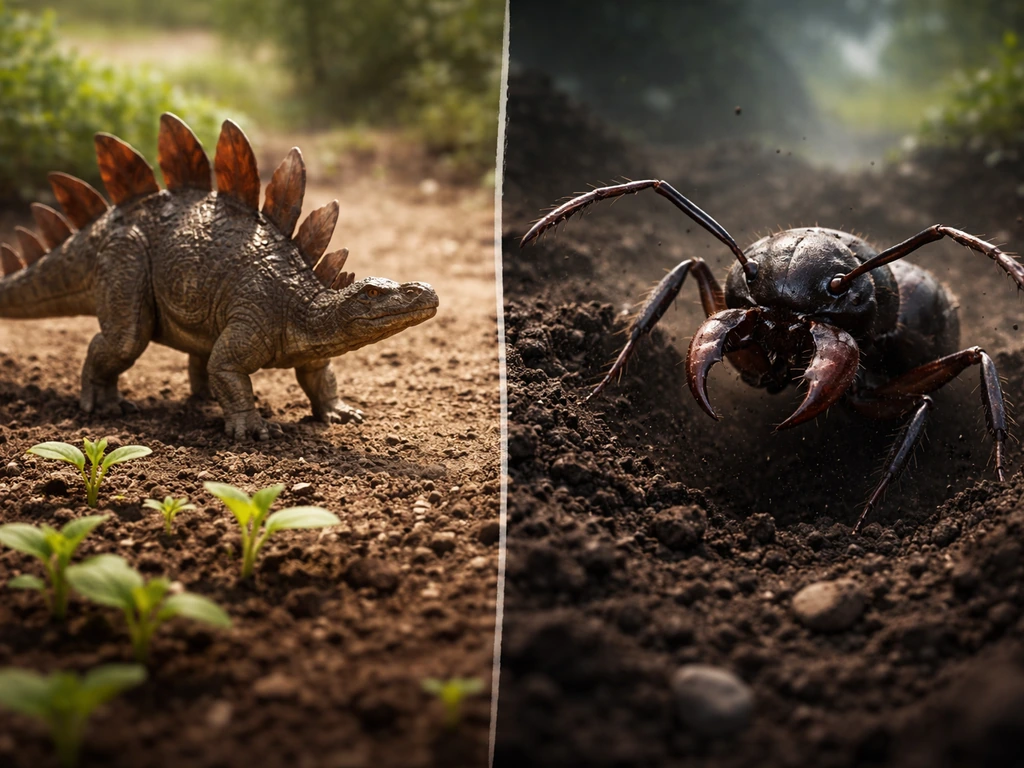
Players in the mid-to-hardcore tier regularly weigh Giant Ant against Stegosaurus and other specialty duplicators. Stegosaurus runs a ~8% base dupe chance with a +5% Prehistoric bonus, making it weaker than Giant Ant in general use but a specialist option for Prehistoric-crop farms. blank" rel="noopener noreferrer">Stegosaurus | Grow a Garden Wiki (Fandom) reports Stegosaurus has about an ~8% base duplication chance, a +5% Prehistoric-crop bonus, and a very large hunger pool (~40,000). Its hunger cost (~40,000, verify live) is significantly higher than either ant variant, which means Stegosaurus requires more feeding investment for the same or lower dupe output. Unless you're deep into a Prehistoric-plant build, Giant Ant is a more efficient choice.
The Giant Bean vs Mega and Giant Golem vs Nightmare comparisons follow a similar pattern to this one, where the question is usually whether a rarer or event-limited creature's specialty bonus justifies the higher acquisition cost. As a general principle I've found consistent across these comparisons: if a creature's specialty bonus doesn't align with your primary crop type, the rarer version rarely beats the accessible version in pure farm output. Cape Buffalo against Giant Ant on a non-Safari farm is a textbook example of this principle.
Tier placement and meta context
Community tier lists from sources like MyGAGCalculator consistently place both Giant Ant and Cape Buffalo in the upper tiers of practical farm pets due to their duplication mechanics. The exact ranking between them varies by list, largely because different lists weight acquisition difficulty differently. Lists that factor in accessibility almost always rank Giant Ant above or equal to Cape Buffalo for practical use; lists that focus purely on per-harvest output at optimal conditions (Safari farm setup) may give Cape Buffalo the nod. For players who don't have a full Safari-type crop build, I'd treat Giant Ant as an A-tier pick and Cape Buffalo as an A-tier pick with a significant asterisk for availability. For a similar in-depth showdown focused on different pets, see giant golem vs nightmare grow a garden for direct comparisons and meta context.
One meta note worth keeping in mind: tier lists shift with game updates, and duplication rates have been adjusted in the past. Any time a patch drops, it's worth re-checking the current community calculators and wiki stat pages before making major breeding investments. The framework for choosing between these two pets stays the same (accessibility, specialty match, stack efficiency), but the specific numbers that feed that framework can change.
Final recommendation by player situation
| Your Situation | Best Pick | Notes |
|---|---|---|
| Starting out, no event pets | Giant Ant | Best bang for egg investment, widely available |
| Building a high-dupe farm, mixed crops | Stack Giant Ants (3+) | Each ant rolls independently; stacking is efficient |
| Running a Safari-type crop specialist farm | Cape Buffalo (if available) | The +5% Safari bonus genuinely compounds here |
| Fruit-type crop farm with Mythical Eggs available | Red Giant Ant | Lower hunger, +5% Fruit bonus, manageable at 9% odds |
| Prehistoric-crop farm | Stegosaurus | Specialist passive outperforms ants on Prehistoric plants |
| Maximizing trade/asset value | Cape Buffalo | Event-limited scarcity drives higher market value |
| Cape Buffalo already owned, mixed farm | Use alongside Giant Ants | No reason to bench it; rolls independently from ants |
The bottom line is that Giant Ant is the right default for almost every player who isn't locked into a Safari-specific crop strategy. It's obtainable, stackable, cheap to feed with Candy Blossom, and performs at the same base rate as the event-limited Cape Buffalo in non-Safari scenarios. Cape Buffalo is worth owning and trading for, but it's not worth restructuring your farm around unless the Safari plant bonus is genuinely central to what you're growing. Stack your ants, keep them fed on Candy Blossom, and let the duplication procs add up over time.
FAQ
Quick verdict — which is better for mid-to-hardcore Grow A Garden players: Cape Buffalo or Giant Ant?
Short answer: Giant Ant is the more practical, farm‑efficient choice for most mid-to-hardcore players because of its higher base duplication utility, cheaper and repeatable egg sources, and better stacking behavior for large-scale farms. Choose Cape Buffalo only when you can reliably obtain it (event/shop limited) and you need a low-risk duplicator for fruit/safari plants at small-to-moderate scale or as a high-value trading/collection pet. Note: exact duplication percentages, hunger numbers, and egg odds should be verified against live game data before high‑stakes decisions.
How do their core abilities and practical effects compare?
Giant Ant: community sources list ~10% base duplication on harvest with an extra ~5% bonus for Candy-type plants. It is fed well by Candy Blossom and Lilac, and is commonly hatched from Bug Egg or Exotic Bug Egg (high odds). It is inexpensive to breed/rebreed and stacks well for high throughput farms. Red Giant Ant (variant) has slightly different numbers (~5% base +5% fruit boost, rarer). Cape Buffalo: community sources list ~10% base duplication focused on fruits/Safari‑type plants and is event/shop-limited. It tends to be treated as higher value due to limited obtainability but lacks the repeatable egg/cheap breeding path that ants have. Flag: verify both pets’ exact numbers against live data.
Feeding preferences — what food does the Giant Ant like and how does feeding affect performance?
Community tests show Giant Ant gains large hunger restoration from Candy Blossom and Lilac; Candy Blossom often restores near‑full hunger for the Giant Ant. Feeding increases hunger/age and enables continued activity; pets level/age based on food consumed. For continuous duplication uptime, prioritize Candy Blossom / Lilac feeding cycles. Exact hunger restoration values and cooldown effects should be checked in-game or with a live feeding guide.
Egg sources, hatch odds and breeding efficiency for Giant Ant and Cape Buffalo
Giant Ant: commonly hatched from Bug Egg and Exotic Bug Egg with high listed odds in community egg tables, making it cheap and efficient to obtain multiples for breeding or stacks. Red Giant Ant variant appears on Mythical Eggs at lower odds (~8–9%) — more costly but collectible. Cape Buffalo: community reports show it was event/shop-limited (Safari Harvest event) rather than a normal egg result, making it expensive or unavailable outside events; breeding via eggs is generally not possible unless re-released. For budgeting: use per‑egg odds tables and hatch-time calculators before mass‑breeding. Flag: hatch odds/hatch times change with live updates; check current egg tables.
Variants — differences between Giant Ant and Red Giant Ant
Red Giant Ant is a rarer variant with different duplication focus and slightly lower/altered base duplication according to community tables (~5% base +5% fruit boost) and lower hunger. Giant Ant (regular) has the higher base duplication (~10%) and higher hunger listed in community resources. Choose Red Giant Ant primarily for collection value or specific fruit‑boost niches; choose Giant Ant for raw farm throughput and breeding efficiency. Verify variant stats against live data before committing eggs.
How do they compare to common alternatives (Stegosaurus, Giant Bean/Mega, Giant Golem/Nightmare)?
- Versus Stegosaurus: Stego specializes in Prehistoric plants with a strong duplication on Prehistoric crops; its hunger and event cost are higher. For general-purpose duplication (Candy/fruit/safari), Giant Ant usually outperforms Stego in price-to-output on repeatable farms. - Versus Giant Bean/Mega: Giant Bean/Mega are high-value but niche (bean/mega crop boosts) and often more expensive; Giant Ant is more flexible and cheaper to mass-stack. - Versus Giant Golem/Nightmare: Golem variants may provide larger or specialized multipliers but are often event or costly; Giant Ant remains the best cost‑efficient dupe for many generic crop types. Use specialist pets (Stegosaurus, Golem) if you focus farms on their specialty crop type. Community tier lists vary by availability—check current meta lists for live ranking.
Next Article
Stegosaurus vs Giant Ant in Grow a Garden: Which Wins?
Stegosaurus vs giant ant in Grow a Garden: roles, breeding, costs, and which boosts farm output faster by stage.