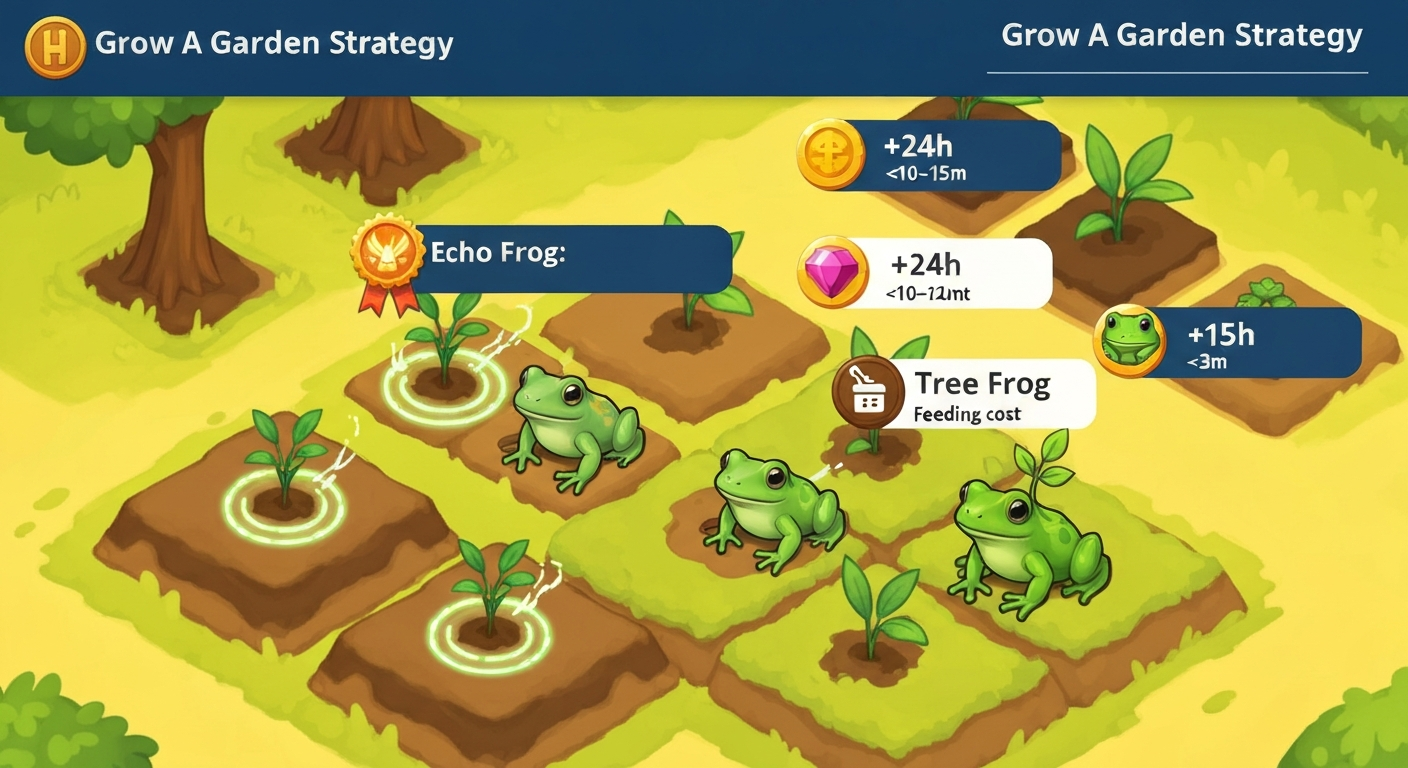
Echo Frog is the stronger farming pet between the two. Its ability advances a random nearby plant's growth by 24 hours, and while the exact cooldown varies by source (anywhere from 5 to 15 minutes depending on version), that single activation can save you a full day of wait time on a slow crop. Pocket Tactics reports Echo Frog croaks once every ten minutes, causing a random nearby plant to advance growth by 24 hours blank" rel="noopener noreferrer">Pocket Tactics reports Echo Frog croaks once every ten minutes, causing a random nearby plant to advance growth by 24 hours.. The vanilla Frog does the exact same thing but on a longer cooldown, closer to 20 minutes, making it a budget-tier version of the same mechanic. Tree Frog is a different trade-off entirely: it procs every 3 minutes but only pushes growth by 15 minutes per activation, which can actually pull ahead in throughput under the right farm layout. Which one you want depends almost entirely on what you're growing and how your garden is set up. For a concise explanation of what type of frog the game categorizes as a Frog, see our guide on what type of frog is a Grow A Garden 'Frog'.
Echo Frog vs Frog Grow A Garden: Breeding, Stats & Tactics

Head-to-Head TL;DR: Echo Frog vs Frog (and Tree Frog)
Here's the blunt verdict: Echo Frog is the best single-pet growth accelerator in the game for high-value, slow-maturing crops. If you're growing anything with a multi-hour or multi-day natural cycle, one 24-hour jump per activation is enormous. The vanilla Frog does the same thing for a lower rarity cost but fires less often, so it's a reasonable placeholder if you haven't hatched an Echo yet. Tree Frog is underrated for dense, fast-cycling gardens because it activates roughly every 3 minutes, and over a long session those 15-minute bumps stack into meaningful time savings across several plants.
Choose Echo Frog when you're running slow-growth premium crops and want maximum impact per activation. Choose Tree Frog when you have a packed garden of faster plants and want consistent, frequent procs. Use vanilla Frog as a stepping stone or a filler slot while you work toward the other two.
Decision Rules at a Glance
Run through this before committing incubator slots or trades to a frog variant. The answer usually falls into one of four situations.
- Growing slow, high-value crops (long natural growth timers)? Echo Frog. The 24-hour advancement per activation outweighs everything else here.
- Running a dense garden with lots of fast-cycling plants? Tree Frog. A proc every 3 minutes across a packed plot adds up faster than Echo Frog's infrequent big hits.
- Just starting out or filling slots on a budget? Vanilla Frog. It's still doing the same 24-hour advance mechanic, just less often. It's not useless, it's just slower.
- Trading or valuing for the market? Echo Frog holds the highest trade value of the three due to rarity and the raw power of its ability. Tree Frog is accessible (high hatch rate from Jungle Egg) so it trades lower. Vanilla Frog sits in the middle.
Exact Stat and Ability Differences
All three frogs share the same core mechanic (advancing plant growth), but the numbers and frequency differ meaningfully. One important note: Echo Frog's cooldown has been inconsistently reported across major guides, ranging from under 5 minutes to 15 minutes, and community threads on Reddit have flagged timing changes and apparent rebalances over time. The most commonly cited figure across mid-2025 guides is roughly 10 to 15 minutes. Treat any cooldown number as approximate until you test it on your own farm, since patches have historically shifted these values.
| Attribute | Frog (Vanilla) | Echo Frog | Tree Frog |
|---|---|---|---|
| Rarity | Uncommon/Rare | Mythical (event-limited) | Common/Uncommon |
| Egg Source | Night Egg | Night Egg (event) | Jungle Egg |
| Ability | Croaks, random nearby plant advances growth by 24 hours | Croaks, random nearby plant advances growth by 24 hours | Advances growth of a random plant by 15 minutes |
| Ability Cooldown | ~20 minutes (community reported) | ~10–15 minutes (sources vary; patches may affect this) | ~3 minutes |
| Affects Crops | Yes | Yes | Yes |
| Affects Eggs | No | No | No |
| Applies Mutations | No | No | No |
| Effective Radius | ~8–15 studs (source-dependent) | ~8–15 studs (source-dependent) | ~8–15 studs (source-dependent) |
| Best Use Case | Budget growth acceleration | Slow/premium crop acceleration | Dense fast-cycle gardens |
| Trade Value | Low-mid | High (event rarity) | Low (common hatch) |
The radius inconsistency matters for farm layout. Different databases put the effect range anywhere from 8 to 15 studs, and the real number could depend on how the game calculates distance. Until there's a definitive developer confirmation, I'd plan layouts conservatively around an 8-stud effective radius and treat anything extra as a bonus.
Egg Sources and Breeding Recipes
There is no breeding mechanic in Grow A Garden in the traditional sense. You cannot pair two pets to produce offspring. Every pet in this game comes from hatching eggs, buying from event shops, receiving event rewards, or trading with other players. When guides mention 'breeding,' they're almost always referring to which eggs you're hatching and in what quantity to optimize your chances of landing a specific pet.
Frog (Vanilla) and Echo Frog: Night Egg
Both the vanilla Frog and Echo Frog come from the Night Egg. The Night Egg has a hatch time of approximately 4 hours and 10 minutes and contains several pets including Hedgehog, Mole, Raccoon, Night Owl, Frog, and Echo Frog depending on the current egg pool. Echo Frog's hatch chance from the Night Egg sits at around 10% according to multiple guides, which makes it a reasonably rare pull but far from impossible if you're running Night Eggs consistently. The vanilla Frog has a higher hatch chance from the same egg, making it the more common outcome.
Tree Frog: Jungle Egg
Tree Frog hatches from the Jungle Egg (sometimes called the Jungle Event Egg), and its hatch chance is reported at roughly 40%, which is high. This is why Tree Frog trades low despite being a solid farming pet. If you want one, just run a few Jungle Eggs and you'll likely land it quickly.
| Pet | Egg | Approx. Hatch Chance | Hatch Time | Notes |
|---|---|---|---|---|
| Frog (Vanilla) | Night Egg | Higher than Echo (exact % varies by source) | ~4h 10m | Standard Night Egg pet, reliable from regular shop |
| Echo Frog | Night Egg (event availability) | ~10% | ~4h 10m | Event-limited; may not always be in rotation |
| Tree Frog | Jungle Egg | ~40% | Varies by egg type | High availability; lower trade value as a result |
How Echo and Tree Variants Are Obtained
Echo Frog is event-limited, which is the main thing driving its value and rarity. It appears in the Night Egg pool during specific events, meaning you can't just go to the shop at any time and hatch one. If you're playing outside an active event window, your options are the trading market or waiting for the next event rotation. This is worth tracking if Echo Frog is a priority for your farm, because missing an event can mean a significant wait.
To get an Echo Frog during an active event: check the current Night Egg pool to confirm Echo Frog is in it, then purchase Night Eggs from the shop and incubate them. With a roughly 10% hatch rate, expect to hatch around 10 Night Eggs on average before landing one, though variance means you could hit it on egg 2 or miss it past egg 20. Stacking multiple incubator slots simultaneously speeds this up considerably.
Tree Frog is the easy one: buy Jungle Eggs when available, hatch them, and you'll almost certainly land a Tree Frog within a handful of attempts given the 40% rate. Because it's so accessible, it's a great option for new players who want a growth-assist pet right now without waiting for an event or burning trade currency.
Practical Steps to Secure Echo Frog
- Monitor the current event rotation to confirm Night Egg has Echo Frog in its hatch pool before spending on eggs.
- Fill all available incubator slots with Night Eggs simultaneously to maximize hatch throughput during the event window.
- Budget for approximately 10 Night Eggs per Echo Frog attempt based on the reported ~10% hatch rate, but plan for up to 20 to account for bad luck.
- If the event has ended, check the player trade market. Echo Frog trades at a premium but is usually available from players who hatched extras during the event.
- Pets that increase egg hatch speed (like Chicken variants, which are documented to add roughly 10% hatch speed) can reduce your total wait time when mass-hatching Night Eggs.
Feeding, Leveling, and Habitat Preferences
Grow A Garden's pet hunger and feeding system means every pet you place needs to be fed regularly to remain active and keep triggering its ability. If you're wondering what do frogs eat in Grow A Garden, see the pet feeding guide for recommended food types and feeding rates. Echo Frog is documented as a high-hunger pet, meaning it costs more to maintain in terms of feed resources compared to lower-rarity pets. This is a real consideration when you're running multiple high-value pets on the same farm: the resource drain adds up, and an unfed Echo Frog sitting in your garden isn't activating its ability.
For feeding strategy, prioritize keeping your highest-impact pets fed first. If Echo Frog is your primary growth accelerator, it should be near the top of your feeding queue. The vanilla Frog and Tree Frog have lower maintenance costs relative to Echo, which is a secondary reason they're good budget options. You get reasonable ability activation at a lower feed cost per hour.
On habitat placement, all three frog variants work on crops (not eggs), apply no mutations, and operate within an effective radius of roughly 8 to 15 studs. Some pet abilities affect egg hatch speed: the Chicken (and variants) are documented to increase egg hatch speed by about 10% (see All Animals and Pet Passives in Grow A Garden (Pro Game Guides)). Place them as centrally as possible within your highest-priority crop zone. For Echo Frog specifically, since its ability targets a random nearby plant, you want the plants you care most about to be within range. A tightly clustered planting grid within the frog's radius means more of your important crops are eligible for the 24-hour advancement proc.
Optimal Breeding Pairings and Incubator Strategy
Since there's no pet-to-pet breeding in Grow A Garden, 'breeding strategy' here means managing your egg hatching runs efficiently. The goal is to maximize your chances of landing the pets you need while minimizing resource and time waste.
Incubator Allocation for Frog Variants
- Run Night Eggs in all available slots simultaneously during event windows when Echo Frog is in the pool. Parallel hatching cuts total time dramatically compared to sequential hatching.
- Night Eggs take approximately 4 hours 10 minutes each. If you have 4 incubator slots and fill them all at once, you're effectively getting 4 hatch attempts every 4 hours instead of one.
- For Tree Frog, Jungle Eggs have a high enough hatch rate that you don't need to batch-hatch. One or two runs should land it. Save your incubator capacity for Night Egg runs during events.
- Use hatch-speed pets (like Chicken variants) to shave time off each hatch cycle. Even a 10% speed bonus meaningfully adds up across 10 to 20 Night Eggs.
- Track your hatches. If you've gone significantly past the expected 10-egg average without an Echo Frog, that's normal variance, not a sign something is wrong. Keep hatching while the event is active.
Timing and Batch Schedules
The best practice is to start a batch of Night Eggs before a natural break in your play session, roughly 4 hours before you'll be back online. Load all incubator slots, log off, and collect your results when you return. This passive hatching approach lets you accumulate hatch attempts without active time investment. Repeat this schedule throughout the event window, spending available Night Eggs in batches rather than one at a time.
Farm-Efficiency Strategies for Frogs
The frog family's core value is growth acceleration without mutation application. If you're wondering 'is frog good in Grow A Garden', the comparison above explains when each frog variant is best. This is a key distinction: you're not getting random trait changes on your crops, just faster harvests. That makes frogs safe to place next to any crop, including ones where you want to control mutations carefully.
Layout Optimization
For maximum Echo Frog impact, cluster your slowest-growing and highest-value crops within its effective radius. Since the ability targets a random nearby plant, reducing the number of low-value plants inside the radius increases the probability that each proc lands on something important. If you have a mix of fast crops and slow premium crops, consider keeping the premium ones in a tighter cluster with Echo Frog centered on them, and placing Tree Frog near the broader fast-cycling area.
Throughput and Resource Budgeting
Running Echo Frog costs more in feed resources than Frog or Tree Frog. Before committing Echo Frog to your farm full-time, make sure your feeding supply chain can support a high-hunger mythical pet sustainably. If you're running multiple mythical pets simultaneously, food resource management becomes a real bottleneck. In that case, consider using Tree Frog or vanilla Frog in secondary zones to save Echo Frog's maintenance cost for your premium crop cluster.
Selective Breeding Runs vs. Mass Production
If your goal is trading, mass-hatching Night Eggs during an event and selling or trading duplicate Echo Frogs can be a strong economy play, since Echo Frog holds high trade value due to event scarcity. For players focused on farm optimization rather than trading, one well-placed Echo Frog in your premium crop zone is usually enough: you don't need multiples unless you're running separate garden zones that don't overlap in radius. Tree Frog is cheap enough to stack in multiple zones without major resource strain if you want consistent lower-magnitude procs across a larger farm footprint.
Automation Tips
- Passive hatch scheduling: always leave incubator slots filled before logging off so hatch attempts run while you're away.
- Pet placement review: revisit your frog placements whenever you change your crop layout, since a radius that covered your best crops in one layout may miss them in a redesign.
- Feed queue prioritization: if you use a feed rotation, keep Echo Frog at the top of the list so it never goes unfed during active farming sessions.
- Pair frogs with other non-mutation pets if you're doing a controlled crop run where you need specific growth outcomes without randomizing traits.
- Monitor patch notes after updates: Echo Frog's cooldown has historically been a target for rebalancing, and a cooldown change can significantly affect its farm value relative to Tree Frog.
FAQ
Head-to-head summary: Echo Frog vs Frog (including Tree Frog variants) — which is better for farm optimization?
Echo Frog is generally the higher-impact choice for mid-to-hardcore farms because its croak advances a random nearby plant by a large chunk of time (commonly reported as 24 hours). Frog (vanilla) has a similar effect but with a significantly longer reported cooldown, making it less consistent for active acceleration. Tree Frog is a different tradeoff: it triggers far more frequently but advances growth by a much smaller amount (commonly reported ~15 minutes every ~3 minutes). Use Echo Frog when you need large, infrequent jumps to finish long/expensive crops; use Tree Frog when you want steady, repeatable small boosts for many short/medium crops.
Exact stats and ability differences (cooldowns, advance amount, radius, hunger/cost)
- Echo Frog: community sources converge on an advance amount of ~24 hours per croak. Reported cooldown ranges vary across sources: roughly 5–15 minutes in some fan pages, 10 minutes in several guides, and up to ~15 minutes in others — PocketTactics and several guides most commonly report ~10 minutes. Radius/area-of-effect is inconsistently documented (estimates ~8–15 studs). Echo Frog is listed with a relatively high hunger/care cost in aggregated pet tables. Affects crops (not eggs) and applies no mutations. - Frog (vanilla): same effect type (advances a random nearby plant by 24 hours in many guides) but with a longer cooldown commonly reported around ~20 minutes; less reliable for aggressive farm use. - Tree Frog: smaller advance per trigger (~15 minutes) but much shorter interval (~3 minutes), making it useful for steady acceleration. Note: exact numeric cooldowns and radii differ between community sources and some players report inconsistencies/bugs.
Egg sources and hatch chances: where to get Echo Frog, Frog, and Tree Frog
- Echo Frog: obtainable from Night Egg / event eggs. Hatch chance from Night Egg is commonly reported ~10% for Echo Frog in community guides. - Frog (vanilla): also documented as a Night Egg pet (same egg pool as Echo Frog). - Tree Frog: commonly listed as coming from Jungle/Jungle Event egg pools with much higher relative chance in that egg (community sources report high hatch rates for Tree Frog in Jungle Egg; some trade sites cite ~40%). Note: pets are primarily obtained via hatching eggs, event rewards, limited shop offers, or trading—there is no developer-described in-game breeding recipe mechanic.
Are there in-game breeding recipes to create Echo Frog, Frog, or Tree Frog?
No. Developer-facing guides and multiple community wikis state eggs are the only reliable way to obtain pets. There is no canonical in-game breeding recipe where you combine two pets to produce a frog variant. Obtain via hatching the correct egg, event rewards, limited offers, or trading with other players.
Feeding, leveling, and habitat preferences — how to care for each frog type
- Feeding/Hunger: Echo Frog is reported in aggregated pet lists as having a relatively high hunger/cost; expect to feed it regularly compared with low-maintenance pets. Frog and Tree Frog have typical pet hunger rates but check in-game pet UI for exact hunger values. - Leveling: level-up increases any passive chance or speed only insofar as the game’s pet-level rules permit; prioritize leveling Echo Frog if you intend to keep it active on high-value plots. - Habitat/placement: place frogs centrally to cover maximum crop area — best practice is near expensive/long-growth crops you want accelerated. For radius-uncertain pets, place them within ~8–15 studs of target plants and cluster them when targeting the same beds.
Practical viability and tier recommendations for farming, meta play, and trading
- Farming: Echo Frog — high tier for finishing long, expensive crops (e.g., endgame seeds) because of large 24-hour jumps. Tree Frog — mid/high tier for high-throughput, short/medium crops. Frog (vanilla) — lower tier due to longer cooldown; acceptable only if you can’t access Echo/Tree variants. - Meta play: Echo Frog is prioritized in pet tier lists for optimization; used in competitive or high-efficiency farms. - Trading/market value: Echo Frog typically trades above vanilla Frog due to demand and event-limited availability; Tree Frog value depends on event availability (often moderate due to higher hatch rate). Value fluctuates with player base and event status — check live trading communities before committing to large trades.
What Egg Hatches the Frog in Grow a Garden: Egg Guide
Find the exact Grow A Garden Frog egg, spawn sources, hatch steps, variants, feeding, breeding, and best farm builds.