There is no standalone pet called the "Golden Monkey" in Grow A Garden's official pet roster. What most players mean when they search this term is either the Gold color-exclusive mutation applied to a Monkey or Silver Monkey pet's produced crops, or the broader question of how Gold variants compare to Silver and Rainbow in terms of real Sheckle value. Gold is a color mutation with a ×20 Sheckle multiplier, Silver sits at ×5, and Rainbow tops out at ×50. If you're trying to maximize your farm output, understanding exactly which variant to target and how to get there is what this guide covers end to end.
Golden Monkey Grow A Garden Meaning: Breeding & Strategy

Julian Russo
12 Jul 2026
What 'Golden Monkey' Actually Means in Grow A Garden
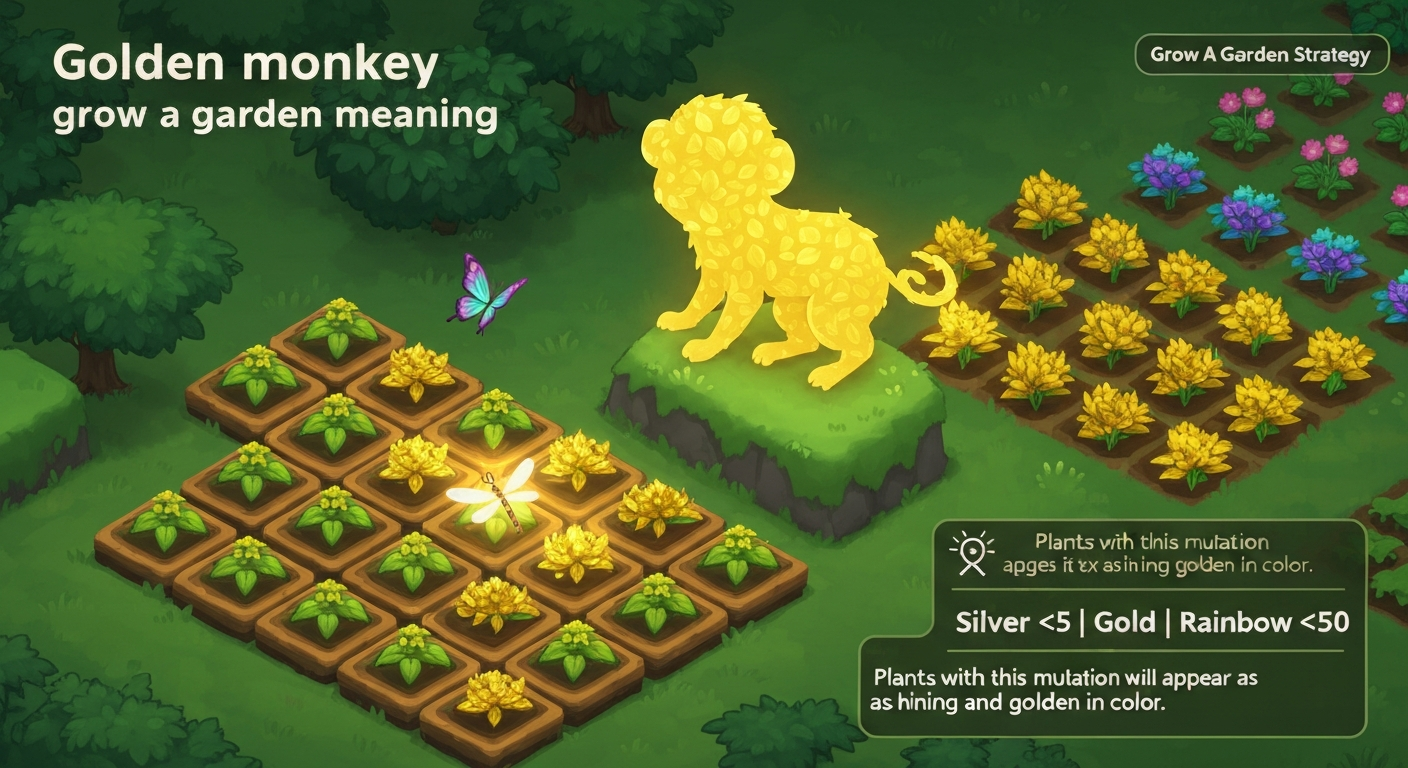
The confusion around the term is understandable. Grow A Garden has a base Monkey pet and a Silver Monkey pet, both well-documented. No official pet page or canonical pet database lists a separate "Golden Monkey" entry. The phrase circulates in the community to describe two distinct situations: a Monkey or Silver Monkey whose sold crops carry the Gold color-exclusive mutation (making those crops worth ×20 their base Sheckle value), or references to a rare in-game event involving a giant golden monkey figure tied to the Sun God event reported by some players. For practical farm optimization, the version that actually matters is the first one, getting Gold-mutated crops from your Monkey pets and understanding the multiplier you're working with.
When a crop carries the Gold mutation, the in-game tooltip describes it as: "Plants with this mutation will appear as shining and golden in color." Mechanically, the Gold mutation is classified as a color-exclusive mutation, meaning it applies a ×20 multiplier to the crop's Sheckle sell price. The game's mutation reference lists Gold as a ×20 Sheckle multiplier and Rainbow as ×50 (Mutations | Grow a Garden Game (mutations list & multipliers)). No other color mutation (Silver or Rainbow) can coexist with Gold on the same crop at the same time. It's a clean, single-slot system, only one color variant wins.
How Color Variants Work, Silver, Gold, and Rainbow Explained
Grow A Garden uses a color-exclusive mutation system, meaning Silver, Gold, and Rainbow occupy the same mutation slot on any given crop. You cannot stack them. A fruit is either Silver (×5), Gold (×20), or Rainbow (×50), never two at once. These are documented in mutation references as "Exclusive (color, only one)" and the multipliers are applied directly to the crop's base Sheckle value at the point of sale.
Here's what the multipliers translate to in practice: if a base crop sells for 100 Sheckles, the Silver version sells for 500, Gold for 2,000, and Rainbow for 5,000. At scale across a full farm, the difference between chasing Gold and Rainbow is substantial. This is why mid-to-hardcore players increasingly target Rainbow as the endgame color tier, while Gold remains a strong mid-game target that's meaningfully easier to apply (via the Dragonfly pet) than Rainbow.
| Color Mutation | Sheckle Multiplier | How Applied | Mutually Exclusive? |
|---|---|---|---|
| Silver | ×5 | Passive mutation / pet interaction | Yes — color slot |
| Gold | ×20 | Dragonfly pet ability (every ~5 min) | Yes — color slot |
| Rainbow | ×50 | Butterfly pet ability (5+ mutation fruit) | Yes — color slot |
Because these mutations overwrite each other, the order of pet ability triggers matters. A Rainbow fruit hit by a Dragonfly becomes Gold (dropping from ×50 to ×20). A Gold fruit hit by a Butterfly that qualifies (5+ total mutations) becomes Rainbow. This directional overwriting is something players get burned by regularly, and it's covered in detail in the conversion section below.
Getting Golden (Gold-Mutated) Crops, Acquisition Methods
Since there is no dedicated Golden Monkey pet to hatch from an egg, obtaining Gold-mutated crops from your Monkey pets comes down to applying the Gold color mutation to your crops via available in-game mechanics. Here are the main routes:
- Dragonfly pet: The most direct and reliable method. The Dragonfly ability triggers every ~5 minutes and turns one random crop Gold. Place it in a farm with high-value crops and let it cycle.
- Natural mutation rolls: Gold can appear as a naturally rolled color mutation on crops at harvest, though this is RNG-dependent and not farmable in isolation.
- Overwriting Rainbow with Dragonfly: If a Butterfly has already converted a crop to Rainbow, the Dragonfly can overwrite it back to Gold. This is usually counterproductive (you're going from ×50 to ×20) but worth knowing if you're explicitly targeting Gold.
- Event mechanics: Player reports reference a Sun God event that produces golden visual effects and possibly Gold-mutated drops, but this is event-specific and not consistently reproducible as a farming method.
For a mid-game player building toward Gold-mutated crops consistently, the Dragonfly pet is the core tool. Pair it with high base-value crops (crops with more base Sheckles benefit the most from the ×20 multiplier) and position it where its 5-minute ability cycle hits the crops you most want converted. There's no dedicated "Golden Monkey" egg or breeding pair that produces a separate golden variant, the Gold mutation is a crop state, not a pet type.
Breeding Rules and Probabilities for Color Mutations
Grow A Garden does not publish official breeding odds for color mutations in the same way some other creature-collection games do. What the community has established through collective testing is a framework rather than a precise probability table. Here's what's known and what's still fuzzy:
- Color mutations (Silver, Gold, Rainbow) are exclusive — rolling one prevents the others on the same crop. This is confirmed across mutation references and calculators.
- Gold mutation appears to have a lower natural roll rate than Silver, reflecting its higher multiplier. Exact percentages are not published by the developer.
- Rainbow has the lowest natural roll rate of the three, consistent with its ×50 value — the Butterfly pet exists partly to give players a deterministic path to Rainbow that bypasses raw RNG.
- Pet abilities (Dragonfly for Gold, Butterfly for Rainbow) function as reliable, non-RNG triggers on a timer rather than random mutation rolls — this is the practical workaround to bad color mutation odds.
- Community evidence from patch testing suggests color mutation rates have shifted across updates; always cross-check current rates against the official Discord or Trello for post-patch accuracy.
The honest takeaway here: if you're planning around Gold specifically, don't rely on natural mutation rolls as your primary source. Use the Dragonfly. If you find Gold appearing naturally at a rate you want to document, share it in the community, this is an area where player-contributed data still drives the reference numbers.
Conversion Mechanics, Dragonfly, Butterfly, and How They Interact
Two questions come up constantly in this corner of the game: can the Dragonfly turn a Rainbow crop into Gold, and can the Butterfly turn a Gold crop into Rainbow? The answers are yes to both, but the conditions and implications are different.
Can the Dragonfly Turn a Rainbow Crop Gold?
Yes. The Dragonfly's ability states it turns "one random crop Gold" every ~5 minutes. Because Gold and Rainbow occupy the same color-exclusive mutation slot, the Dragonfly's trigger overwrites whatever color state the crop is in, including Rainbow. This means if you have a Rainbow crop (×50) in range of a Dragonfly, there's a real chance the Dragonfly converts it to Gold (×20), cutting your Sheckle multiplier by more than half on that crop. Community players have confirmed this interaction repeatedly, describing the Dragonfly and Butterfly as effectively competing over the same mutation slot on shared crops.
Can the Butterfly Turn a Gold Crop into Rainbow?
Yes, but with a critical condition: the Butterfly's ability only triggers on fruits that have 5 or more total mutations. Its tooltip reads: "Every ~30 minutes, flies to a nearby fruit with 5+ mutations, removes all mutations from it and turns it rainbow." This means a Gold crop with fewer than 5 total mutations is invisible to the Butterfly's ability. If your Gold crop does meet the 5+ mutation threshold, the Butterfly can (and will) convert it to Rainbow, which is an upgrade from ×20 to ×50. See grow a garden can butterfly turn gold into rainbow for a focused discussion and community examples of this conversion. The catch is that "removes all mutations" part: the Butterfly strips every mutation from the fruit and replaces the entire stack with Rainbow only. You lose all non-color mutations in the process. Worth knowing before you deploy both pets in the same zone.
The practical implication: running Dragonfly and Butterfly in the same farm area creates a feedback loop where they can continuously overwrite the same high-mutation crops. If you want to maximize Rainbow coverage, keep your Dragonfly away from your highest-mutation crops. If you want Gold specifically, keep the Butterfly out of range or accept that it will upgrade your Gold crops to Rainbow (which is a net positive on value, just not what you were targeting). The directionality of the conversion is relevant enough to the broader comparison that the rainbow vs gold topic covers it in more depth.
Silver Monkey Stacking, Does It Actually Work?
Yes, Silver Monkey refund chances stack. This is one of the cleaner mechanics answers in the game. The Silver Monkey's core ability is a passive refund: when you sell a crop, there's approximately a 7.7 to 8% chance the sold crop is returned to your inventory. Multiple community sources and the in-game Mechanics page confirm that deploying more than one Silver Monkey (or mixing Silver Monkeys with base Monkeys) stacks the refund probabilities.
For comparison, the base Monkey sits at roughly 2.5% refund chance (and that chance decreases further for rarer fruits). The blank" rel="noopener noreferrer">Monkey - Grow a Garden Wiki (Monkey pet page, refund % tooltip) lists the base Monkey's refund chance as approximately 2.5%, decreasing for rarer fruits. The Silver Monkey's ~8% is a meaningful jump, and stacking two Silver Monkeys pushes effective refund coverage noticeably higher. The stacking behavior is not capped at a published hard limit in current documentation, but diminishing returns in practice mean three or more Silver Monkeys is typically overkill for most farm layouts. Two Silver Monkeys is the commonly recommended setup for players prioritizing refund efficiency. For a deeper look at how base Monkey and Silver Monkey compare on refund rates and overall utility, the monkey vs silver monkey comparison covers that side-by-side. See the Monkey vs Silver Monkey comparison in our Grow A Garden guides for a side-by-side breakdown of refund rates and utility.
Monkey vs Silver Monkey vs Gold vs Rainbow, Full Comparison
Here's how all four variants stack up when you're deciding where to invest farm slots and Sheckle value. Note that Gold and Rainbow here refer to the color mutation state of crops on your farm, not a distinct pet type, they're what you're working toward with your Monkey pets and conversion tools.
| Variant | Sheckle Multiplier | Key Ability / Source | Refund Rate | Tier / Best Use Case |
|---|---|---|---|---|
| Base Monkey (pet) | N/A (crop multiplier unchanged) | ~2.5% crop refund on sell | ~2.5% (lower for rare crops) | Budget / early farm; limited value at scale |
| Silver Monkey (pet) | N/A (crop multiplier unchanged) | ~7.7–8% crop refund on sell; stacks | ~8% per Silver Monkey | Strong mid-game; stack two for meaningful refund coverage |
| Gold mutation (crop) | ×20 Sheckles | Applied by Dragonfly every ~5 min | N/A — crop state, not pet | Solid mid-game target; reliable via Dragonfly |
| Rainbow mutation (crop) | ×50 Sheckles | Applied by Butterfly (5+ mutation crops) | N/A — crop state, not pet | Endgame priority; highest value ceiling |
For tiering guidance: Rainbow crops are the top value target if you can meet the 5+ mutation requirement for the Butterfly. Gold is the practical mid-game standard that's easier to achieve consistently via Dragonfly with no mutation-count prerequisite. Silver Monkey (the pet) offers a utility layer through refund stacking that no color mutation replicates, it's not about multiplying sell price but about increasing the effective volume of sellable crops. The two systems are complementary, not competitive. Running Silver Monkeys alongside a Dragonfly-and-Butterfly conversion setup is a strong combined strategy. See the deeper "rainbow vs gold grow a garden" comparison for full details. The broader rainbow vs gold distinction is worth reading if you're deciding which color tier to optimize your farm around.
Step-by-Step Plans to Farm Gold-Mutated Crops
Short-Term (First Week)
- Acquire a Dragonfly pet — this is your primary Gold-conversion tool. Check the current egg pool or pet shop rotation for availability.
- Plant a concentrated block of your highest base-value crops in a single zone to maximize the Dragonfly's 5-minute ability impact.
- Place the Dragonfly in the center of that crop block. Its ability targets one random nearby crop, so density improves hit rate on valuable plants.
- Harvest and sell Gold-mutated crops as they appear. Don't hold them for the Butterfly unless you've already hit 5+ mutations on those crops.
- Add a base Monkey for its 2.5% refund as a small buffer while you work toward a Silver Monkey upgrade.
Mid-Term (Weeks Two and Three)
- Upgrade to one or two Silver Monkeys to stack refund rates to the ~8–16% range. This meaningfully increases effective crop output without changing your layout.
- Start building toward the 5+ mutation threshold on your best crops — stack non-color mutations (Wet, Giant, Frozen, etc.) deliberately so Butterfly upgrades are available.
- Add a Butterfly pet to a secondary zone isolated from your Dragonfly. This lets you run Gold conversion in one area and Rainbow conversion in another without the pets overwriting each other.
- Rotate which crops you expose to the Butterfly based on mutation count — only crops at 5+ qualify, so track your high-mutation plants.
Long-Term (Endgame Optimization)
- Establish a dedicated Rainbow zone: a plot of crops with 5+ mutations each, protected from Dragonfly range, fed exclusively to the Butterfly for ×50 Sheckle conversions.
- Run two Silver Monkeys across your farm for stacked refund coverage on all harvest and sell cycles.
- Relegate the Dragonfly to a separate crop zone where Gold (×20) is acceptable — early-mutation crops that haven't reached Rainbow eligibility yet.
- Review patch notes and the official Discord after each major update. Mutation rates, pet ability timers, and conversion rules have changed before and will change again.
- Cross-reference your farm layout against community calculator outputs to verify your Silver Monkey stacking and color-mutation combination is producing the expected Sheckle totals.
Troubleshooting Common Problems with Color Variants
Your Rainbow Crops Keep Turning Gold
This is the most common complaint, and the cause is almost always a Dragonfly operating in the same zone as your Rainbow crops. The fix: physically separate your Dragonfly and Butterfly operating zones. Move your Dragonfly to a plot of lower-mutation crops where Gold conversion is fine, and let your Butterfly work the high-mutation Rainbow zone without interference. If your farm is too compact to separate zones, prioritize the Butterfly for your best crops and consider whether the Dragonfly is worth running at all given your current layout.
The Butterfly Isn't Converting Your Gold Crops
The Butterfly only acts on crops with 5 or more total mutations. If your Gold crops are sitting at 2 or 3 mutations, the Butterfly will ignore them completely. Check your crop mutation count before assuming the Butterfly is bugged. Stack non-color mutations (Wet, Giant, Frozen, Moonlit, etc.) on priority crops first, then deploy the Butterfly. Also remember the Butterfly's timer is ~30 minutes, it's not as reactive as the Dragonfly's 5-minute cycle, so patience is part of the equation.
Silver Monkey Refunds Aren't Showing Up
At ~8% per Silver Monkey, you will go many sell cycles without a refund trigger, that's expected. If you're running one Silver Monkey, roughly 1 in 12 to 13 sells returns a crop. Players sometimes mistake low-RNG stretches for a bug. To verify stacking is working, run two Silver Monkeys for an extended session and track refund events manually. If the observed rate is significantly below the combined ~16% expectation over 50+ sells, check whether a recent update changed the mechanic, the silver monkey stacking topic has current community reports on this.
Gold Mutation Isn't Appearing Naturally
Natural Gold mutation rolls are low-probability and not a reliable farming mechanism. If you're waiting for Gold to appear without a Dragonfly, you're working against the math. Get a Dragonfly first, then supplement with natural rolls as a bonus. If your Dragonfly isn't triggering Gold either, confirm the pet is placed close enough to the target crop zone, ability range is not unlimited and varies by farm layout.
Mechanics Seem Different From What You've Read
Grow A Garden receives active updates, and pet ability timers, mutation rates, and conversion behaviors have been adjusted across patches. Community guides (including this one) reflect the best available data at time of writing (July 2026), but edge cases and recent changes may not be fully captured. The official Discord and Trello board are the fastest sources for patch-specific changes. When a strategy stops performing as expected, check those channels before assuming something is broken on your end.
FAQ
What does “Golden Monkey” mean in Grow A Garden?
There is no official pet named “Golden Monkey.” In community usage it can mean one of two things: (A) a Monkey pet with a golden/cosmetic skin (cosmetic only), or (B) shorthand for a fruit bearing the Gold (golden) color mutation while being tended by a Monkey. The game’s canonical color mutation is Gold (×20 Sheckles) — a color-exclusive mutation that makes a crop appear golden and applies the ×20 value multiplier. When players say “golden monkey” in a breeding/optimization context they usually mean targeting Gold fruits while using Monkey-family pet benefits (e.g., refund mechanics).
What exactly is the Gold mutation (in‑game effects and mechanics)?
Gold is a color‑exclusive mutation that changes a fruit’s color and applies a ×20 multiplier to its Sheckle value. Color‑exclusive means only one of Silver/Gold/Rainbow can be present at a time. Gold can appear as a natural mutation during breeding or be applied/overwritten by certain pet abilities (see Dragonfly/Butterfly interactions). It is not a separate creature — it’s a mutation on crops, not on pets.
How do Gold, Rainbow and Silver compare (multipliers and tiering)?
Standard community multipliers used for planning: Silver = ×5, Gold = ×20, Rainbow = ×50. Tiering (value-focused): Rainbow > Gold > Silver. For mid‑to‑hardcore farms you typically prioritize Rainbow fruits (endgame highest value), then Gold for a high but more attainable multiplier, and Silver only if you need cheap but stackable boosts or specific refund mechanics.
How can players reliably obtain Gold fruits? (breeding pairs, eggs, pets, conditions, recommended farms)
Ways Gold appears: 1) Natural breeding mutations — breeding two compatible parent fruits can produce Gold as a rare exclusive mutation (no public fixed odds; treat as low probability). 2) Dragonfly pet ability — ~every 5 minutes the Dragonfly will turn one random crop Gold (pet tooltip). 3) Overwrite from other pet effects — Dragonfly can overwrite an existing color on a fruit. Recommended farms: focus on high base‑value fruits for best Sheckle payoff (breeding/lineage optimized), run Dragonfly on rotations in players’ main value beds, and keep several high‑mutation test plots for Butterfly interactions (see Rainbow conversion). Use multiple beds: one dedicated to producing 5+ mutation fruits (for Butterfly→Rainbow) and another dedicated to Dragonfly Gold conversions for high‑value cultivars.
Exact acquisition methods: which breeding pairs or egg sources guarantee or raise chance of Gold?
There are no documented guaranteed breeding pairs that always produce Gold; Gold is a rare exclusive mutation that can occur during normal breeding when mutation slots roll color mutations. Egg sources do not ‘contain’ Gold — egg/seed outputs follow the same mutation system. To raise practical Gold yield: breed toward high mutation counts on high‑value lines (increase overall mutation density), run Dragonfly to periodically inject Gold into plots, and use focused breeding batches (many simultaneous crosses) to increase raw mutation rolls. Monitor patch notes/Discord for any numeric odds changes — official dev channels may publish update changes.
What are the rules for color conversion and overwrite? Can Dragonfly turn Rainbow to Gold? Can Butterfly turn Gold into Rainbow?
Color mutations are exclusive (only one can be active). Pet abilities can overwrite the fruit’s current color state: - Butterfly: converts a fruit with 5+ mutations into Rainbow (it replaces existing color). - Dragonfly: periodically turns a random crop Gold (it replaces existing color). Community testing and reports show these pets can overwrite one another; for example Butterfly→Rainbow can later be turned Gold by Dragonfly and vice versa. Therefore directionality is not permanent — pets’ abilities will overwrite the color when they trigger. Note: timing and randomness matter; use pets intentionally (e.g., put Dragonfly on a bed where you want Gold; use Butterfly on a bed with 5+ mutation fruits you want Rainbow).
Next Article
Grow a Garden: Can a Butterfly Turn Gold Into Rainbow?
Learn the exact Grow a Garden mechanic for turning gold tier into rainbow via butterfly breeding or loot, with tests and