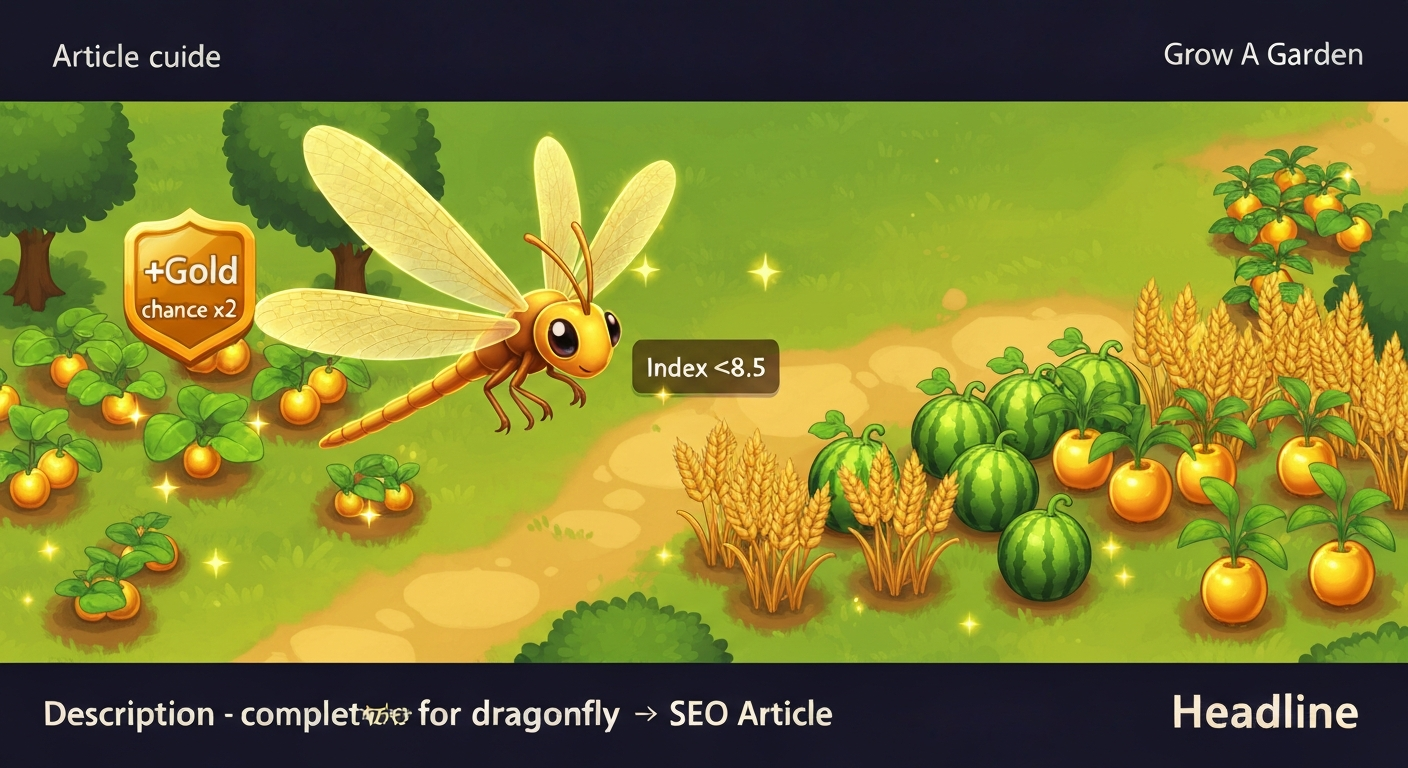
A good offer for a Normal Dragonfly in Grow A Garden 2 sits around a value index of 8.5 (based on realized completed trades tracked by GAG2.GG). That means you're looking at roughly 2–3 Butterflies, a handful of mid-tier crops plus some Sheckles, or one well-formed bridge pet to make the math work. In the original Grow A Garden, the Dragonfly is a Paradise Egg pet with tracker-reported index ranges of 50T–80T, which puts it in an entirely different league, so before you build any offer, you need to confirm which version you're playing and which Dragonfly variant you're targeting.
Good Offers for Dragonfly in Grow A Garden: Complete Trade Guide

Julian Russo
6 Aug 2026
Quick verdict: Is Dragonfly worth pursuing for active players?
Yes, but with important caveats. See Is Dragonfly good in Grow A Garden? for a straightforward summary and buying guidance. In GAG2, the Golden Dragonfly earns its slot because its passive ability doubles the base chance for your plants and fruit to become Gold, a meaningful yield multiplier if you're running a Gold-focused farm. The catch: the effect does not stack. Running two Golden Dragonflies gives you exactly the same bonus as running one, so there is zero reason to hold duplicates unless you're trading them or planning to upgrade to a Big or Rainbow Big form. For the original GAG, the Dragonfly's mutation-adjacent utility and its rarity out of the Paradise Egg make it a high-prestige trade piece even if your farm doesn't specifically need it. Whether it belongs in your active pen or your trade inventory depends entirely on your farm goal, and that decision is worth thinking through before you spend real trade capital acquiring one.
How this guide helps you decide
This guide is built around three player goals: maximizing farm value (does Dragonfly actually move the needle on your output), breeding and acquisition efficiency (what's the cheapest reliable path to getting one), and meta viability (is it worth holding long-term or flip it when the price is right). Each section gives you concrete numbers and examples rather than vague ranges. Whether you're a casual player doing your first serious trade or a mid-to-hardcore optimizer looking for exact comp structures, there's a tier here for you. The valuation data comes from blank" rel="noopener noreferrer">GAG2.GG's completed-trade index, community ratio bands from active trading guides, and restock/hatch math you can verify yourself.
What makes an offer 'good', the core valuation criteria
Five factors determine whether an offer is fair, good, or you're getting taken advantage of. Understanding all five before you enter the trade UI will save you significant resources.
- Rarity and obtainability: In GAG2, Normal Golden Dragonfly hatches from the Common Egg at 0.3%, with Big at 0.006% and Mega at an eye-watering 0.0003%. A Dragonfly that costs 33 expected Common Eggs to hatch (Normal) is fundamentally different from one costing 16,667 expected eggs (Mega). Always factor in replacement cost.
- Form and multiplier: Normal Golden Dragonfly trades around index 8.5. Big and Rainbow Big variants trade near 1,600+ — that's roughly a 188x premium. A single form tier changes the entire trade math, so confirm the exact form before agreeing to anything.
- Current demand and meta relevance: Gold-farming setups are actively popular, which keeps Dragonfly demand reasonably steady. Demand spikes during events when Gold crops are featured, which is your best window if you're selling.
- Trade bundle completeness: The in-game trading system uses a multi-slot bundle flow. Community WFL (Win-Fair-Loss) checkers confirm that value comparison must account for full bundles — pets plus Sheckles plus crops together — not single-item quotes in isolation.
- Version specificity: Values tracked on GrowAGardenInfo apply to original GAG; values on GAG2.GG apply to Grow A Garden 2. Mixing up version data is one of the most common mistakes traders make.
Valuation tiers and fair exchange ranges by Dragonfly form
The table below uses GAG2.GG's realized-trade index as the baseline and maps each Dragonfly form to its approximate trade-equivalent in common bridge pets. These are not buy-it-now prices, they're medians drawn from completed trades, so expect a roughly 10–15% negotiation window on either side in active markets.
| Form | GAG2 Value Index | Approximate Trade Equivalent | Hatch Chance (Common Egg) |
|---|---|---|---|
| Normal Golden Dragonfly | ~8.5 | 2–3 Butterflies (index ~3.0–4.2 each) | 0.3% |
| Big Golden Dragonfly | ~1,600 | ~530–540 Butterflies or ~266 Disco Bees | 0.006% |
| Rainbow Big Golden Dragonfly | ~1,600+ | Similar to Big; slight premium for Rainbow coloring | 0.0003% (Mega tier) |
| Original GAG Dragonfly (Paradise Egg) | 50T–80T tracker range | Version-specific; check GrowAGardenInfo for current realized comps | ~0.08% (Paradise Egg) |
One important note on the original GAG tracker ranges (50T–80T): those figures come from indexed value pages that explicitly warn readers to verify current obtainability and event status before treating them as live market prices. If Dragonfly has recently appeared in an event shop or had its egg odds adjusted, the realized trade value can shift quickly. See Is Dragonfly limited in Grow A Garden? for current notes on event appearances and obtainability. Always cross-reference with the value history tab, not just the headline number.
Actionable price bands by player tier
Here's how the math plays out at three different player experience levels. These bands are designed to give you a starting point for building your offer, not a ceiling.
| Player Tier | Budget Range (Value Index Units) | Recommended Offer Construction | Key Risk to Watch |
|---|---|---|---|
| Beginner | 6.0–8.5 | 2 Butterflies (≈6.0–8.4 combined) or 1 Butterfly + crop bundle padding | Padding with low-liquidity crops may not be accepted; stick to recognized pets |
| Mid-level (Active) | 8.5–10.0 | 3 Butterflies or 1 Disco Bee equivalent split across 2–3 pets + small Sheckle top-up | Overpaying slightly is acceptable for a first acquisition; recoup on the next flip |
| Advanced / Top Trader | 8.5 or below via ladder | Ladder through 3–4 Dragonfly-tier pets accumulated from lower trades; target a straight swap at index parity | Timing matters — don't ladder during a supply wave that compresses floors |
Concrete trade examples by player level
Casual player example
You have two Butterflies sitting in your pet pen and want a Normal Golden Dragonfly. At index ~3.0–4.2 per Butterfly, two Butterflies land you at roughly 6.0–8.4 combined value, which is close to the 8.5 median for Dragonfly but a hair under. The cleanest move: offer both Butterflies and add a small crop bundle (50–100k Sheckles worth of high-demand crops like Gold Watermelons if you have them) to push past the median. For additional guidance on high-demand crops and their best use cases, see our Dragon City best food to grow guide for crop prioritization tips. Most active traders will accept this as a fair deal.
Active mid-level player example
You have one Disco Bee (index ~6 per the community ratio bands, equivalent to roughly 2 Butterflies) and some loose mid-tier pets. Offer the Disco Bee plus one Butterfly, that's roughly 9.0–10.2 combined, which is a slight overpay on the median but reasonable for a clean one-for-one swap with minimal negotiation friction. Alternatively, offer three Butterflies at index 9.0–12.6 combined, this comes in above median, which gives you leverage to negotiate back to a fair deal or sweeten your side with a cosmetic/crop add-on rather than more pets.
Advanced top-tier player example
You're laddering up from lower-value pets. The community-documented ladder path runs roughly: accumulate Dragonfly-tier pieces (index ~8–10) → combine into Butterflies (~3–4 Dragonflies per Butterfly) → combine two Butterflies toward a Disco Bee (~6 index) → two Disco Bees toward a Raccoon (~9 index) → use Raccoon-equivalent value to target shop-limited or high-demand pets. If your goal is specifically a Normal Golden Dragonfly, you're actually coming down the ladder, which means you should be able to get it at or slightly below the 8.5 median by finding someone who needs your bridge pieces more urgently than you need the Dragonfly.
What to actually put in your trade offer, prioritized inventory
Not all trade items are equal in terms of liquidity. Here's a prioritized breakdown of what to offer, organized from fastest to move to slowest.
- Bridge pets (Butterfly, Disco Bee, Raccoon): These are the de facto currency pets of the active trading scene. They're recognized, liquid, and easy to value. If you have them, lead with them in your offer.
- Sheckles (in-game currency): Useful as padding to close a gap between pet valuations. The Normal Golden Dragonfly is also available directly from the in-game map for 9,000,000 Sheckles (0.6% spawn rate for the purchasable version in GAG2), so Sheckles have a real floor value in Dragonfly negotiations — a seller knows exactly what the alternative acquisition cost is.
- High-demand crops and produce (Gold-tier items): Gold crops are particularly relevant here because the Dragonfly's own ability boosts Gold crop production. A seller who runs a Gold-focused farm will value Gold crops more than a generic seller would.
- Common Eggs (as value padding): Common Eggs hatch the Normal Golden Dragonfly at 0.3%, so a batch of 10 Common Eggs represents roughly a 3% expected chance — not high, but it's a recognizable, farmable asset that fills bundle slots cleanly.
- Duplicate pets at or near Dragonfly's value tier: If you have duplicates of pets in the 6–10 index range, these are clean swap candidates. Avoid offering pets that are illiquid or farm-specific (like niche mutators with limited trade demand).
High-value swap combos and bundles that tip a trade in your favor
Bundle construction is where experienced traders gain an edge. The trading UI enforces a multi-slot bundle flow, which means a seller evaluating your offer sees the whole package, not just the lead pet. Here are four tested bundle structures that tend to close deals efficiently.
| Bundle Name | What You Offer | Approximate Combined Index | Why It Works |
|---|---|---|---|
| The Clean Swap | 2 Butterflies + 500k Sheckles in crops | ~7.5–9.4 total | Stays close to median; low friction for seller who wants liquid pieces |
| The Disco Split | 1 Disco Bee + Gold crop bundle | ~6.5–8.0+ depending on crop demand | Seller benefits from the Gold crop synergy with Dragonfly's own ability |
| The Egg Stack Pad | 1 Butterfly + 20 Common Eggs + mid crops | ~4.5–6.5 (borderline low) | Works only if seller is actively farming eggs; not recommended vs. a value-savvy trader |
| The Ladder Flip (Advanced) | 3–4 small pets near index 2–3 each | ~8.0–12.0 combined if chosen well | Seller gets diversified pieces; you move multiple low-value inventory slots in one trade |
One tactic worth emphasizing from the community trading guides: avoid laddering with 'currency pets' during supply waves. When a major restock event floods the market with Common Eggs or a popular pet, the floor value of bridge pets compresses temporarily, trades that looked fair at index 8.5 can feel like a loss if you locked in during a supply spike. Pet egg restocks in GAG2 happen roughly every 30 minutes, and seed restocks run every 5 minutes, so stock-watching before you commit to a big trade is practical and easy to do.
Alternative acquisition paths: breeding, eggs, and the shop
Trading isn't always your best route. Here's how the acquisition options stack up for GAG2's Golden Dragonfly specifically.
- Common Egg hatching (GAG2): 0.3% base chance for Normal. Expected cost per hatch is roughly 333 Common Eggs for a 50% cumulative probability of getting one. If Common Eggs are cheap to farm or purchase, this can undercut the trade value of 8.5 index units — run the math on your current egg cost before trading.
- Map spawn purchase (GAG2): 9,000,000 Sheckles at a 0.6% spawn rate in the shop. This is a hard floor on trade value — no rational seller should accept an offer worth less than 9M Sheckles equivalent unless they need the specific pets you're offering for liquidity reasons.
- Big and Mega forms: Only via egg hatching (0.006% for Big, 0.0003% for Mega from Common Egg). These are not realistically targetable through the shop or event paths at current odds — trading is the primary route for most players.
- Original GAG Dragonfly: Hatches from the Paradise Egg at approximately 0.08%. Paradise Eggs are significantly harder to obtain than Common Eggs, which explains the 50T–80T index range on tracker pages. Event availability can change this picture rapidly.
Mechanic clarifications that affect your valuation
A few mechanics directly impact how much Dragonfly is actually worth to a specific buyer, and knowing these helps you negotiate from a stronger position or decide whether acquisition even makes sense for your farm. If you need to confirm whether the Dragonfly's passive applies while you're logged out, see does Dragonfly work offline in Grow A Garden for a short, specific explanation. For details on whether Dragonflies can die and how pet-death mechanics affect valuation, see can dragonfly die in grow a garden.
- The Gold-doubling ability does not stack: Running two Normal Golden Dragonflies gives the same bonus as running one. This means a seller holding duplicates has strong motivation to trade them, which is useful leverage if you're patient.
- Dragonfly is documented as a mutator-adjacent pet family: Community wikis flag its growth-type mutation or mutation-adjacent bonus role, which is relevant if you're specifically building a mutation-focused farm and need to weigh it against other mutator pets.
- Questions about whether Dragonfly can die, works offline, or interacts with other pets (eating or being eaten) all affect long-term value. If the pet is vulnerable to death mechanics, its effective value for passive farm utility drops — especially relevant for unattended farm setups.
- Version confusion is the single biggest valuation error in this community: If a seller quotes you a value from GrowAGardenInfo (original GAG tracker), that number does not apply to GAG2's Golden Dragonfly. Always confirm the version and use the matching tracker.
Negotiation tactics and market timing
A few practical habits from experienced traders that consistently improve deal quality:
- Use a WFL checker before every trade: Community tools like GrowAGardenInfo's WFL Checker and GAG Calculator's value tools let you input your full bundle and the target bundle side-by-side. If you're in Win territory (your offer is worth less than what you're receiving), great — but verify it's not so lopsided that the other party backs out.
- Time your acquisition around demand cycles: Gold-farming demand peaks when Gold crops are featured in events. Buy Dragonfly slightly before or during these cycles; sell it slightly after the peak when supply catches up.
- Screenshot everything: The Reddit trading community and active Discord servers consistently flag scams and warn that no external middleman system is fully safe. The game itself warns that buying or selling game goods outside the game puts your account at risk. Stick to in-game trades, document your bundle before confirming, and never send items before receiving.
- Ladder up with patience rather than panic-trading: If you don't have enough value for a clean Dragonfly swap today, accumulate two more Butterfly-tier pets rather than padding your offer with illiquid crops. A clean bundle closes faster and at fairer value than a messy one.
- Check value history, not just the headline index: GAG2.GG and similar trackers publish full time-series price histories for pets. A pet whose value has been dropping for three weeks is a worse trade target than one with a flat or rising history, even if the headline index looks attractive.
Keep it or flip it, a quick decision framework
Once you have a Dragonfly, the keep-vs-trade question comes down to a straightforward check. Keep it if: you're running a Gold-crop farm and don't already have one active (the ability is meaningful), you're targeting a Big or Rainbow Big form and it's a stepping stone, or your farm setup genuinely benefits from a mutator-adjacent passive. Trade it if: you already have one in your active pen (duplicates give no additional bonus), your farm goal doesn't involve Gold crops, or you can ladder it into something with higher farm utility at your current play stage. For most mid-level players building toward higher-tier pets, a Normal Golden Dragonfly at index 8.5 is a solid, liquid trade piece, it's not a dead end, it's a rung. For related concerns, such as whether a Dragonfly can eat other pets in Grow A Garden, see the discussion on can dragonfly eat other pets in grow a garden.
FAQ
What exact data types must I collect to define a defensible "fair valuation range" for a Dragonfly (per game version)?
Collect time-stamped completed-trade records (quantity, items, forms, WFL/weight), current listing floors, and shop/egg purchase prices. Record hatch/egg odds, in-shop buy prices (Sheckles), and spawn/purchase rates. Capture form multipliers (Normal/Big/Rainbow/etc.) and completed-trade premiums by form. Keep version tags (GAG vs GAG2) and a rolling time window (30/90/365 days) so medians and percentiles reflect current liquidity. Source evidence: GAG2.GG completed trade history pages, GrowAGardenInfo value-series, and calculator sites (gag-calculator.net).
Which authoritative sources should I cite when giving numbers (percentiles, medians, shop prices, hatch odds)?
Primary sources: GAG2.GG (completed-trade values, hatch odds, form multipliers) and GrowAGardenInfo (original GAG trackers). Secondary corroboration: gag-calculator.net and GrowAGardenPro for mechanics. For restock timing and stock-track strategies cite PCGamesN stock-tracker guide. For trade-safety/legal cautions cite official Grow a Garden FAQ page. Use Reddit/community threads only for anecdotal scam patterns and negotiation color, and always label them as community reports, not official data.
How do I convert tracker numbers into a "good-offer range" (concrete method)?
Compute median trade value and 25th/75th percentiles from completed-trade history for the target form. Create three bands: aggressive buy (<=25th percentile), fair market (25th–75th), and seller ask (>75th). Convert value into common bridge units (Dragonfly=1) or into common pets/currencies using community ratio bands (Butterfly ≈3.0–4.2 Dragonflies, Disco Bee ≈6). Show conversion examples using recent median and percentile values and always tag the snapshot date and version.
What concrete evidence is required to produce example trade offers by player level (new/mid/advanced)?
You need (1) current median values for target and commonly-traded bridge pets; (2) typical bundle compositions (pets + sheckles + crops) from completed trades; (3) player slot limitations and trade UI constraints (bundle slot count). Build example offers using typical in-game trade bundle sizes and show exact item lists + sheckles equivalent to the median or percentile target. Source: completed-trade history (GAG2.GG), trade-calculator/WFL tools (GrowAGardenInfo trade calculator), and community guides for common ladders (AllThings.How).
Which concrete breeding and acquisition costs must be computed to say whether to trade or keep a Dragonfly?
Compute expected sheckles cost-per-obtained (shop buy price) and expected cost-per-hatch: use egg price × (1 / hatch-chance) for expected number of eggs and their total sheckles. Include time costs (eggs/sec restock cadence) and breeding chance reductions for Big/Mega forms (use form hatch odds). Add opportunity cost: value of using breeding slots/resources for other high-ROI pets. Sources: GAG2.GG hatch odds/shop prices and PCGamesN restock cadence; use WFL calculators for slot-bundle cost comparisons.
Give concrete negotiation / market-timing tactics backed by evidence.
1) Watch restock windows: monitor egg and seed restocks (egg restock ≈ every 30min; seed ≈ every 5min) to snipe shop purchases — cite PCGamesN stock-tracker. 2) Ladder offers: present bridge pets in standard ratios (use Dragonfly unit bands: Butterfly 3–4.2, Disco Bee ≈6) rather than raw sheckles to be slot-efficient — cite AllThings.How. 3) Use time-series medians to avoid paying spikes: prefer offers near 25th–50th percentile outside event windows. 4) For low-liquidity forms (Big/Rainbow), offer higher sheckles or rare bridging pets; for high-liquidity Normal forms, use pet bundles. 5) Always screenshot WFL proofs and propose small test trades first; community scam warnings: cite Reddit threads and the official FAQ regarding outside trades.
Next Article
Dragon City Best Food to Grow Dragons Fast
Best Dragon City food for fast growth with element and rarity picks, feeding schedule, and efficient sources to level up